
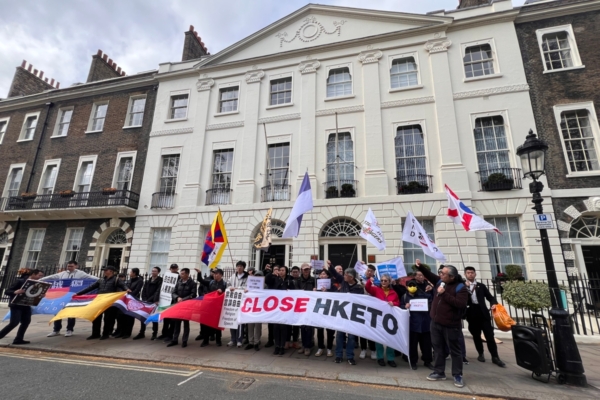
Several Hong Kong citizens working at the Hong Kong Economic and Trade Office in London have been implicated in a spy case involving the surveillance of local Hong Kong activists. They are facing charges brought forth by the British authorities under national security laws, sparking concerns about the Hong Kong government and the Chinese Communist Party’s cross-border repression. Last Saturday (4th), various civic groups staged a demonstration outside the Economic and Trade Office, calling for the UK government to shut down the office and demanding the release of Jimmy Lai and freedom for Hong Kong.
Representatives from multiple civic groups, along with about 60 participants from Hong Kong, mainland China, and other regions, gathered outside the office last Saturday afternoon.
During his speech, Mung Chiu-tat, the General Secretary of Hong Kong Labour Rights Watchdog, described the Economic and Trade Office as a tool used for intimidation, surveillance, and silencing. In a previous court case related to espionage, it was revealed that one of the defendants was trying to track down Mung Chiu-tat’s address. Mung stated that even when Hongkongers leave Hong Kong for the UK, they cannot escape fear as they are constantly being tracked, monitored, and harassed.
He believes that unless the masterminds behind these actions are held accountable, justice cannot prevail, and such abuses of power will continue to occur. He emphasized the need for the UK government to take decisive action to shut down the Economic and Trade Office, stating that it should not allow spy and cross-border repression organizations to exist in a country that values freedom and the rule of law.
Independent scholar in Hong Kong culture and politics, Wong Wai-kwok, pointed out that the Economic and Trade Office has failed to fulfill its intended purpose of promoting economic and cultural exchanges. Instead, it has become a significant platform for cross-border repression. He criticized the ruling Labour Party for not recognizing the severity of cross-border repression and for seemingly turning a blind eye to organizations that abuse the guise of economic and cultural exchange. Wong has friends who have been subject to cross-border repression and harassment by authorities, yet even frontline officials sometimes display a lack of understanding of the seriousness of such repression. He urged the UK government under the Labour Party to thoroughly review the status of the Economic and Trade Office and whether it should continue to operate on UK soil.
A participant from Myanmar spoke about his father, who was originally an elected official in Myanmar but has now become one of over 30,000 political prisoners in the country. He criticized the Chinese Communist Party for supporting the authoritarian government in Myanmar and playing a core role in prioritizing pipelines, ports, rare earth routes, and broader leverage over human rights and freedom. He emphasized how dissent within a country leads to the extension of repression abroad and serves as a tool for cross-border repression.
Director of the UK Hong Kong Residents Association, Chow Ting, stated that closing the Hong Kong Economic and Trade Office is not a hostile act towards ordinary citizens or a refusal to engage in dialogue. Rather, it is a clear and appropriate response to intolerable behavior exhibited by the Hong Kong and Chinese authorities within the UK, asserting that entering the UK does not equate to permission to monitor Hong Kong residents, dissidents, Uighurs, and Chinese activists.
Chow further pointed out, “We know the British government wants trade, and perhaps this will come at a cost. But a country that cannot bear any economic cost in defense of its sovereignty has already put a price on its freedom… The UK must decide what is more important: convenience or principles? Silence or sovereignty? Profit or dignity? We are currently at such a moment.”
Former Wan Chai District Councilor and member of the Hong Kong Civil Assembly, Cheung Ka-lai, highlighted that Hong Kong is now completely under the control of the Chinese Communist Party, no longer enjoying autonomy. She stressed the need to review the office’s diplomatic status and the necessity to close it. She mentioned the recent Hong Kong government’s application to freeze assets under Jimmy Lai’s company, stating, “This is no longer a market economy; this is just another proof that Hong Kong no longer enjoys autonomy.” She urged Hongkongers to take action on closing the Economic and Trade Office through discussions with parliament members, campaigning through petitions, and aiming to gather 100,000 signatures on the issue for parliamentary debate. She also expressed hope to connect with Hongkongers in the US, Japan, and other countries to push for the closure of Hong Kong’s overseas Economic and Trade Offices.
Currently, the Hong Kong government has 15 Economic and Trade Offices overseas, located in various cities such as Bangkok, Jakarta, Kuala Lumpur, Singapore in Southeast Asia; Tokyo in Japan; Sydney in Australia; Berlin, Brussels, Geneva, London in Europe; Dubai in the Middle East; New York, San Francisco, Washington in the US; and Toronto in Canada.