
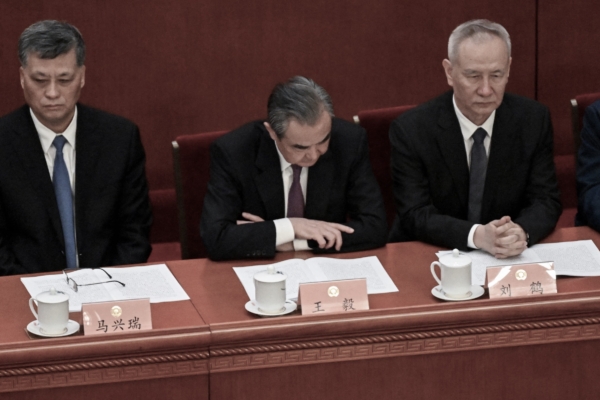
On April 3, the Chinese state-run media Xinhua News Agency released a report from the Central Commission for Discipline Inspection (CCDI) of the Communist Party of China and the National Supervisory Commission announcing that Ma Xingrui, a member of the Political Bureau of the CPC Central Committee, is under investigation. This news quickly sparked discussions in public opinion circles. Ma Xingrui, not only a leading figure in the “aerospace faction,” but also once seen as a potential candidate to enter the highest power core, his abrupt political end has drawn high attention to the reshuffling of the power structure at the top levels of the Chinese Communist Party.
Multiple insiders from within the Communist Party revealed to the media that the investigation into Ma Xingrui had been planned for a long time. An informed source familiar with high-level operations, named Han Gangli, told reporters that the essence of Ma’s case is not merely about corruption, but rather it has touched upon the most sensitive political nerves in the power struggle within the Communist Party.
“Holding a lack of loyalty is the most taboo thing within the system, not corruption,” analyzed Han Gangli. He stated that Ma Xingrui, leveraging his deep background in the military industry and the early trust of high-level officials, exhibited “arrogant” behavior during his time in leading local positions, not only influencing personnel arrangements within the Party, but also being alleged to have expressed differing opinions on projects such as the Xiong’an New Area. In the current political context, such actions have been categorized as severe “dissent against the central leadership.”
Han Gangli further disclosed that the CCDI had long had evidence of Ma Xingrui’s close friends and relatives using his power to seek substantial political and economic gains. He further pointed out, “At the level of Political Bureau members, conventional economic issues often carry some ‘buffer space,’ unless they involve astronomical figures. The real reason Ma Xingrui fell from grace is that he openly violated the political rules set by the top leader, becoming a ‘uncontrollable factor’ politically.”
An insider close to the Communist Party system, named Yao Qinxue, observed that after the official announcement of Ma’s case, the internal interaction within the Communist Party quickly cooled down. He said, “The current officialdom is like walking on thin ice. Not only have banquets disappeared, even the communication between retired officials has been cut off. Everyone is watching the direction of this ‘political storm.'”
This tension is also evident on social media platforms. Yao Qinxue stated that officials’ WeChat groups have fallen into ‘silence’, with almost no one speaking except for forwarding official documents from Xinhua News Agency or the CCDI. Even occasional exchanges are limited to cryptic combinations of sensitive terms like “Guangdong, Xinjiang, aerospace faction,” never crossing the line.
He said, “In the current political environment, any unnecessary interpretations could be seen as ‘incorrect alignment,’ silence has become the last line of defense for officials.”
66-year-old Ma Xingrui, previously a senior executive of the China Aerospace Science and Technology Group, has had a career spanning important regions such as Guangdong and Xinjiang. Against the backdrop of the CPC emphasizing ‘strengthening science and technology,’ he was widely seen as a potential candidate for promotion at the 21st Congress.
Yao Qinxue likened Ma Xingrui’s political downfall to the idiom “an old cat burnt its whiskers,” attributing it to his committing the grave sin of ‘arrogance.’
He pointed out that in the announcement by the CCDI on April 3, the title given to Ma Xingrui had directly omitted the term “comrade,” which holds significant signaling meaning in the political code of the CCP: “This marks that his party membership has been completely denied by the authorities, and his political life has been declared over.” It is reported that with the conclusion of the investigation, Ma’s case will be swiftly transferred to the procuratorial organs for prosecution review.
The scholar He Bin analyzed to reporters, stating that the recent repeated warning by the official CCP about ‘preventing political swindlers’ has exposed the cracks between loyalty and power struggle within the official system.
He said, “If Ma Xingrui is slapped with the label of ‘political swindler,’ it actually reflects the alienation caused by the system’s incentive orientation. Due to the extreme lack of transparency in power operations, ‘feigned loyalty’ has evolved into a survival technique in seeking political dividends or self-preservation in the officialdom.”
He Bin believed that the Communist Party officialdom has plunged into a Cultural Revolution-style political vortex. When the weight of political stance overwhelms governance effectiveness, true loyalty dissolves and is replaced by indiscernible political opportunism.
He emphasized, “The deeper significance of the Ma Xingrui case signals that the highest levels are clearing ‘political risks’ and has entered a deep water zone, any attempts to establish personal authority outside the power core face harsh retaliation from the system.”
In the atmosphere of suppression, officials have generally chosen a stance of not speaking, not expressing opinions, only adhering strictly to official documents. This collective silence not only reflects extreme fear for personal safety but is also becoming an increasingly observable reality within the officialdom.