
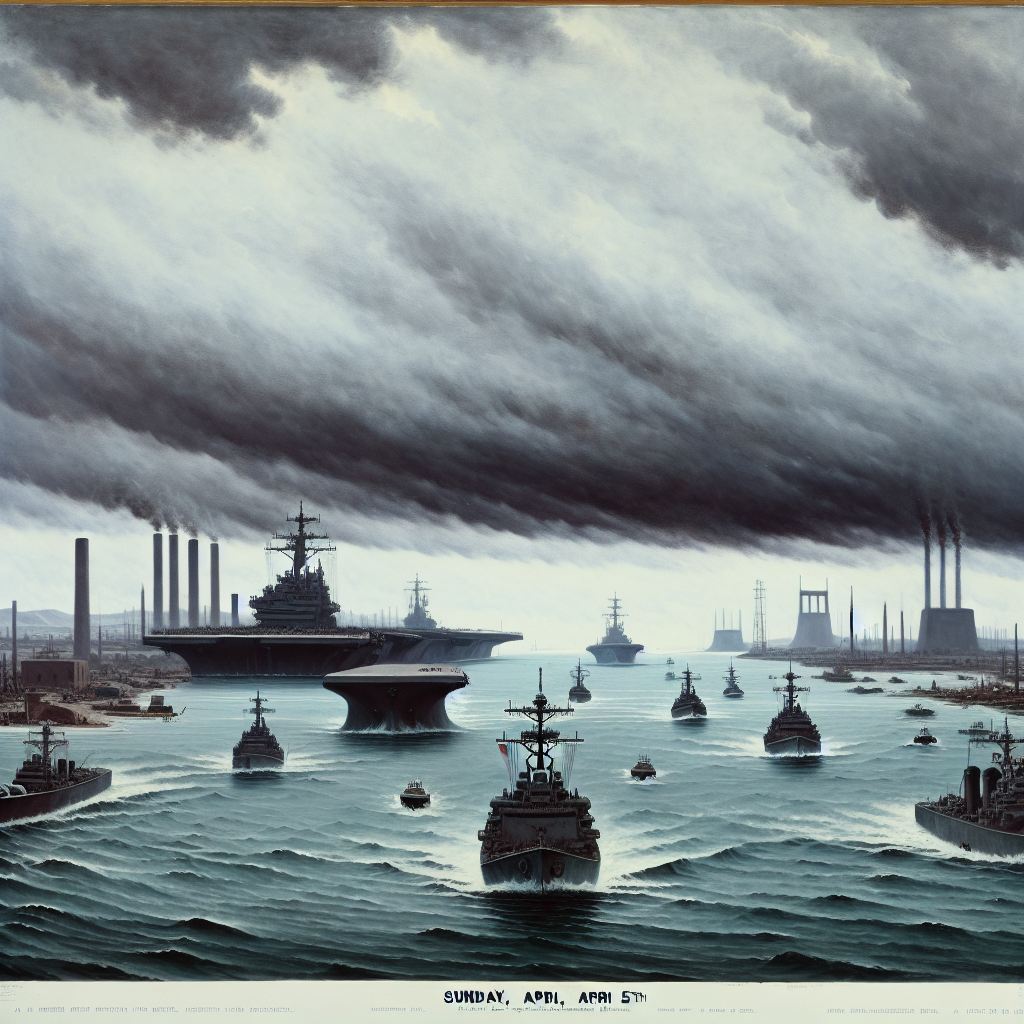
On Sunday (April 5), US President Trump warned Iran to quickly open the Strait of Hormuz, or else Iran’s power plants and bridges will be destroyed. Former Commander of the US Central Command and retired General Frank McKenzie stated that the US has the capability to reopen the Strait of Hormuz.
In an interview with CBS News on Sunday, McKenzie expressed that if the United States chooses to reopen the strait, it has the ability to do so. He mentioned that the current events are considered as the “initial steps” of this operation.
“We aim to weaken Iran’s ability to launch short-range rockets and missile attacks on ships in the strait. We want to destroy their fast attack boats,” McKenzie said.
He noted that at the same time, the US military is working on “clearing out Iran’s naval mines stockpile.”
“All of these operations are currently underway,” McKenzie stated. He also added, “I believe we are steadily progressing towards achieving these goals.”
When asked by CBS News reporters if ground troops are necessary to reopen the Strait of Hormuz, McKenzie commented that the strait could be opened through airstrikes and naval battles, with the use of ground troops potentially resembling a raid.
He explained that a raid refers to an attack with a planned retreat.
Earlier, on Sunday, the president warned that if Iran does not reopen this crucial waterway, he would target Iran’s power facilities and bridges.
Regarding President Trump’s warning on Sunday, McKenzie also cautioned Iran saying, “The Iranian people should heed President Trump’s directions, as he has proven he is willing to act.”
As for the progress of the Iran war, Frank indicated that the war is “progressing very well,” but he anticipated that it would escalate.
“The war has been ongoing for about 30 days, and if you’re in the Central Command, I think you should be quite satisfied with the current progress,” McKenzie said. “If someone had told me the situation now 30 days ago, I would have thought it was overly optimistic.”
He mentioned that so far, “we have been achieving good results,” while also stating that the war will continue. He expressed that for Iran, “the difficulty of launching missiles and rockets will increase,” but “it may take some time before we completely eliminate these threats.”
“I think there is still some time, but everyone understands this,” he said. “I believe we are on the right track, and the operation is progressing very smoothly. I believe the pace will accelerate day by day.”
Eight major oil-producing countries affiliated with OPEC+ announced plans on Sunday to increase daily production by 206,000 barrels starting from next month. The countries signing this statement include some of the world’s largest oil-producing nations: Saudi Arabia, Russia, Iraq, the United Arab Emirates, Kuwait, Kazakhstan, Algeria, and Oman.
These eight countries also warned of the impact on energy infrastructure during a US-Iran war, noting that “restoring damaged energy assets to full capacity operation requires significant costs and a long time.”
Shipping traffic data indicates that since last Thursday (April 2), three Oman-operated oil tankers, one French-owned container ship, and one Japanese-owned liquefied gas transport ship have passed through the Strait of Hormuz.
Data from the London Stock Exchange Group (LSEG) and Kpler showed that on Sunday, an oil tanker loaded with Iraqi crude oil was observed passing through the Strait of Hormuz, near the coast of Iran.