
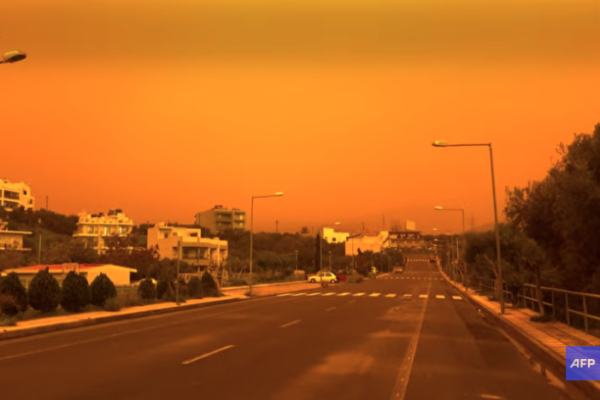
The island of Crete in the Mediterranean, the largest island in Greece, recently experienced an apocalyptic scene as the sky turned orange due to a sandstorm sweeping through the region. BBC reported that the storm named “Erminio” hit parts of Greece, bringing strong winds and flooding that caused streets to be submerged, schools to close, ferries to halt operations, and some individuals to be stranded in their vehicles.
According to the Greek firefighting department, the storm also resulted in the death of a man near Athens. The man, in his fifties, was found under a car in the coastal town of Nea Makri on April 2nd.
Local media reports indicate that the man was believed to have tried to cross a flooded street but was swept away by the torrent. The basement of the Nea Makri police station was also flooded. On the island of Poros in the Aegean Sea, a bridge was destroyed by floods, vehicles were washed away, and some schools had to suspend classes.
Simultaneously, sand dust from the Sahara Desert swept over Crete, giving the sky an apocalyptic orange-red hue just before the Easter holiday. Some flights were canceled on April 1st, forcing residents and tourists to wear masks to avoid inhaling sand particles, disrupting their daily lives.
Sky News reported that Crete also suffered extreme weather conditions brought by Erminio, including strong winds and heavy rain, mixing with dust to form sludge, covering vehicles and buildings. On the island of Santorini and in Tobruk, Libya, the effects of the sandstorm were visibly severe with the sky turning red.
Closer home, in Australia’s western region, the approaching tropical cyclone “Narelle” turned the sky a eerie blood-red. Previously reported by Epoch Times, as Narelle approached the west coast on March 27, residents of Shark Bay witnessed the rare phenomenon of the sky turning red, a sight never seen before, attributed to the iron-rich red soil being carried by Narelle’s strong winds into the atmosphere.
Meteorologists explained that the red sky phenomenon was primarily due to the soil characteristics as Narelle swept a considerable amount of iron oxide-containing dust into the sky, giving it a red appearance in the atmosphere.