
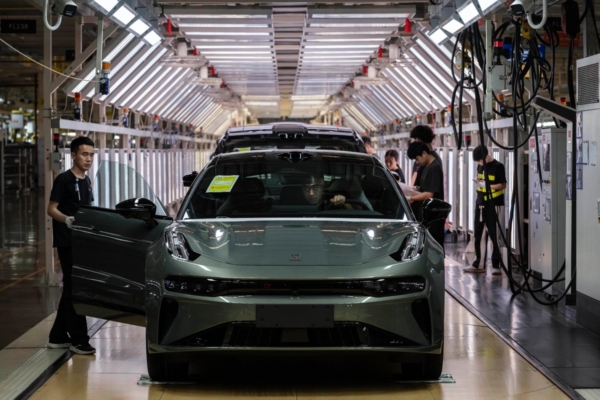
In February, the sales of electric vehicles (EVs) in China experienced a sharp decline, once again highlighting the reluctance of Chinese consumers to spend.
Any monthly fluctuations in statistical series should be approached with caution. Particularly questionable is the heavy subsidization of sales by Beijing before the Lunar New Year celebrations.
However, these early subsidies did not boost sales but rather depleted future demand. This fact underscores how indecisive Chinese consumers are and reveals the extent to which the Chinese economy is fundamentally struggling.
Even considering all relevant statistical limitations, the data for February is still astonishing. According to data released by the China Passenger Car Association (CPCA), sales of “new-energy vehicles” (including EVs and hybrid cars) in Beijing decreased by 32% month-on-month and approximately 25% year-on-year. Due to the decline in EV sales, overall retail sales of automobiles dropped by 34% compared to January.
Facing this sluggish trend and the broader economic issues it reflects, the recent meetings of the NPC and CPPCC, known as the “Two Sessions,” did not introduce additional measures to boost Chinese consumer confidence and encourage freer spending. Subsidies for trading in old cars and appliances, rather than promoting overall economic activity, have created monthly sales fluctuations, exacerbating overcapacity in certain industries—a result of poor planning in Beijing’s Zhongnanhai.
Given the continuous and long-standing property crisis in China that has significantly impacted households, Beijing’s inadequate efforts to stimulate consumer spending are cause for concern. Since the outbreak of the real estate crisis in 2021, as of January 2025 (the latest period for which complete data is available), real estate development activities have decreased by around 70%. As residential construction once accounted for over 30% of China’s total economic output, this decline alone has had a substantial negative impact on the economy.
More importantly, the collapse of the real estate development industry has led to a significant drop in existing home values in China. Data from the renowned global macroeconomic data provider, Trading Economics, shows that in January, the average house prices in China fell by 3.1%, expanding from the previous month’s 2.7% decline, marking the 31st consecutive month of price decreases. This trend has greatly weakened household net worth, forcing Chinese people to cut spending and save costs to bridge this financial gap.
The Beijing authorities need to take strong measures to rectify household finances and encourage consumption. However, as indicated in the recent “Two Sessions,” the Communist Party leaders do not seem inclined to do so.
Amidst a sharp decline in domestic demand, car exports continue to help manufacturers weather the storm. In February, total passenger car exports from China increased by approximately 56%, with over half being new energy vehicles. Around 40% of Tesla China’s production is now exported abroad.
While manufacturers undoubtedly welcome this source of demand, it is at best unstable. The EU, India, and other Chinese trading partners have taken measures to restrict the sale of Chinese cars. Even the past competitive advantage that helped boost Chinese EV exports is no longer reliable, as the prices of copper and lithium have surged compared to the same period last year.
The sudden drop in EV sales in February may not hold significant meaning on its own. However, when viewed in conjunction with the actual circumstances, it reflects fundamental issues in the Chinese economy. Despite the likely rebound in car sales (including EVs) in March due to the fluctuating nature of these and other sales indicators, it is challenging to predict the end of the slowdown in Chinese economic growth given the fundamental problems it faces.
(Note: The article originally published in the Epoch Times and the author’s background information have been omitted for conciseness.)