
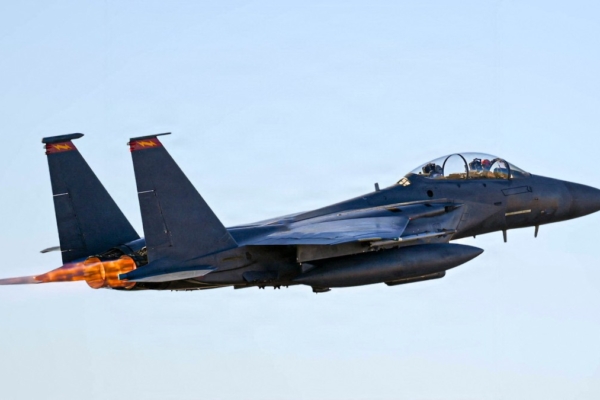
The United States military’s F-15E fighter jet was shot down in Iran on Friday (April 3), resulting in one crew member missing. The elite forces of the U.S. military have ventured deep into Iranian territory to carry out a search and rescue operation. A counterterrorism expert has analyzed the situation in the crash area of the fighter jet and the potential challenges the U.S. military may face during the rescue mission.
The Chief Strategic Officer of the Middle East Forum and former member of the U.S. Army Special Forces, Jim Hanson, provided his analysis of the rescue operation during an interview on Fox & Friends Weekend on Saturday (April 4).
The F-15E fighter jet crashed in the Khuzestan Province of Iran, with two crew members ejecting to safety. While one has been rescued, the search for the other is still ongoing.
Khuzestan Province, where the jet went down, is inhabited by Arab tribes that oppose the Iranian central government. Hanson believes that while this may aid the stranded U.S. soldier, the presence of an increased level of armed forces by the Iranian government in the area – aimed at suppressing potential protests by local tribes – poses challenges for the U.S. military’s rescue operation.
“The IRGC and Basij Militia have a larger than normal presence there to suppress any local tribal protests,” Hanson said. He added that the Iranian authorities might mobilize as many people as possible for the capture operation, “We can only hope that those dissatisfied with the regime are helping rather than conspiring.”
The Iranian regime is actively trying to capture the missing airman before the U.S. military, with official media urging citizens to assist and offering a reward of around $66,000.
Hanson suggests that the missing airman would likely seek out rugged terrain less accessible to Iranian armed forces for cover. While this strategy may complicate the search for the missing crew member, it is essential for their safety.
“You definitely don’t want a bunch of Basij Militia or other Iranian forces roaming around in pick-up trucks being able to easily locate him,” Hanson stated.
This counterterrorism expert describes the U.S. military’s rescue mission as a delicate balance that requires careful consideration. Military officials are weighing how many troops should be deployed to the region to both recover the missing soldier and avoid these reinforcements becoming targets for Iranian attacks.
Citing retired U.S. Air Force Brigadier General and former F-15E pilot John Teichert, Fox reported that while the current environment is dangerous, the lack of ground reports could be a positive sign.
Teichert mentioned that while it’s been some time since the F-15E was downed, causing some concern, “I actually view it as positive overall because they are operating based on their training.”
“They have found a good hiding spot, indicating they haven’t been captured by the enemy. The troops are now assessing the terrain and enemy deployment to find the right time and manner to rescue the downed crew member,” he added.
“Combat search and rescue” missions are considered one of the most complex and time-sensitive operations for the U.S. and allied forces. The ongoing rescue operation is lead by the U.S. Air Force Special Forces unit Pararescue Jumpers, known as the “Swiss Army knife” of the Air Force. These elite combat rescue units undergo rigorous two-year training, equipped as both combatants and emergency medical technicians, specializing in battlefield search and rescue.
Former U.S. Special Representative for Syria and military strategist James Jeffrey told the BBC that such missions typically involve the use of Black Hawk helicopters, aerial refueling tankers, and other combat aircraft for support and cover.