
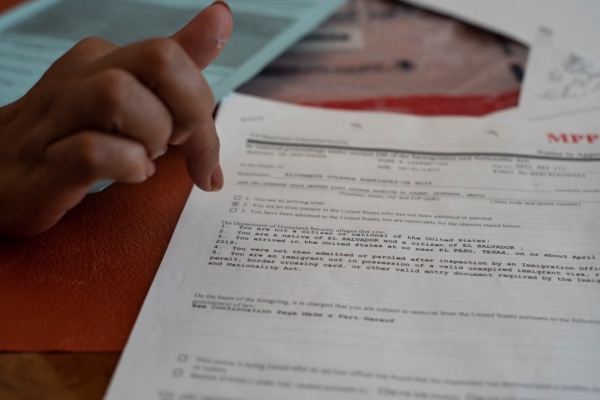
With the acceleration of clearing backlogged cases in the US immigration courts, a precedent ruling made by the Board of Immigration Appeals (BIA) in March 2025, known as Matter of C-A-R-R- (29 I&N Dec. 13), is having a significant impact on numerous asylum cases. This case clearly states that if an asylum application form (Form I-589) is not completed in full, immigration judges may consider the application as waived or abandoned without entering into substantive review, greatly affecting asylum seekers.
According to a ruling obtained by this publication from a New York immigration court, a Chinese immigrant who entered the US illegally, despite submitting Form I-589 along with a personal statement of about 10 pages, had his asylum application deemed “incomplete” by the judge because he did not provide detailed answers to key questions on the form. As a result, his asylum application was directly ruled as abandoned, leading to an order for deportation.
The court pointed out that the applicant failed to disclose crucial information such as the duration of stays in multiple third countries (including Thailand, Turkey, Ecuador, etc.), legal status during those stays, and whether asylum was sought locally, which are essential to asylum review, such as determining “firm resettlement.”
Although the applicant was asked to supplement the missing information and had legal representation, the additional details were not filled in the I-589 form but submitted as supplementary materials, rendering the form still incomplete, resulting in the judge deeming the application as “waived.”
In another notice obtained by this publication from an immigration court, a Chinese individual who entered the US legally on a tourist visa and submitted Form I-589 was supposed to go through an asylum application interview with immigration authorities. However, without undergoing the asylum interview, he received a notice to appear in court, being included in the immigration court deportation proceedings, which was also related to incomplete filling of his I-589 form.
The BIA in Matter of C-A-R-R- outlined two crucial legal principles that have guiding significance for future asylum cases:
First, the I-589 must be fully answered question by question
Under 8 C.F.R. § 1208.3(c)(3), if an asylum application fails to answer all questions, lacks necessary information, or is incomplete, judges can reject the application and consider it as abandoned provided that the applicant was given an opportunity to correct.
Second, personal statements cannot substitute form content
BIA emphasized that even if detailed supporting declarations are submitted, if questions on the I-589 form are not answered in full, it still constitutes an “incomplete application.” Statements serve as supplementary evidence and do not replace the required content of the form itself, aligning with the precedent set by Matter of Interiano-Rosa (2010).
Legal experts widely believe that such rulings are closely linked to current trends in immigration policy. With over 3 million backlogged cases in the US immigration courts, the government is emphasizing improving processing efficiency and reducing procedural delays. In this context, judges are imposing stricter requirements on the formality of application materials.
Analysis suggests that in some past cases, courts may have been more lenient towards form-filling errors, but with the establishment of new precedents, “formal completeness” has gradually become a substantive threshold. In other words, applicants who fail to submit a qualified and complete I-589 may even be unable to progress to the substantive review stage.
Experts caution that incomplete filling of the I-589 can lead to serious legal consequences, such as: inability to undergo substantive asylum review (evaluation of persecution claims), being considered as abandoning asylum application, and facing direct deportation orders. This means that some applicants who may have had valid asylum reasons could lose their opportunity for protection due to procedural errors.
Legal professionals emphasize that the I-589 is not just an application document but also serves as a “ticket” to enter the asylum process. In the current environment of stricter reviews, accurately and completely answering every question has become a fundamental prerequisite for a successful asylum application.
Experts recommend that applicants should fill out the I-589 with the guidance of a professional attorney ensuring clear responses to all questions and consistency with any supplementary statements to avoid the risk of rejection due to technical deficiencies.