
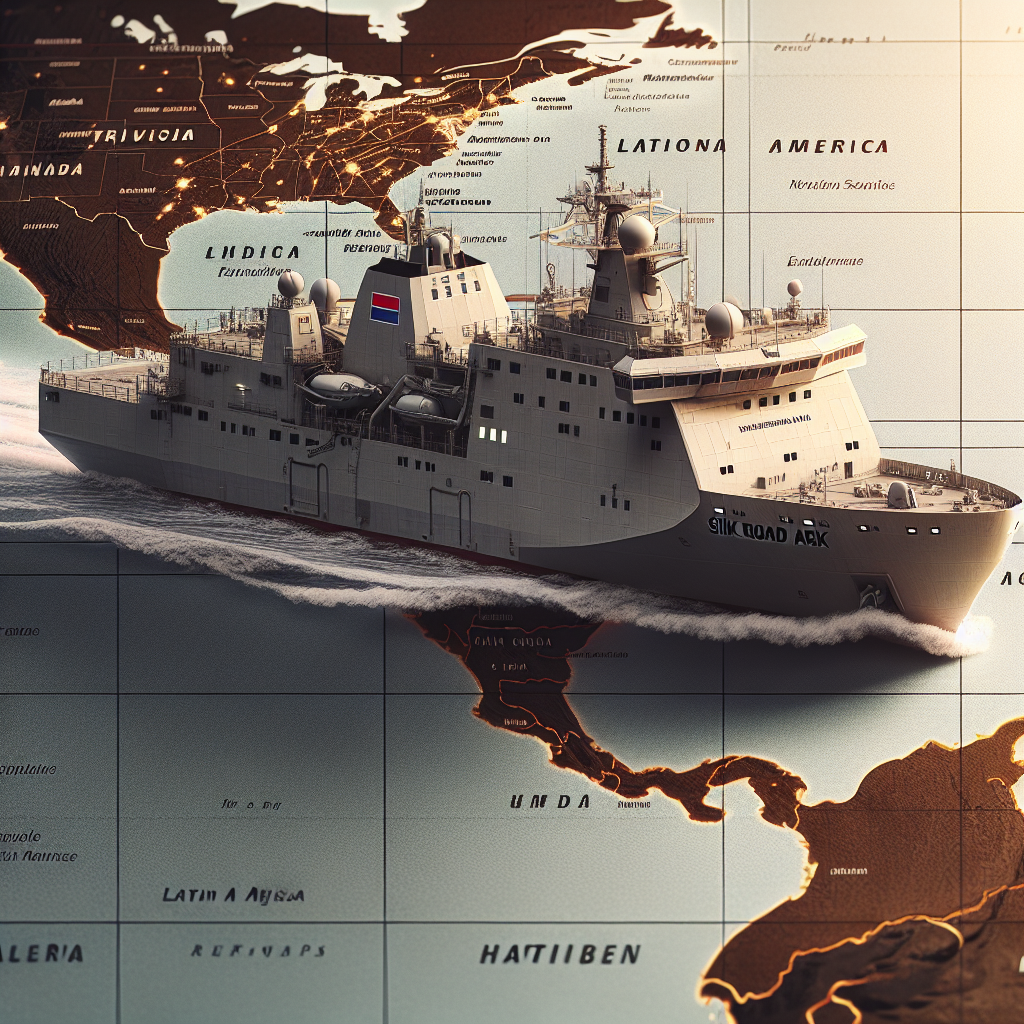
In late 2025, the Chinese Navy dispatched a medical military ship named “Silk Road Ark” to cruise around Latin America and the Caribbean, aiming to showcase the military strength and geopolitical influence of the Chinese Communist Party (CCP). However, it ended in a disastrous failure, as only 6 out of the 33 countries in the region received the ship.
Last December, the CCP issued its third policy document on Latin America, stating its intention to actively engage in military exchanges and cooperation with Latin American countries. The CCP’s goal is to conduct delegation visits and ship exchanges, enhance professional exchanges in military training and strengthen military trade and technology cooperation, among other areas. This indicates that the CCP’s deployment of a medical military ship to cruise in Latin America is not merely about promoting medical services.
According to an article in The Hill, the presence of the CCP’s medical military ship was met with great fanfare, but only a handful of countries such as Brazil, Chile, Jamaica, and Barbados accepted the ship. Nicaragua and Uruguay made last-minute technical stops. While the ship reached Valparaiso port in Chile, the health department rejected the CCP’s proposal. Peru also withdrew the parliamentary bill allowing the “Silk Road Ark” to enter the country citing health concerns.
Mexico, which had initially heavily promoted the visit, quietly backed out in the end. Mexico is a major trading partner of the United States, and Peru has been designated as an important non-NATO ally by the U.S. For these countries, cooperating with CCP military exercises could have serious consequences.
Brazil was the only Latin American country to wholeheartedly accept the CCP military ship. The navies of the two countries conducted a joint maritime search and rescue exercise, while the CCP also conducted a demonstration of combat rescue operations. However, Brazilian officials complained that they were unable to inspect the exercise ships and did not have access to the medical personnel on board.
In contrast, the recent “Southern Waters 2026” military patrol initiated by the United States received unprecedented reception and welcome from Latin American and South American countries. The operation covered the Caribbean region, as well as North America, Central America, and South America, deploying the nuclear-powered aircraft carrier USS Nimitz and the Arleigh Burke-class guided-missile destroyer USS Gridley.
During the patrol, the U.S. military conducted joint exercises with several countries including Argentina, Brazil, Chile, Colombia, Ecuador, Peru, Mexico, El Salvador, Guatemala, and Uruguay, and made comprehensive visits to Brazil, Chile, Panama, and Jamaica, among other countries.
At a recent congressional hearing, General Francis L. Donovan, Commander of the United States Southern Command, outlined four key priorities of the new U.S. policy towards Latin America: preventing hostile forces from establishing a foothold in the Western Hemisphere and exerting undue influence, strengthening command and control in the Western Hemisphere, applying comprehensive systematic pressure on drug trafficking groups and terrorist networks, and developing and deploying targeted, efficient modern forces.
On March 7th of this year, President Trump announced the formation of the Hemispheric Anti-Cartel Alliance. In less than a month, the alliance has achieved significant results: Ecuador launched a strike on cartel infrastructure; Paraguay signed a new Status of Forces Agreement; and Bolivia captured the top wanted drug trafficker in South America.
The stark disparity in treatment between the Chinese and American naval patrols once again highlights CCP’s successive setbacks in the geopolitical, commercial, and military competition between China and the U.S. Despite extensive trade relations between the CCP and many South American countries, the U.S. remains an important ally in terms of security and combating organized crime.
The latest U.S. National Security Strategy clearly states that the U.S. will reaffirm and implement Monroe Doctrine, restore American leadership in the Western Hemisphere, safeguard American territory and key geographical positions in the Western Hemisphere.
The security strategy also emphasizes the U.S.’s determination to prevent non-Western Hemisphere competitors, especially China, from deploying military forces or other threatening capabilities in the region, or from owning or controlling strategically significant assets.