
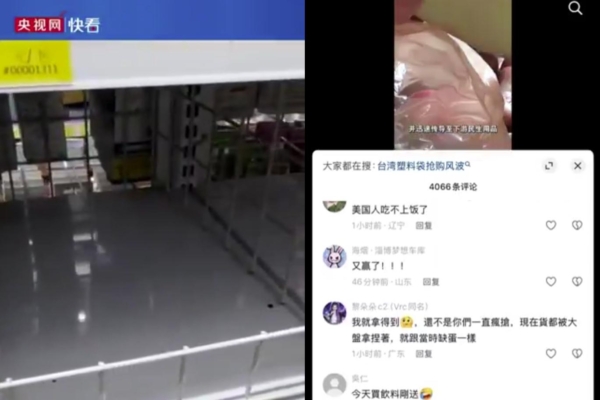
On April 2, China’s official media CCTV reported that the Middle East conflict has impacted the supply chain, leading to a shortage of plastic bags and garbage bags in the Taiwanese market, making it difficult for people to purchase even if they have the money. Footage showed empty shelves with captions like “sold out due to panic buying.” However, this information quickly sparked skepticism, with many Taiwanese netizens publicly denying the situation. Analysts believe that the Chinese Communist Party is sensationalizing with ulterior motives, trying to shift internal pressures by portraying an “even worse outside” narrative.
According to Liu Yu (pseudonym), who previously interned at CCTV’s news department, the most glaring issue with such reports is the “sensorial disconnection.”
Taipei-based netizens commented, “The news reported it, but we don’t feel it much in real life,” with some questioning, “How come I didn’t know about this?” and others doubting, “There can’t really be people who believe this, right?” These comments garnered numerous likes and shares, accompanied by photos from supermarkets showing normal supplies of plastic bags and garbage bags.
Liu Yu mentioned, “When I worked at the TV station, sometimes we would take out pre-written scripts and find actors to deliver the news. Viewers easily spot the loopholes in the broadcast, like using the same person for different stories but with changed roles, leading them to question the authenticity of the news, a situation also present at CCTV.”
Liu Yu further revealed the practices of media within the system, stating, “If reporters can’t find real interviewees that align with the propaganda direction, they often use ‘performers’ instead and guide them to speak according to a predefined script. This report about panic buying in Taiwan not only involves logical leaps but also presents a severe ‘sensorial disconnection.'”
Simultaneously, this “worst-case storytelling” on mainland China’s social media platforms backfired. Many netizens adopted a sarcastic tone, saying, “The US has burst pipes, Japan has run out of eggs, Taiwan is short on bags, and we’re the luckiest ones in the world?” These remarks swiftly spread across platforms.
Mr. Guo, a mainland cultural figure long residing in Taiwan, stated that CCTV’s report directly linking the Middle East situation with Taiwan’s daily consumption lacks substantial support in reality. He argued, “Taiwan possesses a complete petrochemical industry chain, with companies like Formosa Plastics Group having stable production capacities for plastic products. The Chinese official media equating global energy fluctuations to a so-called ‘civilian plastic bag shortage’ is a clear case of logical leaps.”
He also pointed out that when news descriptions deviate significantly from people’s daily experiences, audiences won’t accept explanations but rather develop mistrust directly, saying, “It’s widely acknowledged that Chinese official media often spreads misinformation. This time it targeted Taiwan, sometimes Japan or the US, but mainly deceiving domestic audiences.”
Mr. Zheng, an active netizen from Shandong, mentioned that official media typically uses the narrative of “things are worse elsewhere” to deflect internal pressure, adding, “Nowadays, the closure of businesses, shrinking salaries of some civil servants, forced demolitions of residences, food safety issues, all these realities are seldom reported. When similar ‘things are worse elsewhere’ stories keep emerging, viewers can easily spot the pattern and respond sarcastically.”
He believes that this narrative has long been exposed on the mainland, stating, “The common people simply don’t buy it; this is a common tactic of the CCP propaganda system, countering real pressures by constantly portraying external negatives.”
Some critics pointed out that when the media no longer prioritizes presenting reality but focuses on shaping perceptions, its credibility will gradually diminish. Once this erosion reaches a tipping point, the media loses not just the credibility of individual news but the foundation of the entire information system.