
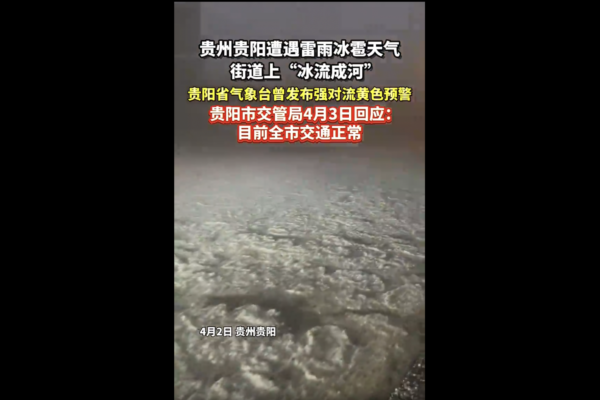
On the evening of April 2nd, Guizhou Guiyang encountered severe convective weather with thunderstorms, strong winds, and hail in many areas. Citizens reported that a dense hailstorm suddenly hit Guiyang, turning the streets into “ice rivers” with hail piling up to the height of car doors and causing wheels to freeze.
According to official reports from People’s Daily’s Weibo, on the night of the 2nd, areas such as Huaxi and Qingzhen in Guiyang were bombarded with a large amount of hail, covering city streets like snow in winter.
The official Weibo video account of the China Meteorological Administration reported that around 7 p.m. on April 2nd, a strong hail cloud appeared in the area from Gui’an New District to Huaxi District in Guiyang, turning some roads into “ice rivers” and causing traffic disruptions.
On April 3rd, the Guiyang City Traffic Management Bureau responded that there were indeed road surface hail accumulations and water pooling on the night of the 2nd.
Citizens posted that the hail stacked up to the height of car doors (about 50 centimeters), leading to a phenomenon where “ice rivers” formed, causing wheels to freeze.
On the evening of April 2nd, Mr. Wu, a resident, shared a video showing a road covered in hail, making it difficult for vehicles to move forward.
Reported by Jiupai News, on April 3rd, Mr. Wu, who recorded the video, mentioned that hail fell for 20 minutes on the night of the 2nd, with some car windows and engine covers being hit. He described the road section as concave, with hail piling up to the height of his car door, hindering electric vehicles from moving forward.
Mr. Wu mentioned that during a red light phase, the melted hail froze the wheels, forcing him to wait for more than two hours. Being a native of Guiyang, he had never seen such large hail before.
According to Shangyou News on April 3rd, some roads in downtown Guiyang became “ice rivers.” Some vehicles were stranded on certain sections, and residents traveling on electric bicycles struggled to move forward in the “ice rivers.” According to the Huaxi District Meteorological Bureau in Guiyang, due to severe convective weather, a large number of branches and leaves falling and blocking drains resulted in waterlogging on some roads. The hail floating on the water surface created a phenomenon similar to an “ice river.”
Reported by Lizhi News, a staff member of the Huaxi District Meteorological Bureau mentioned that the maximum diameter of the hail was 30 millimeters, and it lasted for two to three minutes.
According to incomplete statistics, since late March, there have been at least four instances of hail in the entire province of Guizhou. Meteorological analysis indicates that on April 1st, the lowest temperature in Guiyang was only 9.6 degrees Celsius, rising abnormally to 23.5°C in the afternoon of April 2nd, fully charging the atmospheric energy. The intense interaction between cold air and southern winds, coupled with adequate water vapor, along with the altitude difference between Yunnan and Guizhou, led to a rapid release of unstable energy as the westerly winds entered Guizhou, triggering turbulent conditions in the upper atmosphere. Subsequently, the hailstorm erupted from the Wumeng Mountain area around 5 p.m. on the 2nd, rapidly developing and accurately hitting Guiyang in the evening, resulting in dense hail. The hail clouds continued to move eastward, affecting towns and cities along the way.
Experts from the Guiyang Meteorological Bureau explained that during this event, the hail cloud’s intensity was high, leading to a high hail density. At the same time, there was a short period of heavy rainfall that washed the hail into low-lying areas, creating the phenomenon of “ice rivers.”
The videos of Guiyang’s sudden hailstorm turning the streets into ice rivers quickly spread, sparking discussions among netizens.
“Childish or rational”: Terrifying!
“Zhou Jinglan”: Extreme weather is so frightening.
“Hey-He Buer”: Hail also fell near Guangxi, bordering Guizhou.
“Red Star Shines Ray-Lei Zi”: Insurance premiums will rise again this year, and the whole nation will bear the cost together.