
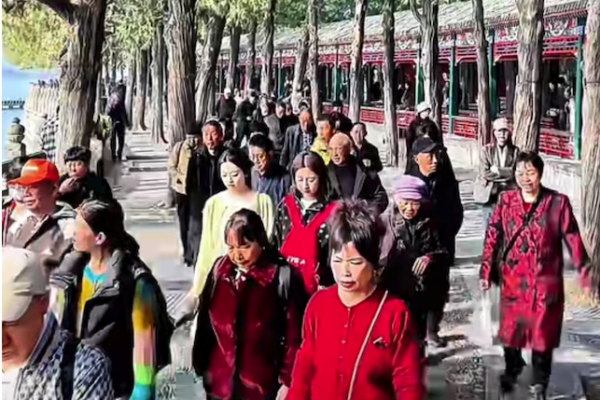
In recent weeks, Beijing has implemented a large-scale identity control system based on big data and facial recognition in public spaces, directly linking ID information with biometric data, making it nearly impossible for individuals to evade. An experience shared by a tourist who encountered 6 security checks and had to show ID 15 times within 5 days illustrates how this system disrupts the rhythm of people’s movements in public spaces.
The tourist, known as “Yueshi Qiufeng,” visiting Beijing recently, stated on a WeChat video, “I was checked 6 times for security and had to show my ID 15 times within 5 days. I have to show my ID almost everywhere I go. There are verification points set up at tourist attractions, subway transfer stations, and some public spaces, constantly interrupting my itinerary.”
Some netizens criticized the situation, saying, “Having to show ID everywhere is not normal in a society.” Others commented that the frequency of checks felt more like screening individuals rather than ensuring security. Another observation pointed out that travel has turned into a process of continuous scrutiny.
Ms. Li, who frequently visits Beijing for petitions, shared with reporters, “I just returned to Fushun from Beijing, and this time, there were more checks than before. Places like Tiananmen Square, Zhongnanhai area, and Qianmen are where petitioners are usually checked, and we have to go through security checks to enter these areas.”
She added, “Now, there are security checks on the subway, and in many places, you need to show your ID. For groups like petitioners, they usually cannot pass through places where ID checks are required. If you are classified as a ‘key group,’ they won’t let you go further, stop you on the spot, and hand you over to the local government.”
Mr. Ma, a petitioner from Dalian, mentioned that Beijing’s technical surveillance is highly comprehensive, saying, “There are facial recognition systems everywhere in Beijing, the surveillance network is dense, once a person appears, the system identifies them, knowing where they are from and whether they are on their blacklist.”
At the same time, differential control measures specific to certain areas are becoming more apparent. A service staff member from a business hotel in Chaoyang District, Beijing confirmed to reporters, “If the ID number starts with 65, additional registration is usually required for guests, and sometimes we have to report to the police station.”
He revealed, “Numbers starting with 65 represent Xinjiang, such as 6501 for Urumqi, 6528 for Bayingolin, and 6531 for Kashgar. Even Han Chinese residents from Xinjiang need to be reported if they stay, while Tibetan people are not allowed to stay.”
Some netizens commented on this, saying, “Being reported separately just because of your household registration is discrimination.” Others expressed, “Numbers have become labels, and people are being categorized and managed.”
Mr. Li, a human rights activist in Beijing, stated during an interview that there is an extensive verification network in the core areas and transportation hubs of Beijing, with checkpoints set up layer by layer at tourist attractions, subway stations, and public spaces, while video surveillance and facial recognition systems constantly track individuals’ movements.
He mentioned that Beijing is implementing a form of technological authoritarian governance, saying, “There isn’t much fun in Beijing at all; the police here have made everyone jittery. Many human rights activists often have police cars parked downstairs from where they live, following them as soon as they step out. I heard that the stability maintenance funds have decreased, and the State Security agents are very unwilling, grumbling all the time.”
In recent years, the Chinese Communist Party has been expanding real-name registration and data monitoring fields based on legal frameworks such as the Anti-Terrorism Law and Cybersecurity Law, with data from hotels, public buses, mobile communications, and internet platforms all being connected to the public security system in real-time.
Internet activist Ye Lan (pseudonym) expressed her thoughts, stating that “urban management is shifting from space prevention to targeted surveillance of specific groups. Authorities are using a combination of facial recognition and identity data, which is more efficient than manual checks. Each mainland Chinese citizen is like wearing an ‘electronic shackle’ all the time.”
She believes that the high-pressure rule by the CCP not only fragments the continuity of social life but also creates a sense of being constantly monitored. Under authoritarian rule, “most people no longer support the rule of the Communist Party and no longer need a king.”
Several interviewees lamented that the CCP’s integration of automated identification and high-frequency verification operations has transformed surveillance of individuals from being “overt” to “covert,” from “intermittent” to “continuous.” Under this pressure, individual privacy and freedom spaces are facing systematic erosion.