
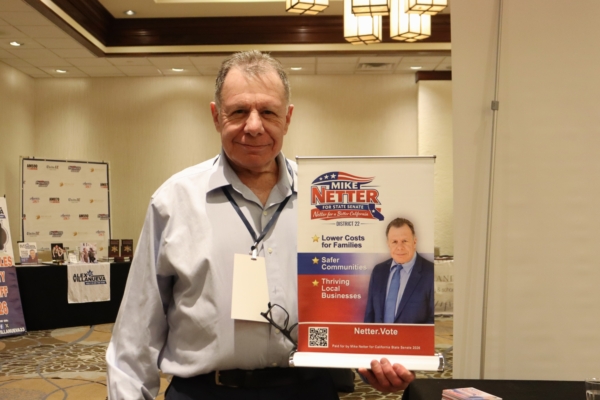
Two months remain until the California primary election on June 2nd. The 2026 elections will cover several important positions including governor, lieutenant governor, secretary of state, treasurer, controller, attorney general, and superintendent of public education, with an increased number of candidates compared to previous years.
Mike Netter, a leading figure in the 2021 recall of Governor Gavin Newsom, announced his candidacy for State Senator in early February. He believes this election could be a crucial turning point for California.
Netter stated that his decision to run is based on three main reasons. Firstly, as a Republican, he noted that while about 48% of voters in California are registered as Democrats, the Democratic Party holds about 75% of the seats in the state legislature. Additionally, around 29% of voters are non-partisan or affiliated with other parties. He sees low voter turnout as a contributing factor to this imbalance.
Currently, the State Senate is composed of 30 Democrats and 10 Republicans, while the Assembly consists of 60 Democrats and 20 Republicans. Democrats hold a two-thirds majority in both chambers, giving them control over major legislation.
Secondly, Netter believes that California’s overall tax burden is too high. He mentioned that many residents feel pressured by taxes and question whether some public expenditures effectively address societal needs. For instance, Proposition 36 passed in the 2024 election aimed to crack down on theft and drug crimes, but lacked sufficient funding for implementation.
Thirdly, he emphasized the need to advocate for the East San Gabriel Valley and the Inland Empire region, focusing on issues such as rising living costs, public safety, and economic challenges faced by local residents. His proposed policy directions include lowering energy costs, supporting law enforcement, promoting job creation, and improving government financial management.
In the 22nd Senate District election, there are three candidates: the incumbent Susan Rubio, Mike Netter, and independent candidate R. R. Jimenez.
Rubio has served as State Senator since 2018 and currently holds the position of Majority Caucus Assistant Whip in the Senate, participating in two committees (Insurance and Domestic Violence Special). She taught in public schools for 17 years before working in city government and serving as a councilwoman in Baldwin Park, Los Angeles County.
Rubio has long been an advocate for addressing domestic violence issues, introducing three related legislative proposals, including SB871 introduced in March. She obtained three restraining orders during her three-year marriage to her ex-husband and former State Assemblyman Roger Hernández.
Having immigrated to the U.S. with her family during her childhood, Rubio earned Bachelor’s and Master’s degrees in education in the country. Her parents were once deported from Texas when they first entered the U.S. illegally; two years later, the family re-entered without documentation, eventually settling in Los Angeles, where she later gained American citizenship.
In December 2024, a California lawmaker was accused of involvement in a bribery case related to the cannabis industry by the U.S. Department of Justice, with Rubio’s name not disclosed. Rubio responded through a spokesperson at the time, denying any involvement in the case. Bill Essayli, former State Assemblyman and the current Chief Federal Prosecutor for Central California, called for an investigation.
Independent candidate Jimenez is a retired Marine, a father, husband, friend, neighbor, and a Christian who has coached a community football team and served in public office. He stated, “I have faced setbacks in life’s journey, but I have gained wisdom and learned to manage risks, and I know that California urgently needs change.”
Netter pointed out that the 6 to 4 ratio of Democratic to Republican voters in the district, but he believes that the largest group are the “non-voters,” stressing the importance of voter turnout not only for state officials but also for local leaders. Historical data indicates that voter turnout in California primaries is typically around 35%.
He urged voters to actively participate in voting, emphasizing the importance of using their votes to voice their opinions, regardless of party affiliation.