
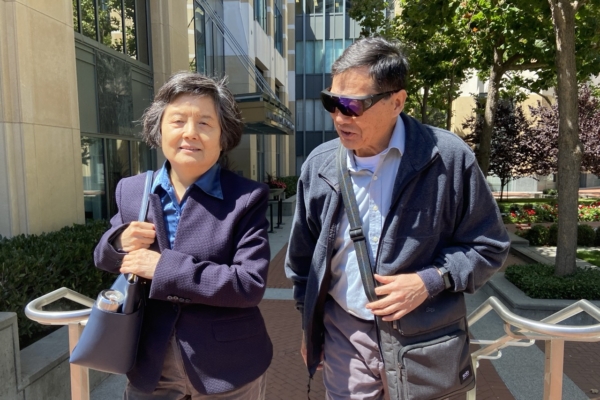
On Tuesday, March 31, the Federal District Court in California ruled that the original diaries and private letters of Li Rui, former secretary of Mao Zedong, will continue to be preserved by the Hoover Institution Library and Archives at Stanford University and made available for public access.
Li Rui had entrusted his daughter, Li Nanyang, to hand over these personal documents to the Hoover Institution. However, Li Rui’s widow in China, Zhang Yuzhen, claimed that these were “national treasures” of the Chinese Communist Party and filed a lawsuit to demand the return of these materials.
The judgment on Tuesday marked the end of this highly publicized civil lawsuit. Previously, there were concerns that these materials could be sent back to China and potentially censored or destroyed. Researchers believe that Li Rui’s nearly 80 years of diaries provide a rare insight into the internal dynamics of the top leadership of the Communist Party and their discussions.
In his ruling, Judge Jon S. Tigar of the Federal District Court in Oakland, California, stated that Li Nanyang holding and donating Li Rui’s materials to the Hoover Institution was legal and aligned with Li Rui’s wishes during his lifetime.
The judge emphasized that the so-called judgment by the Chinese Communist Party in Beijing would not be enforceable in the United States.
He also pointed out that witnesses from both Stanford University and Zhang Yuzhen mentioned China’s censorship system, suggesting that Li Rui’s materials would potentially be subjected to censorship or even banning if kept in China.
The verdict further highlighted that the previous trial proceedings at the Beijing Xicheng District Court involving Zhang Yuzhen showed signs of Communist Party interference, and as a result, the judgment made there would not be enforced.
Li Rui’s materials consist of diaries and letters spanning from 1938 to 2017, including his observations and comments on the bloody crackdown by the Chinese authorities on the pro-democracy movement in 1989 known as the “June Fourth Incident.”
Li Rui passed away on February 16, 2019, at the age of nearly 102 in Beijing. In April of the same year, Li Rui’s widow, Zhang Yuzhen, sued her stepdaughter Li Nanyang at the Xicheng District Court in Beijing, demanding the return of Li Rui’s materials.
In an interview with Voice of America, Zhang Yuzhen stated, “This diary should be public, it’s about work matters. She (referring to Li Nanyang) took it away, the organization felt it was inappropriate, and wanted it back. She didn’t return it, so we had to go to court.”
The Communist Party court ruled that Li Nanyang must return the Li Rui artifacts that had been donated to Stanford. Subsequently, in May 2020, Zhang Yuzhen filed a lawsuit against Li Nanyang and Stanford in a U.S. court.
Stanford and Li Nanyang indicated that Zhang Yuzhen had previously expressed a reluctance to pursue legal action, and being in her 90s living on a pension, lacked the financial capacity to engage in expensive transnational litigation. These factors suggest that she was being controlled by the Communist Party. Zhang Yuzhen passed away in 2025.
Condoleezza Rice, Director of the Hoover Institution and former U.S. Secretary of State, welcomed the court’s decision.