
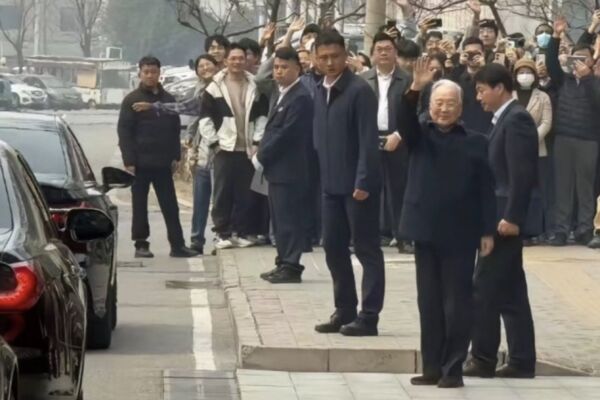
Former Chinese Premier Wen Jiabao, who has kept a low profile in recent years, has made a rare and high-profile public appearance, sparking intense overseas attention to the political situation in Zhongnanhai. A retired senior official within the Chinese Communist Party recently revealed to The Epoch Times that Wen Jiabao’s recent public appearance in the company of a significantly increased number of plainclothes security guards has raised concerns, indicating a high level of vigilance. According to informed sources, such arrangements typically require approval from the office of the Central Committee of the Communist Party of China.
On March 27, 83-year-old Wen Jiabao was spotted in public in Beijing, causing a stir in domestic and international media. Images and information leaked from the scene showed Wen Jiabao inspecting the Institute of Geographic Sciences and Natural Resources Research of The Chinese Academy of Sciences. Photos began circulating on overseas networks from March 27 onwards, with live videos appearing by March 29. Observers noted that under the guidance of accompanying staff, Wen Jiabao waved to onlookers and made traditional respectful gestures towards the crowd multiple times.
Analysts within Chinese political circles suggest that amid the current silence of elderly political figures within the Chinese Communist Party, Wen Jiabao’s public appearance with a strong personal style, accompanied by a high level of security, carries intriguing political implications. An insider who has closely observed the security logic of senior CCP officials, using the pseudonym Lu Yaorong, exclusively disclosed to The Epoch Times that officials at the state level in the Chinese Communist Party have to adhere to a strict process when traveling.
Lu Yaorong disclosed that officials of this level must go through a reporting procedure: “Typically, it needs to be reported to the Central Committee, and for public appearances, it needs to be reported at the level of the Director of the Central Committee. Approval includes details such as time, location, activity arrangements, and security deployment. Especially in Beijing, Shanghai, and other areas, these types of itineraries are generally not made public.”
He said, “After retirement, leaders at the level of a Politburo Standing Committee member often reduce their public activities due to strict approval procedures. This is why after Wen Jiabao left his position, he mostly attended state-related arrangements rather than activities centered around himself.”
However, Wen Jiabao’s recent public appearance is considered “abnormal” and carries a strong political undertone. Lu Yaorong pointed out that the rare removal of security restrictions on-site, allowing and even indulging in close-up photography and videos by the public, is a carefully orchestrated “political release” by Beijing’s top leadership.
Lu Yaorong further analyzed that such “indirect encouragement” of videos circulating overseas serves two real purposes: “One is to send a signal to the international community that through Wen Jiabao’s ‘steady’ appearance, it conveys the message that his political status is still ‘taken care of,’ masking cracks in the top leadership factional struggles. The second purpose is to implement a ‘leverage by intimidation’ tactic, using overseas public opinion to influence domestic affairs, sternly warning dissenters who rely on the elderly to ‘realign’ that Wen Jiabao is under the control of the highest echelons. This not only exploits Wen Jiabao’s lingering presence, but is also a political intimidation and psychological containment within the CCP.”
Overseas analysis suggests that as a key figure among living elder statesmen, Wen Jiabao’s public appearance at this sensitive moment is seen as signaling that “elder statesmen can still move freely,” challenging Xi Jinping’s narrative of fully suppressing various factions within the party. It may also imply that elderly party members are attempting to maintain a certain level of political influence and restriction in the “post-Zhoro and Xia era.”
Footage from the scene shows Wen Jiabao moving freely within and outside the research institute, notably waving to the crowd and making traditional courteous gestures as he departed. This gesture quickly sparked discussions on overseas social media platforms. Many netizens commented, “It’s been a long time since we’ve seen him in public, and he still looks well.” Some astutely noticed the unique nature of the information dissemination: “Domestically, there’s no news at all, all the information is coming from outside.” Users also highlighted the interaction details, noting, “As he walked out, someone called out ‘Hello, Prime Minister,’ and he nodded in response immediately, which appears particularly special in the current political atmosphere of recent years.”
A classmate with the last name Chen of Wen Jiabao during his time at Nankai High School in Tianjin revealed that Wen Jiabao, in his youth, was a sports enthusiast and a key player in the school’s basketball team. The classmate praised him, saying, “His personality back then was extremely gentle, reserved, and he never sought attention. This meticulous, low-key approach was considered a key factor in his smooth rise in his career.”
However, Mr. Chen was greatly surprised by Wen’s recent “high-profile appearance.” He mentioned that their former classmates had tried to invite Wen Jiabao to gatherings multiple times but had never received a response, causing everyone to eventually stop trying. He bluntly stated, “Wen Jiabao has always kept a low profile, so this public appearance with interactive elements clearly contradicts his decades-long discreet style, making it highly unusual.”
Since stepping down from office, Wen Jiabao’s public activities have been extremely limited. In April 2021, he penned a lengthy piece, “My Mother,” as an expression of grief, but he was not physically present at the time; his subsequent two appearances—the CCP’s centennial “Party Celebration” in July 2021 and Jiang Zemin’s funeral in December 2022—were both formal official group appearances. In contrast, his recent appearance at a research institution not only broke his long silence but also featured a more personalized performance, prompting various speculations about the political signals behind it.
Following Wen Jiabao’s appearance, an anonymous individual sent an article to The Epoch Times, stating, “We previously revealed that Xi Jinping attempted to use the United States to attack Iran, unify Taiwan by force, and for this reason, the entire Wen Jiabao family was put under house arrest. This has led Xi Jinping to arrange for Wen Jiabao’s appearance through the Central Committee, indicating that the revelations have had an impact and are influencing the current situation in China.”
The article also mentioned, “After the tragedy of Tiananmen Square in 1989, Wen Jiabao is the only senior leader within the Chinese Communist Party who still insists on reforming the political system, hopes to reverse the verdict on June 4th, and prevent China from undergoing another Cultural Revolution.”
Wen Jiabao’s professional background can be traced back to the Beijing Institute of Geology (now China University of Geosciences). In 1960, he enrolled in the school’s geological mineral survey program, completed his undergraduate studies in 1965, remained at the school to pursue postgraduate studies, and engaged in technical and research-related work. Under the system at that time, the school was under the jurisdiction of the Ministry of Geology and Mineral Resources and served as the cradle for cultivating core personnel in geological exploration and resource survey.
Political analysts in Beijing noted that Wen Jiabao’s public inspection of the “Institute of Geographic Sciences and Natural Resources Research of the Chinese Academy of Sciences” maintained the appearance of aligning with his geological expertise, consistent with his label as a “technical bureaucrat.” However, given the rare solo appearances of retired elderly CCP members at non-celebratory events, this seemingly “academic return” arrangement indicates a deliberate and intentional motive.