
At present, the Central Military Commission of the Chinese Communist Party has only two members – General Secretary Xi Jinping himself and Zhang Shengmin, the head of the disciplinary inspection committee of the People’s Liberation Army responsible for anti-corruption.
“I don’t know what their meetings are like now, because there are only two of them left,” said Cai Si, a senior American political scientist, smiling. “I think they are quite isolated now.”
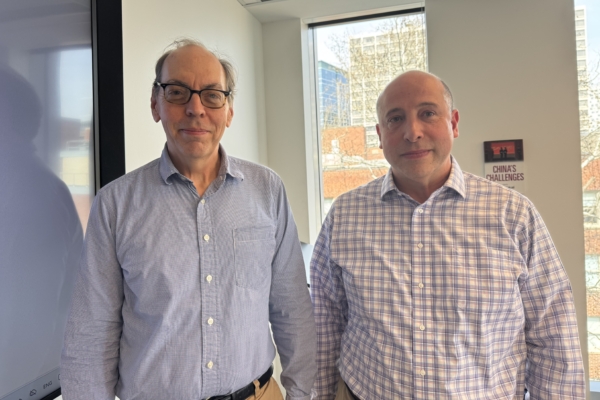
On March 31, 2026, Tuesday noon, the Contemporary China Studies Center at the University of Pennsylvania held a seminar featuring Chase Michael, a senior political scientist at the RAND Corporation and adjunct professor at the Johns Hopkins School of Advanced International Studies (SAIS), to discuss Xi Jinping’s anti-corruption campaign and the downfall of the highest command of the People’s Liberation Army, and the potential impact it brings.
After a major purge at the top level of the Chinese Communist Party, the Central Military Commission’s line-up has been reduced from seven members after the 2022 plenum to the current two.
Many high-ranking officials, including the two vice-chairmen of the Military Commission, have been removed from their positions and are under investigation. “This is a widespread cleansing operation that involves a large number of personnel,” Cai Si said. “About half of the senior officers personally promoted by him have been dismissed.”
Cai Si, a former U.S. Department of Defense official responsible for China affairs, noted that corruption within the PLA has a long history.
In his hour-and-a-half lecture and Q&A session, Cai Si first reviewed the history of corruption within the Chinese People’s Liberation Army (PLA).
During the early stages of the reform and opening up period in the 1980s and 1990s, known as the “PLA Inc.” era, the PLA engaged in various commercial activities, some of which were completely illegal – such as smuggling. It was not until Xi Jinping took office as the top leader that the anti-corruption campaign within the PLA truly accelerated and deepened. The slogan of the anti-corruption campaign shifted to “striking both the tigers and the flies.” “The military’s anti-corruption campaign is just a part of a broader anti-corruption campaign being carried out across the party,” Cai Si said.
According to a report by the Epoch Times on March 30, internal strife and purges within the CCP reached unprecedented intensity in 2025. The confirmed amount of corruption related to embezzlement, bribery, buying and selling positions, and illegal gains totaled up to 800 billion yuan, with over 300 billion yuan of illicit funds still being chased down, surpassing the 1 trillion yuan mark.
Cai Si believes that Xi’s massive purge of the military has three main reasons. Firstly, “corruption within the PLA is a serious problem.” Additionally, “corruption can damage the reputation of the PLA and even the ruling party.” “If officials hand-picked and promoted by Xi Jinping were involved in such scandals, it would be quite embarrassing for him personally.”
“Ultimately, this is mainly about political control, especially Xi Jinping’s personal control; it’s about loyalty to the leader,” he said.
Regarding the consequences of Xi’s purge, “The top leadership of the PLA is clearly experiencing a major turmoil,” Cai Si believes. From the perspective of the PLA’s modernization, the leadership structure, and even the “party commands the gun” military-political relationship, “it will inevitably have an impact on certain aspects – such as whether the ‘2027 goals’ can be achieved on time, or how much trust Xi Jinping has in the new candidates he selected to replace the officials who were purged.” “These consequences are likely to first affect some military equipment procurement and infrastructure projects.”
“It is likely to have a negative impact on the timely realization of the PLA’s established strategic goals and tasks,” he said.
Cai Si expressed that the massive purge will also have a certain negative impact on how the PLA manages its external relations in the future. In the case of the United States, “the Chinese side usually does not want us to have direct dialogues with the vice-chairmen of the Central Military Commission.” “The officer who used to be the Chief of Staff of the PLA Joint Staff Department has also resigned.” He said, “Fundamentally, the reason for the lack of efficient communication is due to bureaucratic systems and procedural processes.”
Based on his personal experience working in the government, Cai Si said dealing with the Chinese side “can be quite tricky.” In the United States, “some things I only need to report directly to the Secretary of State, and then maybe send it to the State Department and the National Security Council for quick review. But on the Chinese side, handling matters of equivalent level may require direct approval from Xi Jinping himself. Therefore, I think their system has a very strict hierarchical color.”
Xi’s massive purge – removing all corrupt, unreliable, disloyal, or problematic individuals, but ultimately unable to eradicate corruption, Cai Si believes, is a result of the CCP system.
According to a report by the Epoch Times by Wang Youqun, Xi has been carrying out an anti-corruption campaign for 14 years since taking office. By March 25, 2026, according to preliminary statistics from the Central Commission for Discipline Inspection, Xi has investigated 1,053 senior officials at the vice-provincial level and above, and other central leadership cadres under his fake anti-corruption campaign.
Cai Si said that the United States and Taiwan have also had cases of corruption exposed within their militaries, but these democratic countries have a complete system of institutions that “can reduce the probability of such incidents occurring through various forms of internal or external supervision. The PRC, however, cannot really establish such a mechanism, because it is impossible to achieve in their political system.”
Cai Si said, the CCP system “lacks investigative journalists who can accept reports and investigate in certain ‘politically sensitive areas’; nor does it have a truly meaningful parliamentary oversight mechanism. … They could have undertaken more functions similar to that of ‘Inspector General’, but they seem to mainly rely on audit and disciplinary inspection methods.”
“Systemic reforms are difficult to truly take root and be implemented within the party,” he said. The PLA belongs to the armed forces of the party, not the state. And as Xi Jinping, who also serves as the Chairman of the Central Military Commission, is essentially the highest leader of the party’s armed forces. Therefore, “any potentially influential reform measures that touch on the core aspects of the party will have a comprehensive impact on the way the entire Chinese government system operates.”
Cai Si also feels that Xi’s massive purge “seems to have no end in sight.” “Since there’s no choice but to continue, we can only grit our teeth and move forward. As for ‘where to go next’, ‘how to proceed concretely,’ and “what it will ultimately evolve into,” it is currently difficult to predict.
In conclusion, Cai Si said, “What exactly has happened inside Beijing? That is indeed a very tricky, difficult problem to untangle.” “Because we currently lack sufficient factual basis to make judgments.”
As for what will happen in China, Cai Si said, “Let’s wait and see.”