
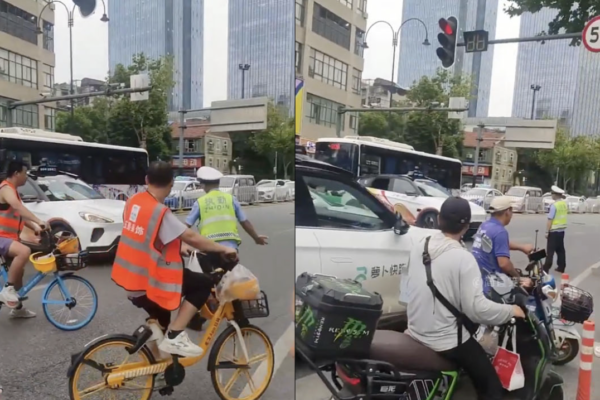
On the evening of March 31st, the self-driving ride-hailing platform “Apollo Go” owned by Baidu, known as “Carrot Run”, experienced a system failure. Multiple passengers in Wuhan had a harrowing experience while riding in the self-driving taxi of “Carrot Run”. The vehicle suddenly stopped in the middle of the road, and the SOS and emergency assistance phone in the car could not be used properly, leaving some people stranded on an elevated road for nearly two hours.
Around 9 p.m. on March 31st, several internet users with IP addresses in Hubei province posted online claiming that the self-driving cars of “Carrot Run” in Wuhan were collectively malfunctioning. Multiple passengers reported being stuck on elevated roads or main roads.
Some netizens commented, “I have seen seven or eight carrots parked with hazard lights on, and the same situation on the elevated road. Is this a strike?” A video circulating online showed a “Carrot Run” car with hazard lights on, halted on the road, causing other vehicles to navigate around it.
According to reports from various mainland Chinese media outlets, starting from 8:57 p.m. on March 31st, nearly a hundred self-driving cars of “Carrot Run” came to a halt on elevated roads in Wuhan, including Yangsigang Changjiang Bridge, Baishazhou Bridge, and the Third Ring Road. The vehicles shut down simultaneously, blocking multiple lanes and causing severe traffic congestion (referred to as “pork liver red” level congestion by Wuhan traffic police). The malfunction lasted for about two hours, leading to complete paralysis in certain areas of traffic.
As reported by “Read News”, a Wuhan resident, Mr. Lu, encountered a similar situation while riding in a “Carrot Run” vehicle. The car came to a stop in the middle of a flyover, flanked by large trucks speeding by. The built-in SOS button was useless as it failed to connect, leaving Mr. Lu feeling terrified. After being stranded for nearly two hours on the vehicle, it eventually moved to the roadside, but Mr. Lu hesitated to exit as he didn’t know where to go.
Mr. Lu repeatedly tried to call the number displayed on the screen in the backseat, but the call was automatically disconnected each time. Despite waiting, he never received assistance from the official helpline. Consequently, he had to resort to calling the police. It wasn’t until around 11 p.m. when the authorities and a driver from “Carrot Run” arrived that he was able to leave safely.
Mr. Lu mentioned that the customer service attributed the incident to a network issue, promising to have a dedicated representative contact him within three days, without mentioning any compensation for the passengers.
Similarly, Ms. Zhou, who was also trapped in a car that night, received a warning in the vehicle to not open the doors due to technical problems shortly before it came to a halt after driving for about 10 minutes. Being on a flyover, she refrained from leaving the vehicle, and no official arrived to assist her. Ultimately, she was still charged the fare, and the customer service didn’t mention anything about compensation.
In the early hours of April 1st, the Wuhan traffic police issued a statement indicating that they had received reports of multiple “Carrot Run” vehicles stuck in the middle of the road starting from 8:57 p.m. on March 31st. The preliminary investigation attributed the cause to a system malfunction.
Industry insiders, as reported by “The Paper”, analyzed that the standstill of “Carrot Run” vehicles was likely triggered by unforeseen circumstances, activating a safety self-check mechanism as a proactive safety measure.
“Carrot Run” was launched by Baidu in August 2021 as a self-driving ride-hailing service platform. It has introduced paid autonomous travel services in some regions, with billing based on distance and duration, and Wuhan was among the first pilot cities.
The incident of the breakdown and stoppage of “Carrot Run” is not unprecedented. In July 2024, there was a similar occurrence where “Carrot Run” vehicles suddenly stopped in peak hours, causing traffic congestion and sparking discussions regarding the safety of autonomous driving technology.