
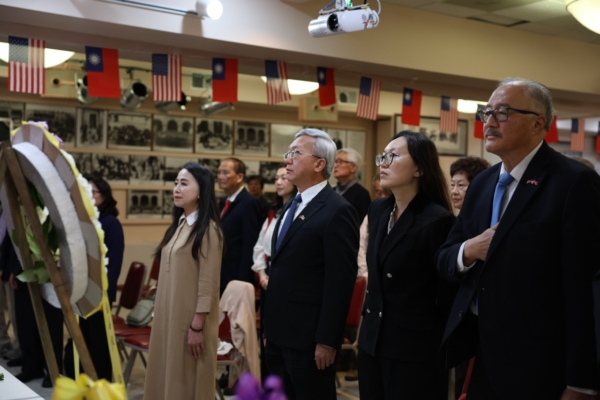
On the occasion of Youth Day on March 29th, the overseas Chinese community in the San Francisco Bay Area held a memorial ceremony at the Golden Mountain Father of the Nation Memorial Hall to commemorate the 72 martyrs of the Huanghuagang Uprising, who sacrificed their lives a hundred years ago to overthrow the Qing Dynasty’s old system and save the nation.
Participants at the event expressed that the spirit of Huanghuagang is not only a part of history but also an indispensable moral force in today’s society, reminding people to cherish freedom and courageously take on responsibilities.
The Huanghuagang Uprising, which took place on March 29, 1911, was an important part of Sun Yat-sen’s leadership in the revolution. Despite the uprising’s ultimate failure, its spirit of sacrifice resonated nationwide and rallied support for overthrowing the Qing Dynasty, directly leading to the success of the Wuchang Uprising in October of the same year and the eventual establishment of the Republic of China.
Originally recorded as 72 martyrs, later research revealed there were actually 86 individuals, many of whom were young people around twenty years old. Therefore, March 29 is also designated as Youth Day, symbolizing the crucial role of the youth in the nation’s destiny.
Against this historical background, many overseas Chinese leaders and politicians delivered speeches at the commemoration event, elaborating on the real significance of the Huanghuagang Uprising from perspectives of historical lessons, spiritual values, and contemporary responsibilities.
Chairwoman Lu Yuzhen of the ceremony stated, “The Huanghuagang martyrs did not see the dawn of victory, but with their lives, they ignited the flames of revolution and awakened the era.”
She emphasized that Youth Day is not just about commemorating but also a reminder for contemporary youth to not forget historical lessons and to remember the peace and freedom earned with the blood of the martyrs.
Lu Yuzhen remarked that the true significance of the memorial ceremony is not just to look back on history but to pass on the patriotic spirit of striving for ideals and sacrificing for democracy.
She urged today’s youth to take the martyrs as examples, “to have a heart for the motherland, shoulder responsibilities, fear no storms, and brave forward.”
During his speech, Vice Consul Zhu Yongchang of the Republic of China in San Francisco specifically mentioned the spirit of sacrifice in the “Farewell Letter to His Wife” by martyr Lin Juemin, showing “sacrificing oneself for the greater good,” which deeply touched him as he aged.
Zhu Yongchang said, “In that era of corruption in the Qing court and oppression by foreign powers, many young people stood up; it was this broader historical context that inspired the youth to join the revolution.”
“Who would willingly abandon their family and risk their lives?!” Zhu Yongchang questioned.
He emphasized that in remembering the martyrs, it is crucial to recognize that youth are vital assets to the nation and society. He called for joint efforts from all sectors of society to encourage youth to assume responsibilities and engage in social affairs.
He also suggested that aging overseas Chinese communities should attract more young people to participate and provide them with leadership opportunities to ensure the community’s continuity.
Executive Director Lin Bingchang of the Chinese Traditional Culture Association stated that the righteous spirit demonstrated in the Huanghuagang Uprising not only influenced the course of the entire Chinese nation but also serves as a “timeless paradigm.”
He noted that many of the Huanghuagang martyrs were teens or in their twenties, and at the outset of their lives, had to bid farewell to their parents, wives, and future, which was particularly poignant.
Lin Bingchang stressed that revolutionaries must possess tolerance and elevate the next generation to achieve great accomplishments. Moreover, he emphasized that national culture should not be severed, stating, “We must promote China’s history and culture… a nation without culture will surely perish.”
Recently elected Central Committee member of the Kuomintang (KMT) Du Lifen expressed that the core of the spirit of the Huanghuagang martyrs is ideals and dedication, values that are increasingly scarce in modern society and need to be promoted overseas.
She shared her experience of returning to Taiwan for elections at the end of last year, admitting that the process was not easy but through it she met many passionate young people engaged in public affairs, including those in the fields of law, philosophy, and social care. She believed that the involvement of the new generation brings hope and vitality to political parties and society.
She also observed that Taiwan has many Youth Day activities but lacks practical significance. In comparison, she believed that the commemoration event that day contributes to sustaining historical memories and values.
She concluded by citing the last will of the founding father, “The revolution is not yet successful; comrades must continue to strive.” She remarked, “I firmly believe that those who strive for the Republic of China are not alone in their virtue.”
A local university student named Mr. Wang, who coincidentally attended the event, stated that the activity allowed him to reacquaint himself with this history.
Mr. Wang left the mainland at a young age, immigrated overseas, and received education influenced by both the Chinese Communist Party and the Three Principles of the People. He found that in education on both sides of the Taiwan Strait, the Huanghuagang Uprising is often glossed over.
He believed that revolution often occurs when reform fails to achieve its goals and in modern society, the majority are complacent, lacking the concept of sacrificing for ideals.
He said, “When we realize that the system no longer suits our pursuit of a happy life, the first step should be reform; when reform cannot achieve its goals, then revolution is necessary.”
Furthermore, he elaborated, “But I think that most people today are in a state where they would just get by, enduring if things get tough, without anyone willing to sacrifice their life to achieve a great dream. You may not see the realization of that dream before you sacrifice your life, but someone has to take that first step, sacrifice themselves, to inspire more people.”
He believed that there are few individuals in contemporary society willing to sacrifice for ideals, which is a significant lesson left by this history for modern individuals. ◇