
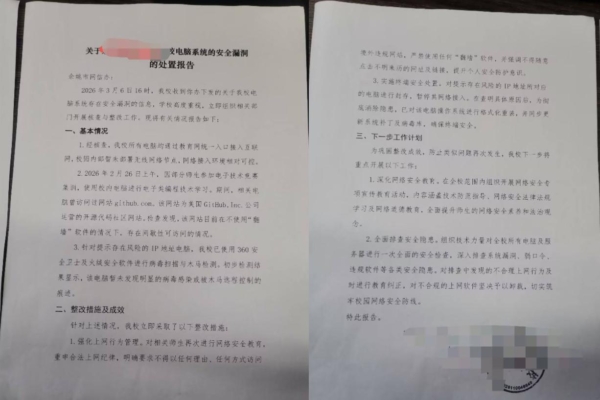
In an internal document leaked from a campus in Yuyao, Zhejiang Province, the local Internet Information Office classified students visiting GitHub as a “security vulnerability,” and ordered the sealing of devices, system formatting, and strictly prohibited teachers and students from accessing foreign internet resources. This move has been criticized for treating normal technical knowledge seeking as a political threat and essentially constituting a comprehensive blockade of information sources.
On March 6, at 4 p.m., the Yuyao Internet Information Office notified the school of security vulnerabilities in its computer system. The school immediately organized an investigation and rectification. Upon inspection, it was found that all computers on campus accessed the internet through the educational network’s unified entrance without deploying a wireless network, making the network environment relatively controllable.
The document titled “Report on Handling Computer System Security Vulnerabilities” revealed that on February 26, students at the school were deemed to have a “security vulnerability” by the local Internet Information Office for visiting the global open-source code platform GitHub during an electronic technology competition training session. The school subsequently took measures such as “sealing computers, formatting hard drives” for rectification.
In response, a network technology expert in Shenzhen, Su Yi (pseudonym), expressed in an interview with reporters that the actions of the Yuyao Internet Information Office were not addressing “vulnerabilities” in the professional field but rather a form of “political detoxification.” He stated, “Even if you just glance at the outside world, your hardware and thoughts are considered ‘contaminated’ and must be erased.”
Despite the school stating in the report that the website was intermittently accessible without using any “wall-climbing” tools and students only visited for learning purposes, the Yuyao Internet Information Office still classified it as a “security vulnerability” requiring rectification.
Under pressure from the Internet Information Office, the school implemented multiple rectification measures: sealing and reformatting relevant computers, prohibiting teachers and students from accessing foreign internet resources in any way, strictly prohibiting the use of circumvention software, conducting inspections of all school servers, and providing education and correction for non-compliant internet usage behavior.
A technical staff member in the network engineering department of the Shijiazhuang branch of the Industrial and Commercial Bank of China, Ge Bin (pseudonym), stated in an interview that GitHub is an important platform for global programmers, with many open-source technologies, AI code, and academic resources concentrated there. He commented, “Considering visiting GitHub as a security vulnerability is equivalent to considering reading an encyclopedia as a violation.”
Ge Bin further pointed out, “This reflects that the administrative power of the Chinese Communist Party’s Internet Information Department has surpassed basic education and technical logic, isolating the next generation from the global technical environment.”
At the same time, the school requested in the report that teachers and students avoid visiting foreign websites, seal and cut off networks for IPs with risks, reinstall and update protective measures for the system after inspection.
Ge Bin added that using methods like “formatting hard drives,” typically used to handle viruses or intrusions, to deal with normal browsing behavior indicates that grassroots units have overreacted under administrative pressure.
Professor Feng, a social scholar in the United States, stated that the relevant reports show that schools are showing a high degree of compliance under rectification pressure. He said, “Authorities are trying to establish boundaries in students’ perception to make them wary of external sources of information.”
He added, “Under the influence of administrative pressure, the campus environment may gradually shift towards control, placing restrictions on exploration and learning spaces.”
In recent years, as the Chinese Communist Party has continued to strengthen its internet management, crackdown reports targeting visits to foreign websites have occasionally surfaced in schools at all levels. Observers have pointed out that when technical learning is included in the realm of risk management, the education system and knowledge acquisition methods are undergoing changes.