
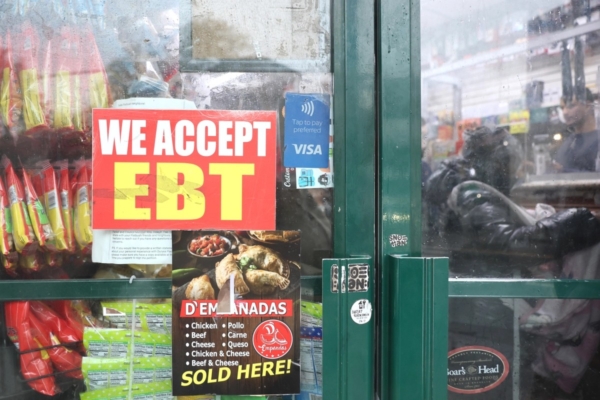
A man used Electronic Benefit Transfer (EBT) cards to purchase a large quantity of Pepsi cola beverages.
Last September, a document filed by the Northern District of Illinois Court described the experience of resident David Quinones shopping at a store referred to as “Retailer A,” while local law enforcement was monitoring him.
The statement said, “The defendant used three different EBT cards to purchase goods including approximately 20 cases of Pepsi cola. Later that day, the defendant drove to another Retailer A store in Calumet City, Illinois. Once again, the defendant used three different EBT cards to purchase goods including approximately 20 cases of Pepsi cola, totaling $211.32.”
The statement continued, “After purchasing these items, the defendant transported them to a gas station in Chicago for resale profit. … On February 6, 2020, law enforcement again monitored the Evergreen Park Store, Retailer A’s store. Around 7 p.m. that evening, the defendant used three EBT cards to purchase 139 cases of soda.”
The statement mentioned, “The defendant also used his EBT card at another retailer (Retailer B) to open multiple accounts in his name for in-store shopping.”
On February 4 this year, Quinones signed a plea agreement, admitting to committing wire fraud in this case.
The plea agreement stated, “Quinones paid cash or other ways to SNAP (Supplemental Nutrition Assistance Program) beneficiaries to obtain their EBT cards and PINs fraudulently to use these EBT cards to obtain SNAP benefits dishonestly. Quinones then impersonated authorized users, using these EBT cards and PINs to make purchases at Retailer A and Retailer B. However, these goods were not provided to SNAP beneficiaries. Instead, Quinones sold some of the goods and kept the proceeds for himself, retaining the remaining goods.”
The plea agreement stated, “Quinones’ fraudulent use of EBT cards led to the United States Department of Agriculture repaying thousands of fraudulent SNAP transactions to Retailer A and Retailer B, involving over 1,200 EBT cards allocated to over 5 SNAP beneficiaries.”
How much loss has the abuse of the food stamp program caused to American taxpayers?
Overall, due to Quinones’ fraudulent SNAP transactions, the USDA paid approximately $1,554,804 in SNAP benefits.
According to Zillow real estate transaction website data, the average home price in Calumet City, Illinois (where Quinones repeatedly engaged in fraudulent consumption using EBT cards) is $151,309. This means that the $1,554,804 in SNAP funds obtained through fraudulent means could purchase 10 properties in that area.
According to the U.S. Attorney’s Office press release this month, a federal district judge sentenced Quinones to four years and four months in prison for fraud. The judge also “ordered him to pay $1,554,804 in restitution to the government.”
So, how many fraud and theft incidents occur each year through the abuse of the food stamp program? Unfortunately, related data is very limited.
In September last year, the Government Accountability Office (GAO) released a page on its website titled “Stolen SNAP Benefits Cost Beneficiaries Millions.” This page linked to a report released by the GAO in September last year.
The report stated, “The information available to the USDA’s Food and Nutrition Service (FNS) about the extent of SNAP Electronic Benefit Transfer (EBT) theft is limited. According to the FNS, state SNAP agencies are not obligated to report data on stolen benefits other than during the statutory period from October 1, 2022, to December 20, 2024.
The report mentioned, “During this period, state SNAP agencies issued over $320 million in stolen benefits to nearly 679,000 households across 52 states with federal funds. However, this data does not represent all cases of stolen SNAP benefits. Instead, these data reflect unauthorized transaction data, where beneficiaries submitted claims for these transactions and ultimately received approval. But some beneficiaries whose benefits were stolen may not be aware of this procedure and may not have filed claims.”
This statistic also cannot cover cases where individuals purchase the usage rights of another’s EBT card and profit from using that card.
As previously noted in this column, the population receiving SNAP benefits is unevenly distributed nationwide. According to the USDA, in 2024, New Mexico had the highest percentage of its population receiving food stamps, at 21.2%.
The District of Columbia ranked second with 19.6% receiving, Louisiana ranked third at 18.4%, Oregon ranked fourth at 17.7%, Oklahoma ranked fifth at 16.8%, West Virginia ranked sixth at 15.7%, Massachusetts ranked seventh at 15.6%, Nevada ranked eighth at 15.5%, Pennsylvania ranked ninth at 15.3%, and Illinois ranked tenth at 15.2%.
Among the states with the lowest food stamp participation rates, Utah had the lowest at only 4.8% of its population receiving SNAP benefits. Wyoming had the second-lowest food stamp participation rate at 4.9%. New Hampshire ranked third lowest at 5.5%; North Dakota ranked fourth lowest at 6.1%; Kansas ranked fifth lowest at 6.3%; Idaho ranked sixth lowest at 6.5%; Montana ranked seventh lowest at 7.2%; Nebraska ranked eighth lowest at 7.7%; Arkansas and Minnesota tied for ninth at 7.8%; and Iowa ranked tenth lowest at 8%.
According to data released by the USDA, in the 2024 fiscal year, the “average monthly number of participants” receiving SNAP benefits was 41.7 million people. That year, the government spent $99.788 billion on the program.
Congress not only needs to eliminate fraud in the SNAP program but also gradually phase out the program itself. Only by doing so can the United States return to a culture of self-sufficiency that existed before the establishment of the program by the 36th President of the United States, Lyndon Johnson in 1964, with the signing of the Food Stamp Act.
Terence P. Jeffrey is the editor-in-chief of CNS News.
*End of the news article.*