
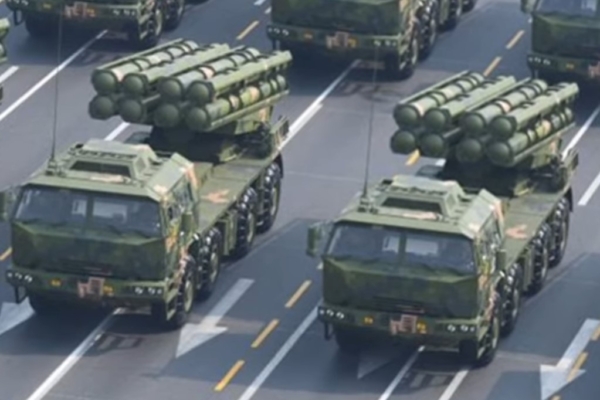
In a rare and unprecedented move, there has been a significant personnel shake-up in the Chinese military-industrial complex over the past three years, involving top leaders from the People’s Liberation Army Rocket Force, high-ranking executives from state-owned military enterprises, and government officials with military-industrial backgrounds. The recent removal of a large number of military-backed academicians from the Chinese Academy of Sciences and the Chinese Academy of Engineering has raised eyebrows and sparked speculation about the underlying reasons for these actions.
The Chinese Academy of Sciences and the Chinese Academy of Engineering, collectively known as the “Two Academies,” are prestigious institutions in China. Membership as academicians is considered the highest academic title in the Chinese Communist Party, carrying lifelong honor. Academicians are typically only advised to retire or have their memberships revoked in cases of serious academic misconduct or legal violations.
Over the past three years, at least 10 military-backed academicians have been stripped of their memberships, including prominent figures like Liu Guozhi, Yang Wei, and Liu Cangli from the Chinese Academy of Sciences, as well as Xiao Longxu, Luo Qi, and others from the Chinese Academy of Engineering. These academicians have backgrounds in fields such as high-power microwave technology, aircraft design, nuclear weapons development, and missile guidance systems.
In March 2026, the personal information of Liu Guozhi, a former director of the Military Commission’s Science and Technology Committee and an academician of the Chinese Academy of Sciences specializing in high-power microwave technology, was removed from the official website of the Chinese Academy of Sciences. Similarly, Yang Wei, known as the “Father of the J-20 Fighter Jet,” was also removed from the list of academicians of the Chinese Academy of Sciences in the same month.
The wave of dismissals also affected figures like Liu Cangli, who previously served as the Director of the China Academy of Engineering Physics and focused on nuclear weapons and advanced conventional weapons research, and Luo Qi, a leading figure in China’s nuclear reactor field who held the position of Chief Engineer at the China National Nuclear Corporation.
In addition to the academic realm, the military-industrial academic community has also experienced a series of deaths or suspected deaths recently, raising questions about a possible connection to the ongoing purge.
One such case involved Sun Yu, an academician of the Chinese Academy of Engineering and an expert in communication technology, who passed away in Beijing at the age of 89 in March due to ineffective medical treatment. Sun Yu was a veteran figure in the China Electronics Technology Group and was known for his contributions to the development of remote control systems for China’s first atomic bomb test.
Another notable figure, Li Youping, an academician of the Chinese Academy of Engineering specializing in electronic and communication technology, passed away at the age of 91 in March in Beijing due to ineffective medical treatment. Li Youping was widely recognized as one of the pioneers of China’s first-generation nuclear missile telemetry system.
Similarly, Wei Zhengyao, an academician of the Chinese Academy of Engineering and an expert in military information technology, passed away in Beijing at the age of 90 in March due to ineffective medical treatment. Wu Dexin, an academician of the Chinese Academy of Sciences and a microelectronics scientist, also passed away in Beijing at the age of 90 in March due to ineffective medical treatment.
These sudden deaths among prominent military-industrial figures have raised suspicions and led to speculation about possible connections to the ongoing purge within the sector.
Furthermore, the dismissal of high-ranking officials in the military-industrial complex has extended to individuals who have transitioned to roles in the party-state system after leaving the military-industrial sector.
Among these individuals is Ma Xingrui, a current member of the Political Bureau of the Central Committee of the Communist Party of China and former Secretary of the Xinjiang Autonomous Region Committee. Ma, who previously held positions in the aerospace field and served as the General Manager of the China Aerospace Science and Technology…
(Continued in next message)