
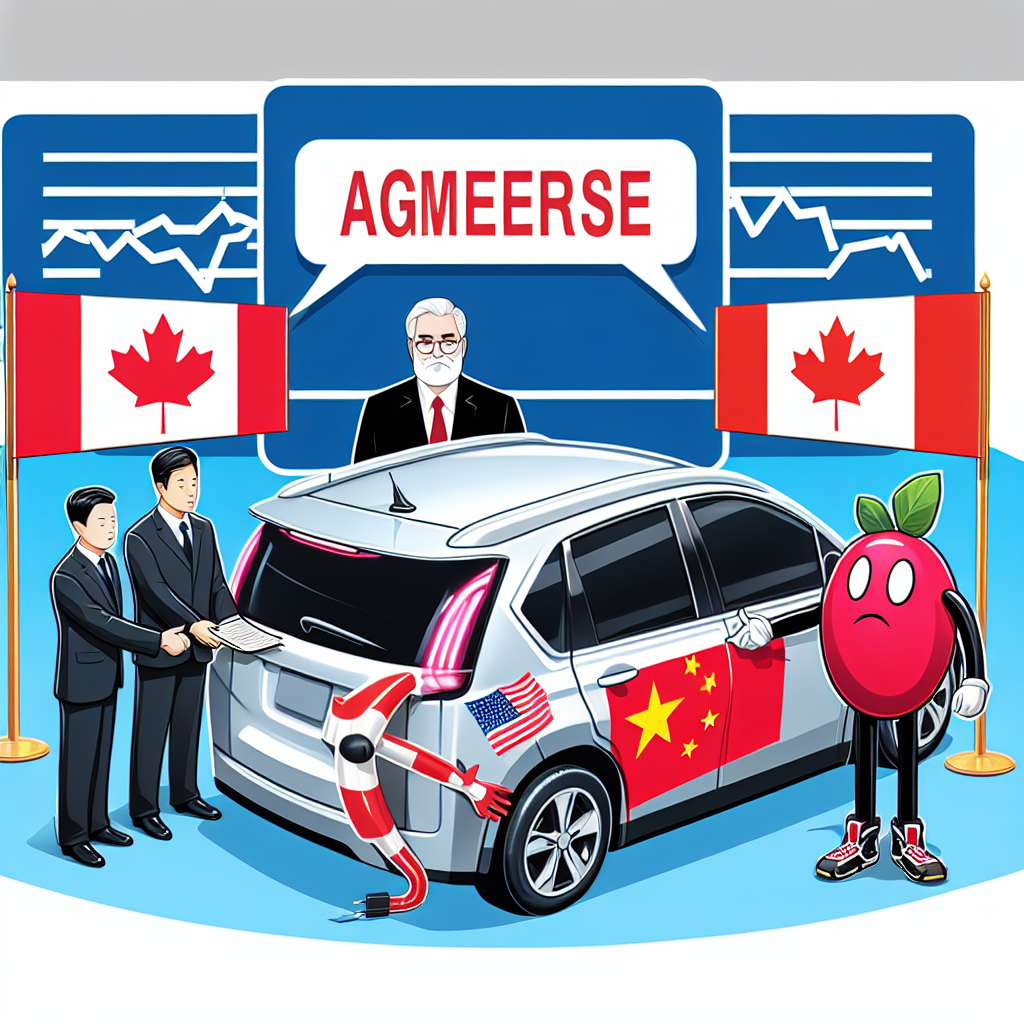
In January this year, Canadian Prime Minister Mark Carney reached an agreement with the Chinese Communist Party to reduce tariffs on electric vehicles. In response, the U.S. Ambassador to Canada stated that the United States will not allow Chinese electric vehicles from Canada to enter the U.S. market due to serious security concerns.
Ambassador Pete Hoekstra emphasized in an interview with Canadian “Rebel News” that, “These Chinese electric vehicles can enter Canada, but they absolutely cannot cross the U.S.-Canada border into the United States. This is something that must not happen.”
He pointed out that due to security issues arising from the collection and transmission of data by vehicles, “We will never allow Chinese vehicles from Canada to enter the United States.”
The White House did not immediately respond to media requests for comments on this matter. Additionally, Hoekstra did not specifically clarify whether this means legally imported Chinese vehicles into Canada will be denied the necessary documentation for resale in the U.S., completely banned from crossing the border, or face other forms of administrative intervention.
Currently, the U.S. has implemented new regulations to strictly limit the sale or import of internet-connected vehicles using Chinese and Russian technologies.
Hoekstra stated in a podcast program, “You have not suffered any harm due to tariffs.” He explained that apart from specific industries such as automobiles, lumber, steel, and aluminum, as long as Canadian goods are traded in accordance with the rules of the United States-Mexico-Canada Agreement (USMCA), they can still be exempt from U.S. tariffs.
In 2024, following the policy of the Biden administration at the time, the Canadian government led by Justin Trudeau imposed tariffs of up to 100% on electric vehicles from China. Subsequently, China retaliated by imposing additional tariffs on key Canadian agricultural products.
After Trudeau stepped down, the newly appointed Prime Minister Carney visited China in January this year and reached a new tariff agreement with the Chinese Communist Party, reducing tariffs on Chinese electric vehicles from 100% to 6.1%, with an annual import quota of 49,000 vehicles.
As a trade-off, China agreed to reduce import tariffs on certain Canadian foods, including canola seeds and lobster.
While former President Trump repeatedly expressed his desire for the automotive manufacturing industry (which has long been highly integrated along the U.S.-Canada border) to return to domestic manufacturing in the U.S., Hoekstra stated that moving car factories south to the U.S. is not an “inevitable” outcome.
He pointed out that when U.S. officials seek to reshape global trade relations, Canada is not the primary target for the U.S. “Canada is not the root of our automotive issues. You can make a strong case to the U.S. Trade Representative as to why Canada should be placed in the lowest tariff category.”
He emphasized that the majority of vehicles manufactured in Canada contain a very high percentage of U.S.-made components. “Cars crossing the border have 50% to 75% U.S. manufacturing content. These are the imported vehicles we welcome.”
He added, “Our biggest threat in terms of automobiles comes from South Korea, Japan, and Mexico. We can take some measures to bring automotive manufacturing (from these countries) back to the U.S. Additionally, we must understand that China (the CCP) is our biggest threat.”
(This article referenced reports from Bloomberg)