
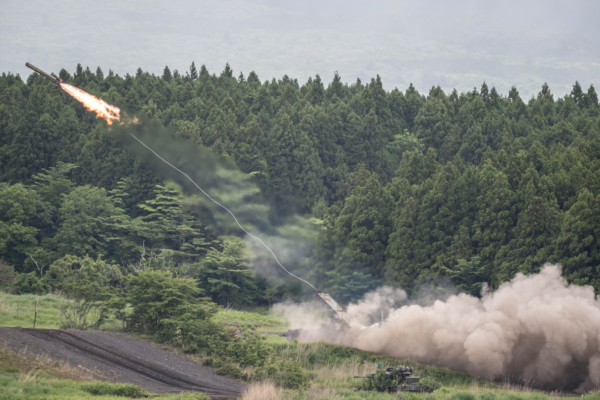
The Japanese government announced on Tuesday (March 31) that it has deployed its first long-range missile at the Ground Self-Defense Force base in Kumamoto Prefecture in southwestern Japan. The aim of this deployment is to enhance Japan’s deterrence and counterattack capabilities.
According to reports by the Associated Press, this upgraded Type 12 anti-ship missile, developed and manufactured by Mitsubishi Heavy Industries in Japan, is now operational at the JS Ketagawa base in Kumamoto.
Japanese Defense Minister Taro Kono stated to reporters, “Japan is facing the most severe and complex security environment since World War II… This capability is crucial for strengthening Japan’s deterrence and response capabilities. It demonstrates Japan’s firm determination and capability to defend itself.”
The upgraded Type 12 missile has a range of approximately 1,000 kilometers (620 miles), a significant extension from the prototype’s 200-kilometer (125-mile) range, allowing coverage of the Chinese coastline and much of the East China Sea, including the northeastern part of the Taiwan Strait.
This deployment of long-range missiles equips Japan with the ability for “stand-off attacks,” enabling strikes on enemy missile bases from a distance, marking a shift from Japan’s long-standing purely defensive posture under its peace constitution.
In addition to deploying the first long-range missile in Kumamoto, Japan also deployed a new weapon system designed for island defense – the Hypersonic Glide Vehicle (HGV) at the base in Fuji, Shizuoka Prefecture, west of Tokyo. Japan plans to further deploy upgraded Type 12 missiles and HGVs in other locations, including Hokkaido and Miyazaki, by March 2028.
Furthermore, Japan plans to deploy U.S.-made Tomahawk missiles with a range of 1,600 kilometers (990 miles) on the JS Chokai escort vessel later this year, and ultimately on seven other escort vessels.
Japan considers China to be the primary security threat in the region and has been strengthening defense capabilities on its southwestern islands near the East China Sea in recent years.
The government led by Prime Minister Sanae Takahichi approved a record-breaking defense budget last December, exceeding 9 trillion yen ($80 billion), for the fiscal year starting in April, aiming to enhance Japan’s coastal defense and counterattack capabilities through cruise missiles and unmanned weapon systems.
In June last year, Japan first detected two Chinese aircraft carriers operating near Japanese islands in the Pacific Ocean, highlighting Beijing’s military activities extending beyond its borders and causing concerns in Tokyo.
Last week, Defense Minister Taro Kono announced the establishment of a new office dedicated to countering Chinese military threats in the Pacific.
In November last year, Prime Minister Sanae Takahichi mentioned in a parliamentary inquiry that an invasion of Taiwan could pose a crisis for Japan’s survival, possibly prompting Japan to exercise its collective self-defense rights. This statement by Takahichi sparked reactions from China, escalating tensions between China and Japan.