
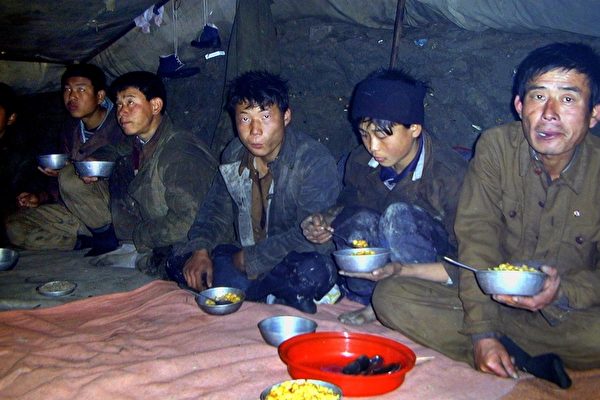
According to a report by an international human rights organization, more than 100,000 North Korean workers are currently deceived by the Kim Jong-un regime to work overseas under extremely harsh conditions. However, their hard-earned money is ruthlessly extorted by the North Korean authorities, with the level of exploitation leaving people shocked. Some North Korean workers have told investigators that they live a life worse than livestock.
Global Rights Compliance, an international human rights organization, released a new report along with interviews conducted by Fox Digital News, exposing the firsthand experiences of North Korean workers exported by Kim Jong-un to Russia and revealing how North Korea’s national quota system systematically extorts their wages.
One North Korean, identified only by the initials RT for protection, shared his ordeal with Fox Digital News. He was a victim of Kim Jong-un’s forced labor program overseas.
“Every morning before 6 a.m. in the harsh Russian winter, we would wake up and walk to the construction site together. We would work from 7 a.m. until 10 or 11 p.m., sometimes even until midnight. There was no rest time, no fixed quitting time. We could only stop when the task was completed. Rain or snow didn’t matter. We worked without gloves, heating, or any protective gear. My hands were so cracked that I couldn’t even grip tools, but you couldn’t stop,” he said.
“They told me I could earn money,” RT recalled. “That was all they said. No one mentioned quotas. No one told me that most of the money I earned would be taken away. I thought if I worked hard in Russia, I could save enough money to improve my family’s life. But once I got there, I realized it was all a lie. The money I earned was not mine and would never belong to me.”
Yeji Kim, North Korea Affairs Consultant at Global Rights Compliance, told Fox Digital News, “All North Korean workers sent overseas must pay a mandatory monthly fee to the state, known as the national quota. As one worker told us, this money ‘must be paid even in life or death situations.'”
Kim stated that an ordinary worker can earn around $800 per month, working up to 420 hours. However, $600 to $850 is deducted as national quota fees, in addition to travel and collective living expenses, leaving only about $10. If a worker fails to meet the quota, the shortfall accumulates, resulting in some individuals carrying debt for a whole year.
One worker described the quota paid to the government as a “heavy burden” that impacts every aspect of their life overseas.
“We have to pay every month,” RT said. “There’s no negotiation. If you don’t meet the quota, the debt carries over to the next month. We were told, ‘You must meet the quota at all costs, even if it means putting money from your own pocket.’ You come here to earn money, but in the end, you have nothing. If you fail to meet the quota too many times, they will send you back home. But going back home doesn’t mean freedom; it means being blacklisted, interrogated, and sometimes even your family paying the price.”
Kim emphasized the significance of the overseas labor program for the North Korean economy, stating that the UN expert panel estimates the program alone brings in approximately $500 million annually for the Kim Jong-un regime. In a country facing the most comprehensive UN sanctions in history, this revenue is crucial, sustaining the ruling elite, funding internal networks of power, and supporting military ambitions including nuclear weapons development.
The report from Global Rights Compliance highlighted testimonies from 21 North Korean workers in three cities in Russia, revealing 11 indicators of forced labor recognized by the International Labor Organization (ILO), including debt bondage, restriction of movement, wage deductions, excessive overtime, physical violence, surveillance, deception, isolation, abuse of vulnerable groups, and harsh working conditions.
Instances of physical violence were reported, with one worker in a particular case being severely beaten to the point of being unable to work for two weeks. On-site surveillance was constant, using collective punishment to force workers to monitor each other.
Workers described living in overcrowded shipping containers infested with cockroaches and bedbugs, showering only once or twice a year, with some workers having only one day off per year. One worker told investigators that they were forced to “live worse than livestock.”
The report also revealed that upon arriving in Russia, workers’ passports are immediately confiscated and held by North Korean security officials. During police inspections at the worksite, paper passports are distributed individually to each person and collected back once the inspection is over.
“My passport was confiscated on the day I arrived, and I never got it back,” RT said.
These findings vividly illustrate how the Kim Jong-un regime maintains its survival under UN sanctions: by exporting its citizens as laborers, exploiting their wages, and maintaining full control over overseas workers.
RT, who escaped the North Korean labor system, feels obligated to speak out now.
“We are ordinary people just like you, but we work like cattle. We all have families. We left our homeland to give our children a better life, but what we found is a system that takes everything from us.”
He mentioned that tens of thousands of people are still trapped in this exploitative system.
“I hope everyone understands that at this moment, some people on construction sites in Russia work 16 hours a day, sleep in containers, earn no money, cannot call home, and cannot leave. Their names are not in any reports, no one knows they are there, but they are indeed there. If I could say one thing to them, it would be – the world is starting to listen, please hold on.”
The report from Global Rights Compliance stated that the process of North Korea sending laborers overseas is neither transparent nor voluntary in any meaningful way.
Recruitment is carried out through a highly centralized command system, starting from Pyongyang and extending through various ministries, provincial governments, and local party and governmental bodies.
All positions are not openly advertised.
Travel by these workers must be done in a team format and supervised by political officers or translators responsible for monitoring behavior and risks of defection.
“Even though workers physically cross national borders, they do not break free from the North Korean system,” the report said. “Their actions, document processing, and interactions with the local society are under strict control. Hence, sending laborers overseas is not about relaxing control but strengthening it.”