
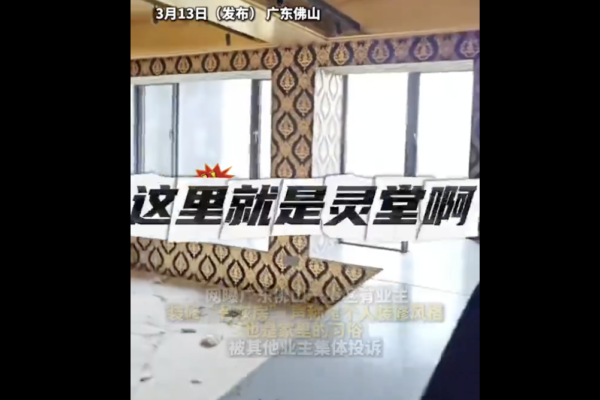
Amid the cooling real estate market and declining house prices while cemetery prices continue to rise, a large number of “ash storage houses” have emerged in various parts of China, where residents store cremated remains, causing anxiety among the surrounding communities.
On March 30, the newly revised “Funeral Management Regulations” of the Chinese Communist Party (referred to as the Regulations) came into effect. The Regulations prohibit residents from specifically using residential housing for cremains storage. Chinese issues expert Wang He stated that the background for this amendment of the funeral regulations is the popular saying in recent years among Chinese people that “even death is unaffordable”. By officially introducing a regulation to strengthen supervision over “ash storage houses”, the Chinese Communist Party is seen as merely scratching the surface, according to Wang He.
Doctoral student Wu Xinyi from University of California, Irvine, mentioned in her research that “the new law may deter real estate or property enterprises from openly selling ‘ash storage homes’, but some families may continue to do so privately.”
Mainland Chinese netizens have been discussing the issue, with comments such as “treating the symptoms without addressing the root cause, it’s completely upside down,” and “without exorbitant grave plots, where would these ash storage houses come from?” and “The Civil Affairs Bureau should not be an accomplice to profiteering. The chaos in the funeral industry directly leads to the inability of the living to afford death; we must think of alternative solutions.”
Public reports show that as early as 2017, in a small community in Rugao, Jiangsu, property owners gathered to protest against “ash storage houses”. In recent years, the chaos surrounding “ash storage houses” has been escalating, with a facility in Tianjin Binhai New Area, built under the guise of “family ancestral hall”, storing tens of thousands of cremation remains, resembling ordinary residences. Similar incidents have been observed in residential communities in Hebei and Jiangsu, where during memorial periods, the concentration of incense and activity has disturbed the neighboring residents. On March 15, 2025, protests erupted in the Tianyu Riverside community in Foshan, Guangdong, when 15 houses were suspected to have been converted into “ash storage houses” and operated publicly.
The so-called “ash storage houses” refer to residences that some individuals purchase or own as vacant properties, which are then renovated to house cremated remains. These properties are mostly located in third or fourth-tier cities or urban-rural fringe areas, with some being transformed into familial ancestral halls, capable of storing dozens or even hundreds of urns. These spaces are rarely occupied, only seeing activity during traditional memorial periods like Qingming.
According to a report by the Financial Times, the phenomenon of “ash storage houses” is closely related to the tight supply and demand and high prices of cemetery plots. Against the backdrop of a cooling real estate market where house prices are falling in some areas, cemetery prices continue to rise. Additionally, the limited usage period of cemetery plots and the high cost of maintenance make residential housing a lower-cost alternative.
Based on a 2020 global survey by insurance institution SunLife, the average funeral expenses in China are around 37,000 RMB, accounting for approximately 45% of the average annual salary, making it the second highest globally after Japan.