
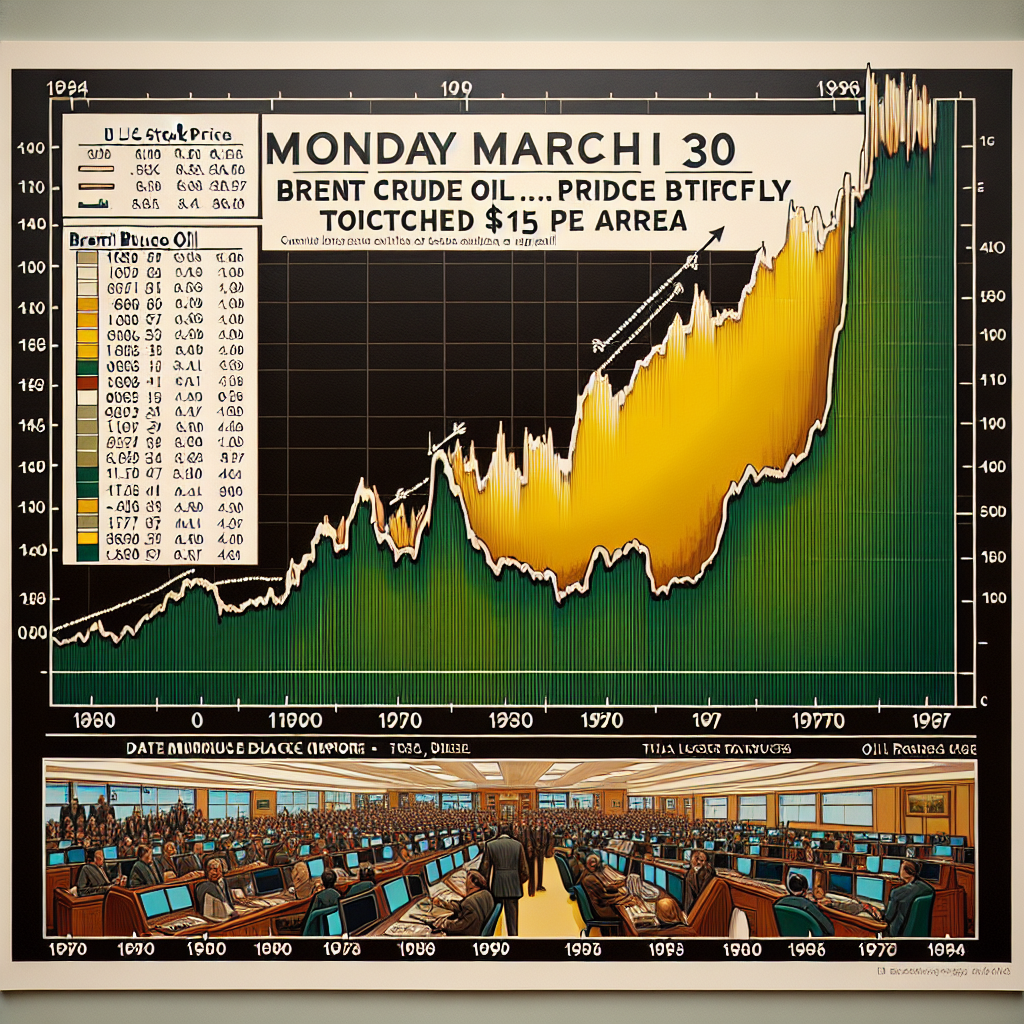
On Monday, March 30, the price of Brent crude oil once touched $115 per barrel. However, despite this surge, the U.S. stock market saw gains on Monday, reclaiming some lost ground.
According to data from Oilprice.com and FactSet, the international benchmark Brent crude oil price briefly rose to $115 per barrel on Monday before retreating to $107.95 per barrel. The U.S. benchmark West Texas Intermediate crude oil price rose by 2% to $101.70 per barrel.
In March, Brent crude oil prices have soared by over 55%, potentially marking the largest monthly increase in history.
President Trump warned Iran on Monday, stating that unless they reopen the Strait of Hormuz, the U.S. would destroy their oil wells, power plants, and Khark Island.
Nevertheless, the U.S. stock market saw gains on Monday, recovering some lost ground. The S&P 500 index rose by 0.6% in early trading, following its worst week since the outbreak of the Iran conflict. As of 11 a.m. Eastern time, the Dow Jones Industrial Average rose by 381 points, up 0.85%; the Nasdaq Composite Index increased by 0.3%.
Previously, after five consecutive weeks of decline, the Dow Jones Industrial Average entered a correction phase last week. On Monday, Wall Street’s focus was on Trump’s more positive declarations.
Trump posted on the Truth Social platform on Monday, stating, “The U.S. is engaging in serious negotiations with a new, more reasonable regime to end our military actions in Iran.”
CBS News reported that Chris Larkin, Managing Director of Trading and Investments at E*TRADE under Morgan Stanley, mentioned in an email that the stock market continues to face the dual challenges of rising oil prices and political uncertainties. He emphasized that most geopolitical impacts on the market tend to be relatively short-lived, but without clear signs of an end to the Iran conflict, the market would struggle to maintain its upward momentum amidst current volatility.
Mohamed El-Erian, Chief Economic Adviser at Allianz, noted on CNBC’s “Squawk Box” regarding market sentiment, “We still believe this is temporary, with definite short-term impacts, but we should overlook these effects.” He added that investors have not taken into account the limited “policy flexibility” resulting from the war.
With the Persian Gulf conflict in constant flux over the weekend, the timing of its resolution remains uncertain. Oil prices have risen, causing market rebounds. Global investors are closely watching whether the oil and gas supply in the Persian Gulf can return to normal to prevent soaring inflation.
According to CBS, some economists suggest that if the Federal Reserve considers oil prices too high and needs to raise borrowing costs to control inflation, the risk of the Fed maintaining or even increasing benchmark interest rates is increasing. Higher rates help to curb inflation but can also drag down economic growth and lower the prices of various investments.
Amid these concerns, U.S. Treasury yields have been steadily climbing in the bond market since the outbreak of the war but saw a slight retreat on Monday.
In recent weeks, traders have been worried that rising energy prices could harm the economy. El-Erian believes that the next economic inflection point will be a “physical shortage.” He stated on Monday, “If Asia starts to experience this situation, it will have an impact on the U.S.”
He continued, “The U.S. will now have to import products at higher prices, the question is, will we also see disruptions in product supply?”