
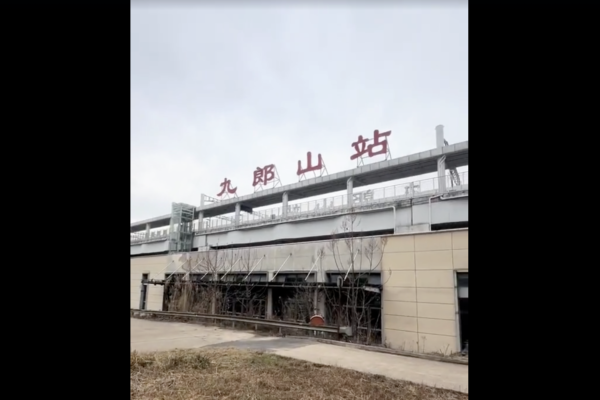
China’s high-speed rail network has been criticized for wasteful investments, with many high-speed rail stations being built but left unused across the country. One such station, the Jiulangshan High-Speed Rail Station in Zhuzhou City, Hunan Province, which cost over a hundred million yuan to build, has seen minimal daily passenger flow since it opened at the end of 2016, with only single-digit numbers of passengers per day. It has been idle for four years since it was shut down in March 2022.
Local residents in Zhuzhou expressed that there are hardly any people around the station. Driving from downtown Zhuzhou to Jiulangshan Station takes 30 to 40 minutes, and only a few nearby residents may use it. The area around the station is mountainous, with a sparse population mostly living in private homes, lacking significant industrial development nearby.
According to Zhuzhou City’s Transportation Bureau, the main reason for halting operations at the station is the extremely low passenger flow, with daily passenger numbers only in single digits.
Due to low usage and insufficient daily maintenance, despite looking relatively new inside, the exterior of the Jiulangshan Station has shown signs of aging, with walls peeling off.
In January this year, some people took to the internet to question the closure of Jiulangshan Station and whether it could be reopened. The Transportation Bureau of Zhuzhou City responded that based on a survey by the Hunan Inter-City Railway Company, Jiulangshan Station is currently not considering reopening.
Chinese netizens have raised doubts, questioning how such a project was approved in the first place and what purpose it serves to build a station in such a location.
These abandoned and unused high-speed rail stations in China are dubbed as “ghost stations” by internet users and are prevalent throughout the country. For instance, the Zhouchun East Station of Zibo, Shandong, has remained unused for 16 years since its completion, ranking as the top ghost station in China.
Official reports also mention that there are over 20 similar sites nationwide, such as the Wutong Station on the Guiyang-Guangzhou High-Speed Railway located in Wutong Town, Lingui District, Guilin City, which commenced operations in March 2018 but was shut down in 2022, with its square in front of the station briefly being used by local farmers to dry grains. In Nanjing, Jiangsu Province, the Zijinshan East Station in Qixia District and the Jiangpu Station in Pukou District, completed in 2010 and 2011 respectively, have yet to be put into use, earning the moniker of the “two deserted stations in Nanjing” by netizens.
Despite these instances, on December 26 last year, the Xi’an to Yan’an High-Speed Railway officially opened, with state media lauding the so-called achievements of China’s high-speed rail system, claiming that China’s operational high-speed rail mileage had exceeded 50,000 kilometers, ranking it as the world’s number one, according to China Central Television.
However, what official media failed to mention is that China’s high-speed rail projects are burdened with substantial debt. As of the end of 2024, the total debt of China National Railway Group reached 6.2 trillion yuan, with a debt ratio of 63.52%.
Hong Kong’s Ming Pao pointed out that only a few high-speed rail lines in China, such as Beijing-Shanghai, Beijing-Tianjin, Shanghai-Hangzhou, Shanghai-Nanjing, Ningbo-Hangzhou, and Guangzhou-Shenzhen-Hong Kong, which are located in economically developed and densely populated areas, are profitable, accounting for only about 5% of the country’s total high-speed rail mileage.
Observer Net with official background reported on May 11, 2024, that as of the end of 2023, China’s operational high-speed rail mileage totaled 45,000 kilometers, with profitable mileage only at 2,300 kilometers, accounting for 6% of the total mileage on lines like Beijing-Shanghai, Beijing-Tianjin, Shanghai-Hangzhou, Shanghai-Nanjing, Ningbo-Hangzhou, and Guangzhou-Shenzhen-Hong Kong.
The Wall Street Journal previously reported that the Chinese authorities have been following a pattern of sustaining economic growth through infrastructure spending, even when the country already possesses most of the necessary infrastructure. This approach has now created a “vast money pit.” The report raises questions about whether China truly needs so many high-speed rail projects.