
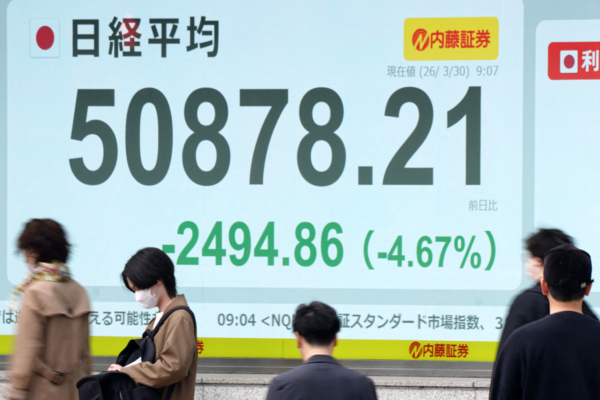
Middle East conflict has entered its fifth week, with the Houthi group in Yemen launching missiles towards Israel over the weekend, marking their direct involvement in the ongoing hostilities. This escalation has led to a surge in global market risk aversion sentiments, causing sharp declines in Asia-Pacific stock markets on Monday. South Korea’s KOSPI and Japan’s Nikkei 225 indices both experienced drops of over 5% at the opening.
On Saturday, the Houthi armed group targeted sensitive military sites in Israel with ballistic missiles for the first time since the conflict began. Houthi spokesman Yahya Saree stated on the social platform X that the missiles were launched to support Iran and Hezbollah in Lebanon, signaling a further escalation of the conflict and shattering hopes for a quick resolution in the Middle East.
Amid geopolitical turmoil, Japan’s Nikkei 225 index plummeted by 5.1% shortly after opening, with electronic and banking stocks bearing the brunt of the impact. Shoji Hirakawa, Chief Global Strategist of Tokai Tokyo Intelligence, noted to Bloomberg that expectations of prolonged conflict in the Middle East will continue to weigh on the Japanese stock market.
In addition to geopolitical pressures, Monday in Japan coincided with ex-dividend dates for many companies, exerting significant downward pressure on the indices. According to Bloomberg data, dividend adjustments led to a reduction of approximately 357 points in the Nikkei 225 index and an expected decrease of around 35 points in the Topix index.
Meanwhile, South Korea’s benchmark KOSPI index also experienced a sharp decline of over 5% at the opening, with the Kosdaq index representing small-cap stocks falling by 3.97%. Australia’s S&P/ASX 200 index dropped by 1.46%, Taiwan’s weighted index fell by 2.3%, Hong Kong’s Hang Seng index decreased by 1.52%, and the Shanghai-Shenzhen 300 index declined by 0.77%.
Globally, there has been a noticeable shift in investor sentiment, with traditional safe-haven asset allocations proving ineffective. Analysts point out that standard defensive measures have failed in preventing the current downturn.
Wee Khoon Chong, Senior Asia-Pacific Market Strategist at BNY Mellon Bank in New York, highlighted in a client report that the market behavior clearly reflects a shift towards capital preservation. He noted, “Assets that have performed well recently are increasingly vulnerable to profit-taking and position closures. However, due to concerns about rising inflation pressure, funds are unlikely to significantly shift towards fixed-income assets.”
Consumer confidence in the United States has fallen to a three-month low, with inflation expectations surging due to rising oil prices. The market has ruled out the possibility of a Fed rate cut this year, and some investors are even preparing for a potential rate hike.
As the Strait of Hormuz remains closed, energy prices continue to rise. During early Asian trading, oil prices increased, with WTI crude futures rising by 2.58% to $102.19 per barrel and Brent crude futures climbing to $109.10 per barrel.
Previously, analysts from Macquarie Group warned in a report that if the closure of the Strait of Hormuz persists and the war extends until June, oil prices could soar to a record-high of $200 per barrel. The probability of such an extreme scenario occurring is estimated to be around 40%, and if it does happen, it will have a profound impact on the global economy.