
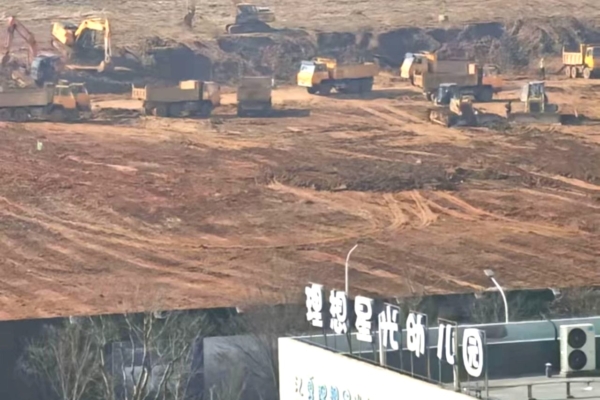
In Wuhan, Hubei Province, plans to convert land originally designated for schools and hospitals in the Huangjia Lake area of Jiāngxià District into a large-scale power battery factory have sparked strong dissatisfaction among local residents. The proposed factory is located less than a hundred meters away from surrounding residential areas and kindergartens. The water quality around the existing Phase One factory has already deteriorated, leading to protests by thousands of property owners since February of this year.
Since February, thousands of property owners have been protesting. In mid-March, local officials publicly promised to suspend the project, but later reneged on their promise and began suppressing the protesters. On the night of March 28th, about 600 residents took to the streets again in protest and were forcefully dispersed by the police, with many individuals being taken away. Local residents expressed their lack of trust in the government, stating, “The government has completely lost credibility, and we no longer believe in any of their promises.”
Around 2022, multiple residential complexes such as Vanke Ideal Starlight, Poly Time Impression, and Minmetals Vision Waterside were completed in the Huangjia Lake area of Jiangxia District in Wuhan. Property owners were initially informed that the vacant land across from their complexes was designated for commercial use and planned for the construction of schools and medical facilities.
One of the property owners, Chén Ruìlín, stated in an interview with Dajiéyuán on March 29th, “At that time, we had screenshots of the response we received from the mayor’s hotline, clearly stating that the land across from us was commercial land.”
On February 8, 2026, the Wuhan municipal government signed an investment agreement with Chu Neng New Energy Co., Ltd. for the construction of the Wuhan Chu Neng Phase Two 80GWh new energy battery production project, which involves building a large-scale power battery factory.
According to public information provided by residents, on February 13th, Jiāngxià District officially released a “Control and Planning Modification Notice,” proposing to change the land originally planned for educational, medical, and ecological residential purposes into industrial land. The public notice period lasted until March 15.
Chu Neng New Energy’s Jiāngxià project (including Phase One and Phase Two) is located at 489 Xīngguāng Avenue, approximately 276 meters from Vanke Ideal Starlight complex, about 300 meters from Poly Time Impression complex, and around 500 meters from Minmetals Vision Waterside complex.
Chén Ruìlín mentioned, “Shortly after signing the investment agreement, the vacant land saw the arrival of many bulldozers and excavators carrying out construction activities, leveling the land. Moreover, the government did not make any announcements or notifications.”
Another property owner, Zhèng Wényù, revealed that the actual distance between the battery factory and the residential complex is even closer than the official data indicates, “The actual distance from Poly Time Impression complex is less than a hundred meters, right across the street, and it is very close to the kindergarten, also within a hundred meters.”
Residents have reported continuous construction activities at the site since early February, with excavators, dump trucks, and pile drivers operating day and night, despite the official signing of contracts and subsequent planning notifications. The authorities explained that the construction during the New Year period was for “land leveling,” a government action rather than private enterprise construction, a claim widely disbelieved by the residents.
Regarding the various official explanations, Chén Ruìlín expressed, “They keep changing their statements between commercial land and industrial land, and now we are really unclear about the nature of the land across from us. The government has absolutely no credibility now, so we no longer believe anything they say.”
He also mentioned that the Phase One factory, already operational, is less than two kilometers away from the residential complex, with “white smoke floating above the factory every day,” officially claimed to be water vapor, a statement he doubts.
Wúhàn resident Wèi Wénhào’s relatives live in the affected complex. He told Dajiéyuán that the water quality in Huangjia Lake has deteriorated, with “many dead fish floating along the shore.” Despite residents’ complaints to the environmental protection bureau, no response has been received.
He said, “Back then, the average price was around thirteen thousand when we bought it. Now the prices have already dropped. Once the factory is completed, property prices here will drop further because of the heavy pollution.”
Residents in the vicinity of the residential complex have protested multiple times against the construction of the power battery factory near their homes.
On March 8th, hundreds of property owners took to the streets demanding government responses to their demands. The authorities deployed a large number of police and riot police to disperse the protesters, detaining several. Outraged property owners surrounded the vehicle of a deputy mayor at the scene, demanding the release of the detained individuals and urging the government to “serve the people.” Under continued pressure from the residents, the deputy mayor briefly engaged with the crowds. However, the detained citizens were not released, and the power battery factory project was not officially canceled.
On March 15th, local property owners gathered for protests once again. Under pressure, the head of the Jiāngxià District Letters and Visits Office publicly announced in front of the crowd that the planning adjustment notice previously issued was invalid, and the project advancement process was forced to pause, temporarily calming the protests.
However, the official’s promise is seen as a delay tactic by the authorities. As disclosed by local residents, following the withdrawal of the notice, the authorities immediately shifted their focus, summoning and pressuring rights-defending property owners, warning several citizens and forcing them into silence. Meanwhile, construction at the site did not stop as promised.
On the night of March 28th, about 600 property owners, fed up with the situation, once again took to Xīngguāng Avenue in Jiāngxià District, marching along the streets chanting slogans such as “Defend our homes, Chu Neng go away, oppose industrial land,” demanding that the authorities fulfill their promises.
Chén Ruìlín, who actively participated in the protests, informed Dajiéyuán that there had been two or three smaller gatherings before, with around “three to four hundred people,” but on Saturday night, the 28th, the number of participants significantly increased. “On the street near the residential complex, around ten o’clock, there were at least five to six hundred people, many more arrived.”
Initially, the police on site claimed they were there for “maintaining public order.” However, Zhèng Wényù revealed to the Dajiéyuán reporters that the situation rapidly deteriorated that night, saying, “Yesterday, dozens were arrested, not just ten or so. These videos couldn’t be posted online; they were quickly taken down. The scene was chaotic.”
She mentioned that to this day, it remains unclear about the whereabouts of those who were arrested.
On March 29th during the day, tensions remained high, with authorities once again amassing a large number of police in the Huangjia Lake area. Wèi Wénhào stated, “Now the police are out in the streets to maintain stability.”
Chén Ruìlín expressed indignation, saying, “They let the people buy houses, and after buying the houses, commercial land turns into industrial land. We resorted to demonstrations due to the lack of avenues for complaints; otherwise, who would go to such lengths?”
He added, “The government is really unscrupulous when it comes to economic interests.”
In recent years, China has vigorously promoted the development of new energy industries, with power battery projects being a significant target for local governments to attract investment, involving investments of hundreds of billions of yuan.
According to publicly available data, Chu Neng New Energy Co., Ltd. was established in 2021, headquartered in Xiàogǎn, Hubei Province, specializing in energy storage and power battery businesses. The company is concurrently advancing significant asset projects in Xiàogǎn, Wuhan, Yíchāng, among other locations. Chu Neng New Energy’s founder is Dài Dé-míng, and the car dealership group he founded, Héngxìn Automotive Group, is the fifth-largest car dealer in China.
At the time of writing, there has been no official definitive stance on whether the Chu Neng Jiāngxià Phase Two project has been officially canceled, and the release of the detained citizens has not been confirmed.
(For safety considerations, the interviewees mentioned above are using pseudonyms.)