
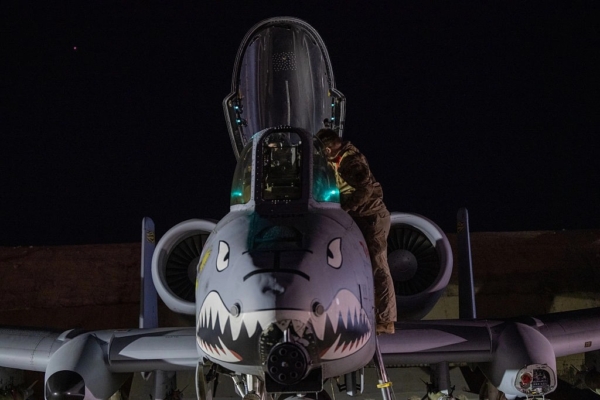
The US Air Force claims that the A-10 attack aircraft has become irrelevant on the modern battlefield (a claim they have been insisting on for decades). However, once again, the A-10 has proven its unparalleled versatility and loitering capability by destroying fast attack boats, drones, and enemy positions. In the US military’s “Operation Epic Fury,” the nicknamed “Warthog” aircraft outshines any F-35, F-15, F-16, B-2, or even the most advanced drones in the US arsenal.
Despite sleek and high-performance stealth fighter jets like the F-35 dominating a large portion of the Air Force budget, the Air Force relies on the A-10 Thunderbolt II in fierce battles with enemy forces in the Strait of Hormuz. The US Central Command has confirmed that the A-10 attack aircraft is destroying fast attack boats of the Iranian Islamic Revolutionary Guard Corps (IRGC), shooting down the Shahed drone, and striking ground targets.
During a briefing on March 19, General Dan Caine, Chairman of the Joint Chiefs of Staff, highlighted the role of the A-10 in the southern flank, pointing out that this attack aircraft can provide continuous surveillance for the US military. In clearance operations, speed and altitude are actually disadvantages, making the A-10’s versatility and ruggedness an ideal choice.
The versatility of the A-10 attack aircraft is first manifested in its tremendous payload capacity. A single “Warthog” aircraft can carry up to 16,000 pounds of mixed munitions through 11 external hardpoints. Currently, its missions include carrying AGM-65 Mavericks for precision strikes against ships or armored vehicles, APKWS II laser-guided rockets for cost-effective destruction of cheap drones and fast boats, and AIM-9 Sidewinder missiles to enhance its air-to-air or anti-drone combat capabilities. The A-10 can also accurately deploy general-purpose bombs and lay mines. In addition, it is equipped with the legendary 30mm GAU-8 Avenger seven-barrel Gatling gun, with a firing rate of up to 3,900 rounds per minute. The GAU-8, carrying 1,174 rounds of ammunition, can destroy almost anything except the heaviest armor, small ships, buildings, and personnel with incredible kinetic energy.
No other fixed-wing platform or helicopter can seamlessly switch between missiles, rocket pods, cannons, and bombs like the A-10 attack aircraft can in a single flight mission. Its anti-drone interception rockets cost only $25,000 to $35,000 each, while missiles to shoot down a $20,000 drone with an F-35 could cost tens of thousands to over a million dollars.
The A-10’s versatility is enhanced by its unparalleled capability: it can strike a target first, then quickly withdraw to a ridge or other terrain behind, and return to attack another target. Fast high-altitude fighter jets take off from hundreds of miles away, consuming fuel rapidly, and typically have to return to base after one attack. Advanced and highly-priced drones like the MQ-9 Reaper may have strong endurance but lack the A-10’s robust firepower and survival capability. In contrast, the A-10 can loiter at low altitude for hours, attacking multiple IRGC fast boats or drone groups, then retreat out of sight or behind terrain to evade enemy fire, reengage in combat within minutes using the gun, rockets, bombs, or even air-to-air missiles. This capability is crucial in the current critical operation to break Iran’s control over the Strait of Hormuz.
Certainly, the “Warthog” aircraft is not invincible. However, its unparalleled ruggedness, excellent low-level flying and terrain masking capabilities, and a comprehensive set of defensive countermeasures enable it to operate in environments where other aircraft would struggle to cope. The titanium alloy armor weighing 1,200 pounds in the A-10’s fuselage acts like a “bathtub,” tightly encasing the cockpit and critical systems. Double or even triple redundancy ensures that the aircraft can safely return after sustaining potentially lethal damage. Chaff, decoy flares, and electronic warfare jamming pods help the aircraft avoid exposing its vulnerable points. The A-10’s legendary slow-flight capability allows pilots to fly low or hide behind ridges, evading enemy radar and gunners’ line of sight. While other aircraft need to maintain high-altitude flight or engage in long-range combat, the “Warthog” aircraft can hit the heart of the battlefield directly. With Iran’s air defense capabilities significantly diminished, the chances of the A-10 safely returning after missions have greatly increased.
Those who claim that the A-10 attack aircraft is irrelevant in the “modern battlefield” have long been refuted by the A-10’s outstanding performance. Since passing the test of actual combat in the Gulf War of 1991, the A-10 has been performing remarkably. During the Gulf War, the A-10 conducted over 8,000 combat missions, destroying hundreds of Iraqi tanks and thousands of other vehicles. What’s more impressive is that it withstood ground fire sufficient to bring down any other aircraft, helicopter, or drone. In the US military’s Operations Iraqi Freedom and Enduring Freedom, Joint Terminal Attack Controllers and ground forces repeatedly rated the “Warthog” A-10 as the best close-air support platform.
We can compare the combat records of the A-10 attack aircraft with the F-35 Lightning II fighter jet. The pride of the Air Force, the stealth fighter jet, is essentially a flying computer, but due to its unreliability, extreme fragility, and poor low-speed handling capabilities, it can’t perform the sustained, low-altitude, high-density strike missions that the A-10 carries out today. When loaded with a large amount of external munitions like the A-10, the F-35 exposes itself to enemy air defense radars and becomes a bulky, short-range aircraft. Its 25mm gun is far less potent than the A-10, carrying a meager 180 rounds of ammunition compared to the A-10’s 1,150 rounds of 30mm armor-piercing shells. The F-35 lacks the A-10’s rugged structure, redundant systems, loitering capability, and the ability to use terrain and horizon to interfere with or weaken the effectiveness of air defense systems. What’s more concerning is that in an effort to salvage the F-35 project, authorities have spared no expense even by stripping off many protective safety features from the F-35, such as ballistic liners and onboard fire suppression systems, only to ensure the aircraft’s body weight is light enough to fulfill its flying missions. This has made the F-35 even more vulnerable, becoming one of the most fragile fighter jets in the sky.
Other advantages of the “Warthog” aircraft include daily flight sorties at least twice that of the F-35 and an hourly cost less than half that of the F-35. The F-35 does not meet the requirements of a close-air support aircraft, no matter how many costly “block upgrades” are implemented, they cannot change this fact.
Retired Air Force Lieutenant Colonel Thomas Norris, with over 3,000 hours of flying experience on the A-10, stated, “Unless you’ve been on round-the-clock close-air support missions, you simply cannot fully understand the difficulty and importance of this mission, and you are likely underestimating it.” An experienced Air Force Joint Terminal Attack Controller (JTAC) also expressed a similar view from past operations: “I have worked with F-16s, B-1B bombers, F-15s, F-111s, F/A-18s, and other aircraft, but there’s no comparison to any other close-air support aircraft like the A-10.” Today, as the A-10 “Warthog” aircraft hovers over the Gulf, carrying out missions that high-speed jets and drones cannot accomplish, these seasoned aviators’ evaluations of the A-10 remain resounding.
Despite the A-10 aircraft continuously demonstrating outstanding performance on the battlefield, the Air Force is still determined to retire this type of aircraft. Last June, the Air Force accelerated the retirement plan of the remaining 162 A-10 aircraft, aiming to complete it by the end of the 2026 fiscal year (September 30, 2026). However, the latest National Defense Authorization Act once again intervened, prohibiting reducing the number of A-10 retirements to below 103 by the end of the 2026 fiscal year. Currently, the Air Force is still striving to complete the full retirement of A-10 aircraft by 2029. For over twenty years, the Air Force leadership has consistently underestimated the value of the A-10 aircraft, even though its performance far exceeds those expensive “tarmac-class” fighter jets—most of which spend more time on the ground for maintenance than actual flight.
However, ground forces and Joint Terminal Attack Controllers (JTACs) who call for A-10 airstrikes in combat situations truly understand this. The combat records of the 2026 Iran war once again confirm this. Indeed, drones can provide some types of close-air support, but the sturdy, durable, firepower-strong, and undisturbed A-10 attack aircraft, coupled with daring pilots who face danger, can bring advantages to the battlefield that drones and their operators cannot reach—reasons why the A-10 should not be retired in the foreseeable future.
Therefore, as the battle over the Strait of Hormuz intensifies, the “obsolete” A-10 once again demonstrates its unmatched cost-effectiveness and lethality compared to any other American aircraft, proving that durability, reliability, and combat capability at the front line is unmatched on the modern battlefield.