
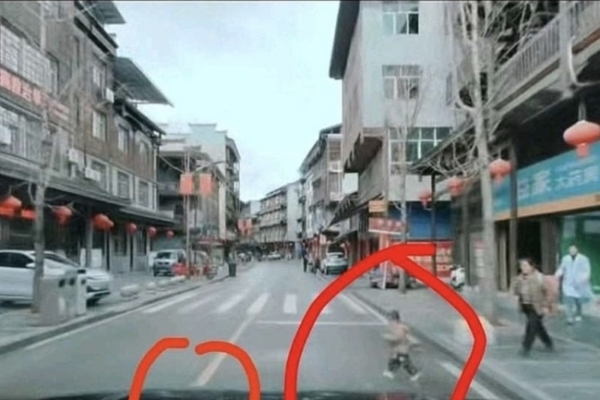
Recently, in Chongqing, a Huawei electric vehicle (Hongmeng Intelligent Drive) crashed into a 2-year-old toddler crossing the road while in NCA intelligent driving assist mode. The video footage from the vehicle’s dashcam was uploaded online, sparking public attention.
According to mainland Chinese media The New Yellow River, the incident occurred in Sanyi Road, Zhaoshui Town, Qianjiang District, Chongqing. The dashcam footage shows that on March 9th at 13:46:06 to 13:46:08, the Hongmeng Intelligent Drive vehicle was in NCA intelligent driving assist mode. The vehicle’s speed increased from 24 km/h to 31 km/h, and 2 seconds later, a 2-year-old toddler suddenly stepped onto the road from the sidewalk. The speed dropped from the peak of 32 km/h to 28 km/h. At the moment of impact, neither the brake nor accelerator pedals were engaged, indicating no active braking from the driver or the system. Subsequently, the toddler entered the blind spot of the vehicle’s front, and the NCA intelligent drive icon remained active until around 13:46:13. The vehicle’s front shook, and the body vibrated before coming to a stop at 13:46:14.
Local shop owners confirmed that the toddler is a child of nearby shop owners and suffered bleeding from the mouth and nose after the accident.
In response, Huawei’s Hongmeng Intelligent Drive customer service stated that the toddler was not seriously harmed, and after communication with the vehicle owner, they “did not find any issues.”
The customer service also mentioned that “this incident was not caused by a vehicle issue” but did not provide specific evidence to support their statement.
Industry experts pointed out that Huawei’s Hongmeng Intelligent Drive system emphasizes proactive avoidance capabilities in their advertisements, yet in this low-speed sudden pedestrian crossing scenario, the system did not intervene. The hasty conclusion of “not a vehicle issue” without a detailed investigation by the customer service has raised questions about the disparity between the promotion of intelligent driving technology and the definition of responsibility.
Online users expressed various opinions, with some saying, “Testing all day is impressive, but when encountering real situations, it is of no use.” Others commented, “With such a broad field of vision, this amounts to no effective surveillance,” and “I’ve seen the original video; if it was a human driver, they could have definitely avoided the collision.” Doubts were also raised about the claim that the child was unharmed despite the vehicle passing over them.
Furthermore, some netizens reported that they were forced to sign an agreement promising not to share any negative news about Huawei after posting the accident video online.
On March 28th, the topic of “Hongmeng Intelligent Drive vehicle crashing into a child in intelligent driving mode” trended on Weibo.
In fact, Huawei’s electric vehicles have been involved in several accidents leading to injuries and fatalities. On January 26th of this year, in Changsha, Hunan province, a high-end Huawei “smart driving” electric vehicle collided with a sanitation worker within a guided traffic line during the intelligent driving process. Fortunately, the sanitation worker only suffered minor injuries due to the vehicle’s slow speed.
On November 22nd, 2025, a Huawei Wanjie M7, while in “smart driving” mode, hit and killed an elderly person crossing the road.
On April 26th, 2024, a Huawei Wanjie M7 on a highway in Shanxi province rear-ended another car, causing a fire and resulting in the immediate death of three occupants.