
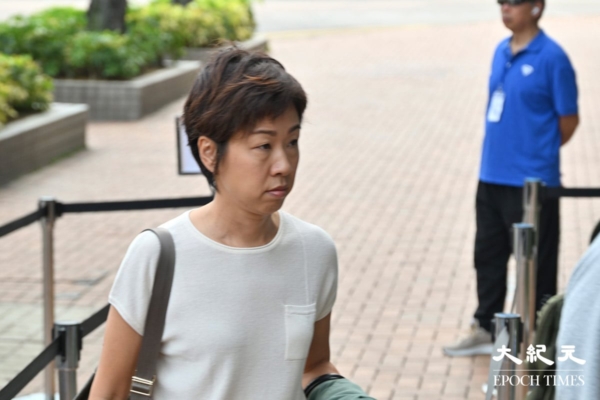
Hong Kong – The independent commission investigating the 5-alarm fire at the Grand Fortune Garden in Tai Po entered its fourth day of hearings today, with residents attending to testify expressing disappointment over certain entities and individuals refusing to participate. Specifically naming Hong Yi, Hong Ye, and Wong Pik Kiu, residents felt that they should personally appear at the hearings to provide explanations.
Hong Yi Construction Co., Ltd. is responsible for the major repair works at the Grand Fortune Garden and Amity Garden as the engineering consultant. Hong Ye Construction Co., Ltd. is the main contractor for the exorbitant repair works at Grand Fortune Garden. Wong Pik Kiu is a member of the Tai Po District Council.
One resident, Luo Xiaoqi, who lost her mother in the fire at The Mun Chong House, mentioned that after attending the hearings for several days, she noticed the commission’s thorough preparation with a large volume of documents and videos. This led her to have an even greater desire to uncover the truth behind the event, including the sequence of the disaster, possible legal loopholes, instances of negligence, and any violations. She believed it necessary to investigate these matters through the commission.
She mentioned that new involved parties are expected to testify at the hearing on Monday, And she expressed disappointment towards those who had declined to attend, such as Hong Yi, Hong Ye, and Wong Pik Kiu. She emphasized the importance of providing these organizations and individuals with the opportunity to explain themselves, especially in light of accusations against the Building Department’s Independent Checking Unit (ICU) for supplying internal information to the consulting company Hong Yi.
Regarding authorization regarding tickets, she explained that her mother was in charge at the time since she was the property owner, and she did not consult her children or seek assistance. During residents’ meetings, neighbors would often directly request authorization tickets from her mother. She clarified that while most buildings faced similar situations, it was not necessarily the healthiest approach, and it was essential to take personal responsibility.
Another resident, Wang Shulan from the Wang Zhi House, shared her experiences with two fires, including one in 1975 in Tiu Keng Leng. She recalled the previous British colonial government’s efficient handling of the situation, providing compensation even for unaffected properties. The government not only compensated them but also engaged politely with the affected residents. Wang Shulan highlighted her grandfather’s decision regarding the allocation of public housing units to avoid overburdening government resources.
During the transitional period, the government assigned them units in a seven-story building without separate kitchen and bathroom facilities. After the completion of new housing renovations, they were relocated to units with independent facilities. She emphasized that the government ensured the fire victims were not excessively burdened and did not need to worry too much about their living situation.
However, the current situation forced Wang Shulan to constantly calculate and worry about expenses since the government’s compensation could not fully restore their original property. Banks were unwilling to assist with mortgages, even for village houses, leaving them with limited options due to insufficient funds. She insisted that their intentions were not selfish but aimed for stable and secure housing.
She raised concerns about the lack of transparency regarding donations and their use, particularly on whether volunteer teams were utilizing the funds properly. She questioned certain individuals who claimed to represent residents in communication with the government without understanding how they were chosen.
Wang Shulan explained that she was not initially on the witness list, but due to time constraints and her brief testimony, the commission added her to the list after a review. She believed that residents had the right to voice their opinions since the estates were purchased with their own money.
She expressed reluctance to accept the government’s proposed housing units out of fear of living with the same group of people again and concerns about privacy. The financial burden imposed by the government’s resettlement proposal was seen as unrealistic for many residents, especially senior citizens who had to deplete their savings to meet the requirements.
Xian Shanqing, a resident of Tai Po Homestead’s Wing Tai House, who previously served as the treasurer of the Owners’ Corporation Committee 19 years ago, attended the hearing today and shared her experience in an interview. She viewed her participation as a civic duty and wished to recount her mindset during the crisis. She specifically thanked the four firefighters who saved her life and recalled the police officer who provided calm guidance during her distress, enabling her to follow instructions and ultimately be rescued.
She mentioned that following a theft incident that she reported to the police station, officers inspected her unit and confirmed its completeness. However, they noticed smoke damage near the windows, indicating it had been exposed to fire or smoke. When asked about allegations involving Wong Pik Kiu, a district councilor from the Democratic Alliance for the Betterment and Progress of Hong Kong (DAB), approaching residents for authorization, Xian stated she heard rumors but had no direct contact with someone requesting an authorization signature from her.
The residents who chose to testify today, like Wang Shulan and Xian Shanqing, felt it was their civic duty to participate in the hearings and share their perspectives on the incident, emphasizing the need for transparency, accountability, and fair treatment of affected individuals.