
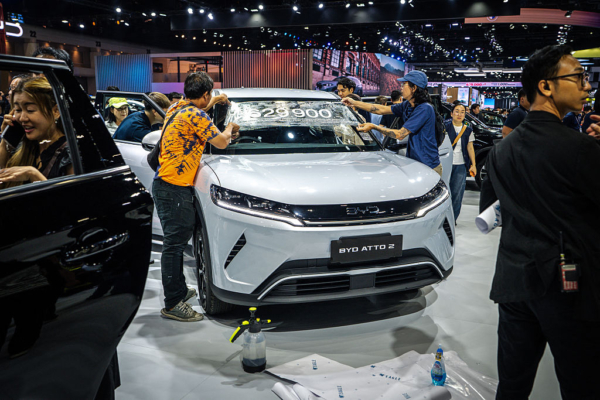
Chinese EV giant BYD faces pressure as profit declines more than expected. Despite increasing revenue, the company’s profit dropped by 19% in 2025 to 32.6 billion Chinese Yuan, with a 3.5% revenue growth to 804 billion Chinese Yuan. Their gross profit margin hit a three-year low at 17.7%, below 19.4% in 2024.
BYD’s aggressive discount strategy aimed at grabbing global market share by boosting deliveries has led to a profit decline, despite surpassing Tesla in sales volume. Data compiled by Bloomberg shows BYD’s profit has fallen below expectations for three consecutive quarters, along with sales figures falling short of analysts’ average projections. This marks the first annual profit decline in four years for BYD, with the lowest revenue growth rate in six years.
The reality test for BYD’s electric vehicles is challenging, particularly with slowing domestic sales in China requiring significant investments to keep up with tech-focused models from competitors like Xiaomi.
Intense competition is squeezing profit margins for Chinese EVs, as government subsidies phase out and shorter production cycles make it challenging for any company to maintain a consistent lead.
The opening of 2026 is not optimistic for BYD. Data shows that in the first two months, their sales in China have significantly declined, losing the top spot to Geely Auto.
BYD Chairman Wang Chuanfu admitted in a shareholder letter that the competition in the Chinese EV market has reached a “white-hot” stage, with a brutal “elimination game” underway.
The surge in oil prices due to the Iran conflict in late February has boosted prospects for EV sales. BYD’s mainland China stock price has risen by 17.5%, marking the best monthly performance in nearly a year, yet still 22% lower than its peak in May 2025.
Apart from fierce domestic competition and overseas trade barriers, BYD faces challenges internally as well. Some Chinese consumers have complained on social media about BYD’s “Sky Eye” intelligent driving system, alleging false advertising and technical limitations that apply to all their vehicles before resolving all issues.
After falling behind competitors like Huawei and Xiaomi in software innovation, BYD aims to enhance its offerings by addressing concerns about driving range.
In early March, BYD unveiled the latest “Blade Battery” and ultra-fast charging technology, promising to charge from 10% to 70% in five minutes and near full capacity in nine minutes. However, real-world application may differ from lab tests, with issues on battery energy density, overall costs, and grid capacity, which require feedback from actual users after delivery.
While battery performance has improved in cold weather, real-world endurance and charging consistency in extreme conditions are still under observation.