
According to data released on Friday, despite the worsening of relations between China and Japan due to territorial and security issues, the number of Chinese residents in Japan continues to increase against the trend.
As of the end of last December, the number of Chinese residents in Japan increased by 6.5% from the previous year, reaching 930,428 people. Data from the Immigration Services Agency of Japan, which is under the Ministry of Justice, shows that Chinese people account for 22.6% of all foreign residents in Japan, ranking first as the largest foreign group in Japan.
In general, the total number of foreign residents in Japan increased by 9.5% last year, reaching 4.13 million, while Japan’s total population is approximately 123 million.
After Prime Minister Sanae Takashi explicitly reaffirmed the position that “Taiwan’s situation is Japan’s situation” in November last year, the Beijing authorities immediately issued a travel warning to Japan. Despite this, the total number of visitors to Japan surpassed 40 million for the first time in the past year.
From January to November last year, the number of tourists from China increased by 37.5% compared to the same period the previous year, reaching 8.77 million. Analysts point out that although tensions in Sino-Japanese relations have slowed down the growth of Chinese tourists, with the contraction of the Chinese economy, more middle-class individuals are actively seeking overseas asset allocation or long-term residency, becoming the main reasons for the increase in the number of Chinese people in Japan.
According to data from online travel platforms, there has been a change in the consumption structure of Chinese tourists. Against the backdrop of the depreciation of the yen, the total consumption of visitors to Japan increased by 43% compared to 2019, but the per capita consumption of Chinese tourists only increased by 30%, much lower than that of tourists from other countries.
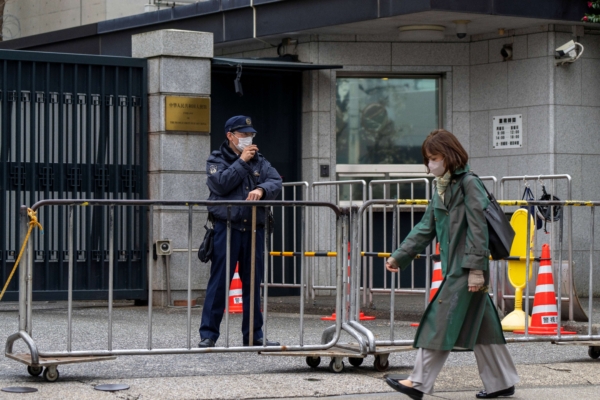
This week, a member of the Japan Self-Defense Forces entered the premises of the Chinese Embassy in Tokyo wielding a knife, sparking a dispute once again. The man has been arrested, and the highest spokesperson of the Japanese government expressed regret over the incident.
Chinese Foreign Ministry spokesperson Lin Jian stated at the routine press conference on Friday that Japan had expressed deep regret over the incident, “but this is far from enough.”
China has long used nationalistic sentiments to incite people to “boycott Japan”. In sharp contrast to the stable growth in the number of Chinese people in Japan, the situation for Japanese people in China is becoming increasingly severe. In recent years, the intensified enforcement of the “Anti-Espionage Law” by the Chinese authorities has resulted in the arrest or imprisonment of several Japanese business leaders and expatriates. In addition, hate speech on Chinese social media poses a threat to Japanese businesses in China. In recent years, there have been several incidents of harassment and extreme attacks against Japanese schools and citizens, leading to the evacuation of many Japanese corporate employees from China and a reduction in investment.
According to statistics from the Japanese Ministry of Foreign Affairs’ “Survey on the Number of Japanese Nationals Residing Overseas,” the number of Japanese nationals in China has decreased by about 38% compared to its peak of around 150,000 in 2012.
In the current environment, it is not just Japanese people who are accelerating their exodus from China. According to a population study report from 2025, the foreign population in major cities in China such as Beijing and Shanghai from developed countries in the West and Asia has shown a significant decline, with some cities experiencing reductions of over 40%.