
California Legislature passed a bill on March 26 to rename the upcoming commemoration of farmworker leader Cesar Chavez’s “Cesar Chavez Day” to “Farmworkers Day.” Governor Galvin Newsom promptly signed the bill into law, but did not issue a statement.
This swift legislative action occurred just one week after allegations of sexual misconduct surfaced against the late Latinx farmworker leader Cesar Chavez, aiming to rename the day before March 31, a state holiday celebrated in California for 26 years. However, it remains a statutory holiday in California, with government agencies including departments, libraries, parks, public schools, among others, still observing closures.
In 2000, California established “Cesar Chavez Day” on March 31 as a paid holiday to commemorate the farmworker movement icon. In 2014, former President Obama declared this day annually as “Cesar Chavez Day” at the federal level, though not a federal holiday. Many cities across the U.S. have streets, parks, and schools named after him.
Like many cities in California, San Diego has various streets, schools, and buildings named after Cesar Chavez. Since the sexual misconduct allegations against Chavez came to light, San Diego swiftly joined other Californian and American cities in initiating efforts to disassociate from Chavez.
San Diego Mayor Todd Gloria signed an executive order on March 20 to remove all references to Chavez from city property and rename “Cesar Chavez Avenue.”
San Diego Unified School District has also started the process of renaming “Cesar Chavez Elementary School.”
Barrio Logan in southern San Diego, a Latinx community, houses a street named after Cesar Chavez and a subcampus of San Diego Community College District (SDCCD) called Cesar E. Chavez Continuing Education. The district will discuss renaming in early April.
California State University San Marcos (CSUSM) in northern San Diego County took preemptive action by removing a nearly 30-year-old bronze statue of Chavez on campus within days of the allegations surfacing.
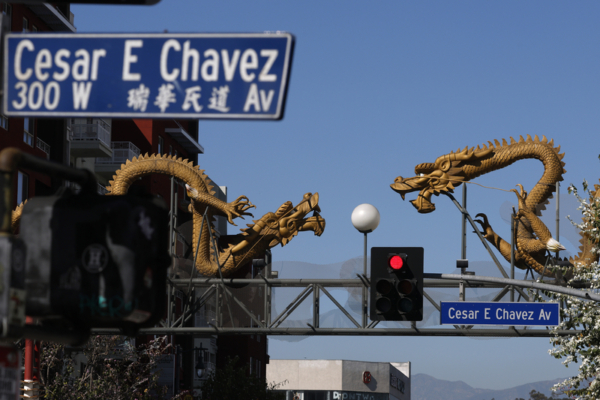
Los Angeles and other cities are also considering similar renaming actions. Downtown Los Angeles has “Chavez Avenue,” while Los Angeles Unified School District (LAUSD) has César Chávez Elementary School and César Chávez Learning Academies. The Mayor of Los Angeles previously mentioned the city’s need to consider adjustments, including reevaluation of holidays, buildings, street names, and other namings.
Cesar Chavez rose to fame in the 1960s and 1970s for leading a nonviolent farmworker movement and passed away in 1993 at the age of 66.
Allegations made public on March 17 claim that during the farmworker rights movement in California in the 1960s, Chavez sexually assaulted and abused girls and women. One significant accusation came from Dolores Huerta, a 95-year-old California civil rights leader who was a prominent figure alongside Chavez in the farmworker movement.
Huerta told the media that Chavez raped her in 1966. Several other women also accused Chavez of sexually assaulting followers as young as 12 or 13. Huerta mentioned that she was young at the time, and without government support for the farmworker movement, she feared speaking out would damage the cause. Chavez’s reputation was formidable, and she worried about not being believed within the union, risking isolation and being seen as a traitor to the movement. However, in her later years, she believes the societal culture has evolved, allowing for the safe disclosure of truth.
Following the allegations, the Democratic-controlled California Legislature and various levels of government swiftly distanced themselves from Chavez.