
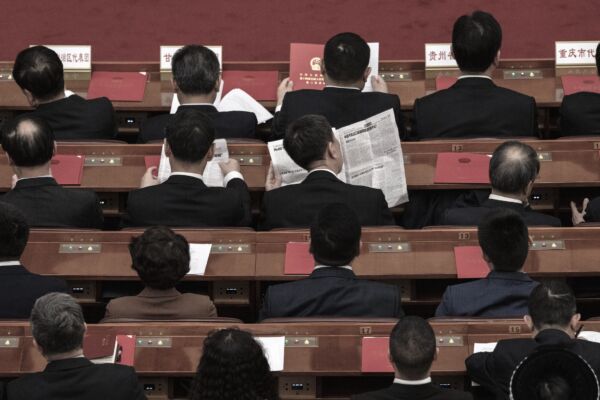
The Central Political Bureau of the Chinese Communist Party (CCP) emphasized in its meeting today (27th) the need for local party committees to firmly uphold the authority of Xi Jinping’s central leadership and “centralized unified leadership.” Analysts believe that such rhetoric indicates that local party committees may not fully support Xi Jinping at present, and that Xi’s authority is declining, evidenced by the prevalent trend of officials in the political arena daring to criticize the central leadership.
According to reports from the CCP official media, the Central Political Bureau convened a meeting on March 27 to deliberate on the “Regulations on the Work of CCP Local Committees.” The meeting was chaired by Xi Jinping.
The report stated that the Political Bureau demanded local party committees to “firmly uphold” the “authority of the central Party committee with Xi Jinping at its core and centralized unified leadership,” and to make “the full implementation of the decisions and deployments of the central Party committee a top priority.”
Chinese affairs expert Li Lin told Epoch Times that first of all, the CCP often demands what it lacks; setting regulations at the central level that local authorities must support indicates that the central leadership may not receive full backing from local authorities. This suggests that there are many instances where support for the central leadership, particularly Xi Jinping, is lacking. The increasing number of high-ranking officials accused of “baselessly criticizing the central leadership” is evidence of Xi Jinping ostensibly holding vast powers while actually losing authority within the political circle.
It is worth noting that the “Regulations on the Work of CCP Local Committees” were initially issued in a trial version on April 5, 1996. The version revised by the Central Political Bureau was deliberated and passed on December 14, 2015, and took effect on December 25, 2015. The version deliberated on March 27 this year did not specify whether it was a revision.
Li Lin commented that introducing a new set of regulations without announcing amendments shows Xi Jinping’s hastiness, disregarding the CCP’s own rules, while those around him, including the official media, do not scrutinize the process. It is also possible that the original regulations were ineffective, prompting a fresh start; however, such paper documents are essentially ineffective.
In recent years, an increasing number of high-ranking officials have been implicated by the authorities for “baselessly criticizing the central leadership.” Zhou Derui, former member of the Tianjin Municipal Party Committee and Minister of the Organization Department, was removed from office last year on charges of “baselessly criticizing the central leadership.” Recently, Zhou’s remarks, including mocking Xi’s “common prosperity” policy and real estate policies, have sparked controversy.
On February 6 this year, Ni Qiang, former Secretary of the Hainan Provincial Party Committee, was expelled from the Party and public office. It circulated widely on the internet that Ni Qiang, under the influence of alcohol, stated that the Hainan Free Trade Port is destined to be a failed project, akin to Xiongan. This conversation was clandestinely recorded and submitted to the provincial disciplinary committee, leading to Ni Qiang’s expulsion. Xi Jinping spearheaded the establishment of the “Hainan Free Trade Port,” which officially commenced with the island-wide lockdown in December last year.
CCP officials frequently emphasize their loyalty to Xi Jinping in public statements. However, Ma Ruilin, former Deputy Secretary of the Gansu Provincial United Front Work Department who defected to the United States two years ago, recently confirmed in an interview with CNN that the majority of individuals within the system do not actually favor party leader Xi Jinping, but merely flatter him outwardly.
The recent meeting of the Central Political Bureau also called on local party committees to “establish and practice a correct view of political achievements,” among other directives.
The CCP recently initiated a campaign under the guise of responding to Xi Jinping’s so-called “correct view of political achievements” to redefine the evaluation criteria for officials’ performance.
An informed source, Mr. Chen, stated in a previous interview with Epoch Times that under Xi Jinping’s highly centralized system, frequent rectifications of cadres through party building channels reflect not stability, but anxiety. Such political adjustments often occur during periods of loosening power dynamics rather than during a period of strong consolidation.