
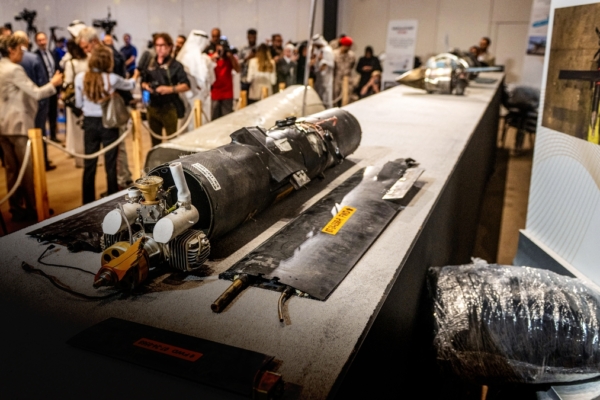
The “Epic Fury Operation” aimed to weaken Iran’s military capabilities, however, just one day into the US military operation, it faced the deadliest casualties of this operation. A drone filled with explosives broke through the anti-aircraft defenses around the Tactical Operations Center at the Port of Shuaiba in Kuwait.
On March 1, an Iranian drone attacked a US Army Reserve base belonging to the 103rd Expeditionary Sustainment Command, resulting in the deaths of six soldiers and multiple injuries.
This aerial attack on March 1 highlighted the challenges that may arise in large-scale conflicts: a mix of numerous attack drones and dense ballistic missiles targeting to deplete defense networks. These relatively inexpensive weapons are prompting military planners to reassess defense systems and strategies.
In response to this deadly attack, US Secretary of War Pete Hegseth stated that the US military possesses “incredible air defense systems,” but “unfortunately, occasionally a plane – what we call a ‘squirter’ – will slip through the defenses.”
On March 8, a seventh US soldier died due to injuries sustained during a drone attack at the Prince Sultan Air Base in Saudi Arabia on March 1.
Attack drones have also caused losses to other US allies and partners in the Middle East.
The Ministry of the Interior in Bahrain reported that on March 9, the island of Sitra was attacked by a drone that resulted in several civilians being injured.
On March 12, a one-way attack drone targeted a French outpost in Iraq, causing the death of one French soldier and injuries to six teammates.
Moreover, drones have been used to set fire to fuel depots in Gulf Arab countries where US forces are stationed.
“The challenge we face, especially in confronting Iran, is that Iran has a very extensive range of potential targets for attacks,” said Doug Bandow, a senior researcher specializing in foreign policy at the Cato Institute based in Washington, D.C.
“Defending all facilities in the entire Gulf region, including airports, airbases, energy centers, and more, is very difficult.”
Before the outbreak of current Middle East conflicts, one-way attack drones had already begun reshaping the modern battlefield.
After a surge of Russian troops into eastern Ukraine in 2022, the Ukrainian military swiftly deployed disposable drones to slow down the advancement of Russian forces.
Unable to fully control Ukrainian airspace, Russian forces often use one-way attack drones to target Ukrainian cities and critical infrastructure. In the conflict in Ukraine, a drone named “Geran-2” has garnered attention, derived from Iran’s “Shahed 136” drone, which plays a significant role in ongoing conflicts in the Middle East.
Drawing from the experience of the Ukraine conflict, the US military has developed a derivative model of its “Shahed” drone known as the Low-cost Uncrewed Combat Attack System (LUCAS). The US military has deployed LUCAS attack drones in its ongoing strikes against Iran.
Since the outbreak of the conflict in Ukraine, US military planners have taken measures to enhance air defense capabilities.
In 2024, Army unit design documents required the establishment of multiple new encampments to provide close-range air defense against drone attacks.
Last summer, Hegseth ordered the formation of a joint interagency task force to expedite methods of enhancing air defense against drone threats.
The US and Israeli militaries have been working to eliminate the threat posed by Iranian drones.
In the latest assessment on March 19, Hegseth stated that recent joint strikes had targeted Iran’s drone production facilities, resulting in a 90% decrease in the launch of Iranian one-way attack drones compared to the peak of drone attacks during the conflict’s early stages.
Even with the reduced frequency of Iranian drone launches, Gulf Arab countries still report dozens of Iranian drone intrusions every day. On March 20, Kuwait, Saudi Arabia, and the United Arab Emirates reported over 50 drone intrusion incidents in their airspace.
A Pentagon spokesperson stated that Bahrain, Jordan, Kuwait, Qatar, Saudi Arabia, and the United Arab Emirates had jointly launched operations to intercept drone attacks. Some of these operations were conducted during drone flights.
On March 19, General Dan Caine, Chairman of the Joint Chiefs of Staff, announced at a Pentagon press briefing that partner forces in the region had dispatched AH-64 Apache attack helicopters to shoot down Iranian drones.
The Advanced Precision Kill Weapon System (APKWS) – a 2.75-inch diameter “Hydra” rocket fitted with a guidance package – can be employed for anti-drone operations. These rockets can be mounted on Apache helicopters and jet aircraft for aerial interception. Additionally, these rockets have a land-based launching version.
Not all attack drones can be destroyed on the production line, launcher, or during flight. Systems like the Counter Rocket, Artillery, and Mortar system (C-RAM) – capable of firing up to 75 20mm airburst rounds per second – can provide a final defense line near the targeted attack drones.
On March 17, the US Embassy in Baghdad was attacked. Witnesses told Reuters that a C-RAM drone shot down two incoming drones, but a third drone hit the embassy compound.
On March 20, Kuwait’s airspace detected 25 attack drones, with the Kuwaiti military intercepting 15 of them.
In response to evaluation requests, a US Central Command spokesperson declined to disclose the rate of interception of attack drones by US and ally forces in the current conflict.
The low production cost and ease of manufacturing of one-way attack drones pose significant economic challenges for countering such drones.
Bandow stated that a Shahed-style drone valued at tens of thousands of dollars could be used to destroy much more expensive systems, such as tanks valued at millions of dollars. Even the cost of shooting down these attack drone systems could potentially exceed the drone’s cost.
“Typically, the missiles used to shoot them down are worth millions of dollars,” Bandow said.
The rapid proliferation of low-cost drones in modern warfare may leave military planners vexed. For years, they have viewed air defense as a faceoff with opponents nearly matched in technological prowess.
” We’ve always thought it was a $2 million missile against a $2 million missile,” said Jeff Thompson, President and CEO of Red Cat Holdings, a US drone technology company based in Puerto Rico, “but when you start factoring in the low-priced Shahed-136 (priced at $30,000 or $40,000), everything changes.”
Thompson not only closely monitors the latest developments in one-way attack drones but also the tools to stop these drones.
So-called “non-kinetic” interception methods – including signal jamming and directed energy weapons among others – can lower the cost of thwarting drone attacks. However, non-kinetic interceptors are not foolproof.
Thompson mentioned that using directed energy systems, such as lasers and high-powered microwave pulses, requires significant power.
“You can’t expect them to provide protection 24/7 because there might not be enough power to do that level,” he said.
Irina Tsukerman, President of the security consulting firm Scarab Rising Inc., noted that the resistance of attack drones to signal jamming is increasing.
“The flight routes are typically loaded before takeoff, and the aircraft will rely on internal navigation, supplemented by inertial systems and periodic satellite corrections if available,” Tsukerman explained to The Epoch Times, “Interference with GPS will decrease accuracy of flight, sometimes significantly, but degraded accuracy may not necessarily prevent drone missions.”
Thompson believes that kinetic interceptors are currently the best choice. He highlighted that some emerging low-cost intercept missiles and AI systems that can automatically target and control machine gun fire with just a few bullets can down even the smallest, fast-moving attack drones.
Ukraine has already developed smaller, more agile drones capable of intercepting larger, slower incoming attack drones, such as the Geran-2.
On March 20, Rustem Umerov, Secretary of the Ukrainian National Security Council, announced that Ukraine had dispatched equipment and operator teams to several Gulf Arab countries to assist in the interception of drones during the Iran conflict.
As one-way attack drones force air defense systems to continuously evolve, emerging drone countermeasures may prompt attackers to come up with their innovative solutions.
Thompson suggested that the next generation of Shahed-style drones will likely rely on rocket propulsion rather than propellers, making them faster and harder to intercept.
(Reference was made to related information from Reuters and AP, published in The Epoch Times)