
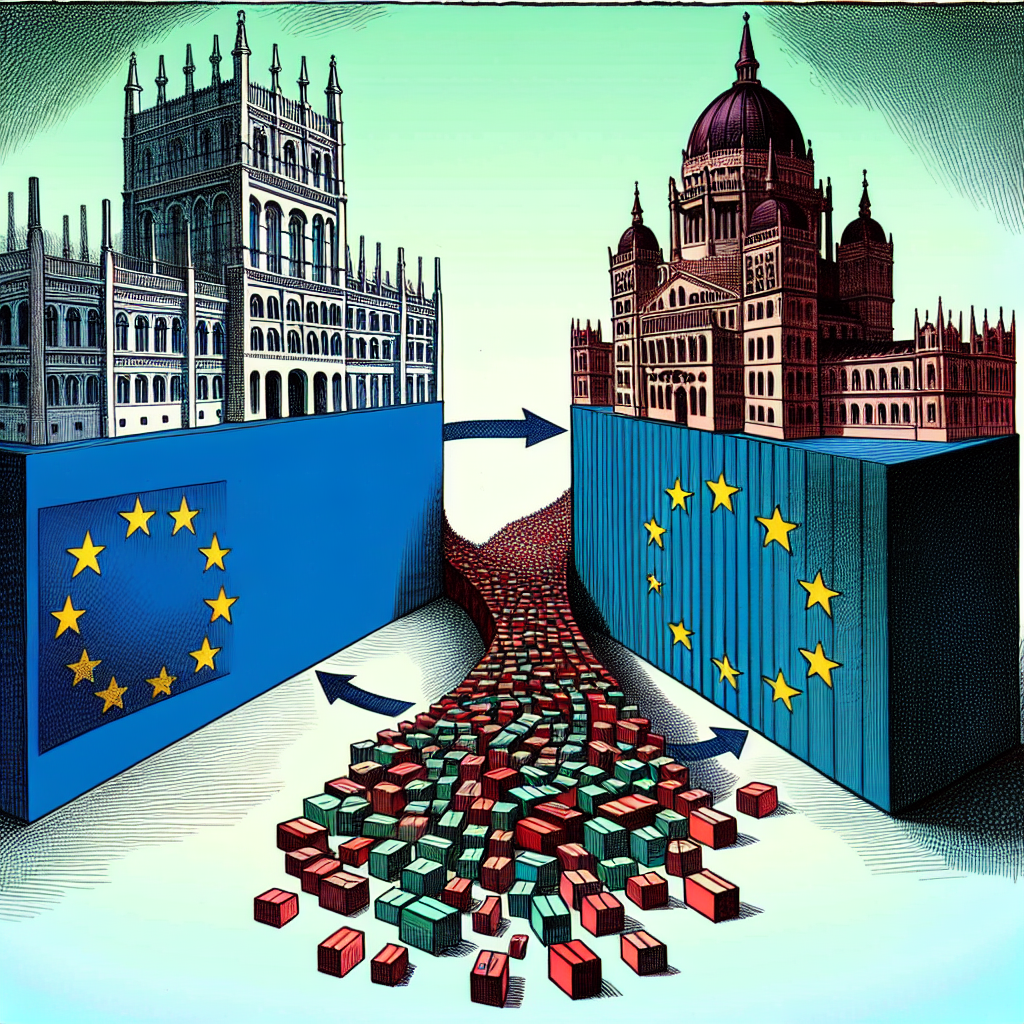
On Thursday, March 26, the European Parliament and the Council of the European Union reached an agreement on the comprehensive revision of the “EU Customs Code” to address the influx of large quantities of non-compliant low-priced goods (mainly from China) into the European market. This agreement aims to strictly combat cross-border e-commerce platforms that systematically violate EU laws, such as selling illegal or unsafe products, which could result in substantial fines.
This new regulation will reshape the operational model of cross-border e-commerce by eliminating tax exemptions, imposing additional processing fees, and holding online platforms legally responsible and accountable. This action aligns with the stance taken by U.S. President Trump to abolish the “de minimis exemption” system, demonstrating that major Western markets are simultaneously strengthening regulations on Chinese e-commerce.
As a transitional measure starting from July 2026, low-value parcels – those valued at 150 euros (approximately $174) or below – will be subject to a unified tariff of 3 euros per parcel. Furthermore, starting from November 1 of the same year, an additional “processing fee” will be imposed to cover the increased costs of customs processing the surge in parcels, with this fee set to be reassessed every two years.
This move signifies that the business model that attracted consumers with ultra-low prices ranging from 4 to 8 euros in the past will lose profit margins due to the overlay of tariffs, processing fees, and value-added tax, leading to an expected increase in online shopping costs for European consumers.
Additionally, the EU encourages sellers and platforms from non-EU countries to establish warehouses in the EU. For example, Zalando, the largest online shopping platform in Europe, has adopted this practice. If their goods are imported in bulk and the scale is sufficient to enhance customs inspection efficiency, the parcels sent to EU consumers can enjoy lower “processing fees.”
The agreement stipulates that in the future, online platforms selling goods directly to EU consumers will be considered as “importers.” This means that platforms can no longer pass on responsibility to consumers or courier companies, but must directly bear responsibility for the product’s safety, compliance with EU regulations, and tariff payment.
These platforms must submit structured shipping data to customs within a specified timeframe, including details of manufacturers, product origin, and safety information. If companies repeatedly violate EU regulations, they may face fines equivalent to 1% to 6% of their total import value to the EU in the past 12 months, and the relevant platforms may even be suspended and classified as high-risk operators by customs.
The overwhelming number of parcels and severe security risks, mostly originating from China, are the reasons that have compelled the EU and the United States to take tough actions. Over the years, Chinese e-commerce platforms such as SHEIN, Temu, and global AliExpress have rapidly expanded by exploiting tax loopholes for parcels valued below 150 euros in the EU and below $800 in the U.S., aiming to absorb China’s domestic overcapacity overseas.
These platforms directly ship low-priced goods from China to consumers in Europe and the U.S., leading to various regulatory and safety issues. This includes misreporting the value and quantity of goods, shipping drugs (mainly fentanyl), counterfeiting and selling counterfeit products, illegal goods, or engaging in malicious money laundering.
An investigation released by the European Commission in March found that up to 60% to 65% of imported cosmetics, food supplements, and personal protective equipment (such as bicycle helmets) do not comply with EU safety regulations, with most of these non-compliant products coming from these three platforms.
Furthermore, data from the U.S. Customs and Border Protection (CBP) show that some criminal groups use e-commerce platforms to send high-purity fentanyl or precursor chemicals disguised as ordinary goods (such as phone cases, clothing, and jewelry) from China, Mexico, and Canada to the U.S., circumventing customs checks through low-priced tax-exempt parcels.
To standardize supervision, the city of Lille in France was selected on Wednesday, March 25, as the future headquarters of the “EU Customs Agency” (EUCA). The agency is expected to have 250 employees responsible for overseeing the brand-new EU data center to provide more centralized and digitized supervision for goods entering the EU.
The data center is expected to be operational for e-commerce goods by 2028 and replace the existing 111 customs software systems of member states by March 2034. This is anticipated to significantly enhance customs operations and risk analysis efficiency while strengthening international cooperation.
The EU has also introduced the “trust and check” simplification mechanism. Enterprises willing to fully open electronic systems to customs, maintain a high level of transparency and compliance, will benefit from minimal cargo inspection rates, faster clearance times, and greater flexibility in tax payments.
The current “Authorized Economic Operator” (AEO) qualification will continue to be retained to ensure that small and medium-sized traders can still obtain convenient customs clearance qualifications.
According to Yves Tussaud, an expert from the Swiss IT consulting company CTOL Digital Solutions, this is an “industry policy” intended to penalize opaque e-commerce that handles goods individually and encourage them to transition to a traditional large-scale import and onshore warehousing model. Consequently, the endless “treasure hunt” style of ultra-low-priced online shopping experience might come to an end in Europe.