
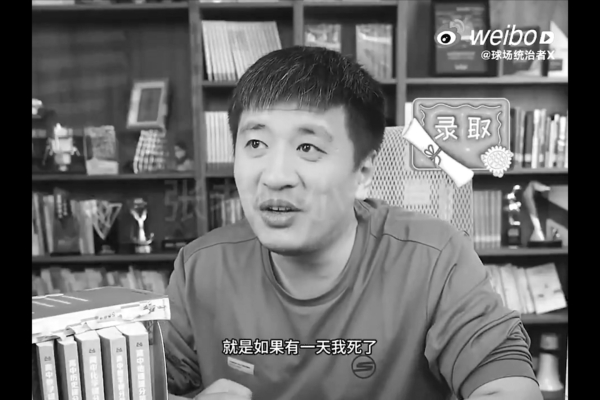
Recently, Chinese education blogger Zhang Xuefeng, who has millions of fans, passed away suddenly in Suzhou at the age of 41, sparking public shock and reflection. Several commentators have pointed out that his death is not just a personal tragedy, but also reflects a societal structural dilemma driven by anxiety and competition as the norm.
According to the obituary released by Suzhou Fengxue Niowei Education Technology Co., Ltd., Zhang Xuefeng passed away on March 24, 2026, due to sudden cardiac death at the age of 41. Reports from media outlets such as “Suzhou Evening News” stated that he suddenly felt unwell after running at the company, was rushed to the hospital for treatment, but unfortunately passed away despite efforts to save him.
His passing quickly drew widespread attention, sparking discussions on health risks, work pressures, and the social environment.
As the event unfolded, public focus quickly shifted from the “cause of sudden death” to deeper issues: why couldn’t someone who made a living from “planning lives” avoid their own risks?
Canadian Chinese writer Sheng Xue, in an interview with Dajiyuan, stated that Zhang Xuefeng’s death cannot be explained solely by personal health or work intensity. This event is not just an individual tragedy, but a microcosm of a “mutually destructive survival structure.”
“Zhang Xuefeng’s success stemmed from his ability to tap into the anxiety ordinary people face when uncertain about the future. He taught people how to avoid getting caught up in excessive competition, only to tragically die in the extreme competition at the cost of life,” Sheng Xue pointed out.
She noted, “He stripped away almost all the idealism in education, turning it into a very naked survival tool.” Particularly when dealing with the lower class and regular families, the core logic he conveyed is how to maximize survival probabilities through precise calculation of paths.
She further introduced the concept of “cooperative destruction”: “In such an environment, everyone is vying for limited resources, which has evolved from competition to a survival scramble involving mutual harm.”
In this logic, even individuals who have achieved wealth accumulation still find it difficult to shake off insecurity. Sheng Xue stated, “It’s not that he didn’t know exhaustion, but he couldn’t stop.” She said this ongoing escalation is fundamentally rooted in the fear of sliding down the social ladder.
At the same time, Sheng Xue also pointed out another contradiction: “He was extremely astute at survival skills, but unbalanced in some basic judgments.” She described this state as “being able to calculate the path clearly but unable to determine the direction.”
On March 26, Hong Kong Economic Daily published a commentary pointing out that Zhang Xuefeng’s rise to fame was due to the tense employment environment and information asymmetry in education. He analyzed professional returns and job prospects in a straightforward manner, treating education as “human capital investment” and providing realistic “safe paths” for families lacking resources.
The article suggests that this highly utilitarian choice logic reflects a shift in education from ideal-oriented to survival-oriented. In the context of intensifying competition and high trial-and-error costs, “choosing the right profession” is seen as a key step in changing one’s destiny, forcing more people into excessive risk calculations.
Ironically, the educational blogger who long advocated for rational planning and hard work ultimately succumbed to high-intensity work and sustained pressure.
The article notes that such phenomena will not cease with the individual’s passing. When “life calculations” evolve into endless self-consumption, society also needs to reflect on whether it should provide a more secure and diverse development environment so that individuals do not have to exchange basic stability for extreme sacrifices.
Zhang Xuefeng’s sudden death quickly became the focus of public opinion, sparking discussions not only on middle-aged health risks but also extending to vaccine safety, career choices, and social structures.
Independent critic Jiang Feng pointed out on a self-media program that Zhang Xuefeng’s passing struck a chord with many people because they saw themselves reflected in him: “The first reaction of many people is to subconsciously ask themselves: Am I also overextending myself?”
Jiang Feng believes that for a long time, high-intensity work has been packaged as “self-discipline” and a “success paradigm,” while its cost has been overlooked. “Is sleeping four hours a day a sign of hard work or the body’s final warning?” he questioned.
He further pointed out that the danger of this culture lies in convincing people that willpower can break through physical limits indefinitely. “The most frightening thing is not the pressure but willingly treating oneself as fuel.”
He believes that this notion is not coincidental but a continuously reinforced value orientation leading individuals unconsciously to their limits.
Canadian cultural scholar and independent critic Wen Zhao stated on a self-media program that this “multi-topic overlay” of public opinion eruption is not accidental but because Zhang Xuefeng himself has become a highly symbolized figure. He was not only a top representative in the education consulting industry but also actively involved in public expression, naturally magnifying the effects of his statements and image.
“Wen Zhao pointed out that Zhang Xuefeng gained immense influence by providing simple, direct, and certain answers that resonate with the public’s fear of uncertainty in the future.”
He noted that this certainty is not reliable in itself: “The future is inherently uncertain, and no one can design a path that guarantees success.”
Public records show that Zhang Xuefeng, whose real name is Zhang Zibiao, was born in 1984 in Fuyu County, Qiqihar City, Heilongjiang Province. After graduating from Zhengzhou University, he entered a training institution. In 2016, a lecture video titled “Decoding 34 Top 985 Universities in Seven Minutes” quickly gained him popularity, making him one of the most influential bloggers in the field of Chinese college entrance examination and postgraduate guidance.
After nearly 10 years in the training industry, he founded the Fengxue Niowei Education Technology Co., Ltd. in Suzhou in 2021.
Zhang Xuefeng publicly advised students not to study journalism and made controversial statements such as “humanities are all service industries,” which kept him in the midst of disputes for a long time.
After the CCP’s 93rd National Day military parade on September 3, 2025, Zhang Xuefeng expressed his thoughts, stating that if the mainland China attacks Taiwan in the future, he would “donate at least 50 million” and announced that the company as a whole would donate 100 million yuan. This declaration quickly triggered public shock.
Subsequent related videos circulated on overseas social media platforms. Zhang Xuefeng was summoned by the CCP’s Cyberspace Administration and asked to be mindful of the influence of his statements.
On September 24 of the same year, Zhang Xuefeng’s accounts on platforms such as Douyin, Kuaishou, Weibo, Xiaohongshu, and Bilibili were temporarily banned. His team responded that this was due to inappropriate comments during a live broadcast violating platform rules and stated that they were rectifying the situation. The accounts were resumed on October 22.