
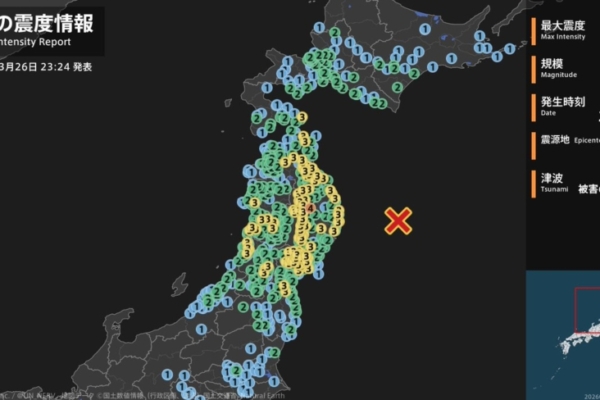
On March 26th, a strong earthquake occurred off the coast of the Tohoku region in Japan. According to the Japan Meteorological Agency, the magnitude of this earthquake reached 6.5, classified as a shallow earthquake with a depth of only about 10 kilometers, and no tsunami was generated.
The earthquake struck around 23:18 local time (22:18 Beijing time) with its epicenter located in the Sanriku Offshore region, along the Pacific coast of northeastern Honshu, Japan, at 39.5 degrees north latitude and 143.3 degrees east longitude, with a depth of approximately 10 kilometers. The agency initially reported the magnitude as 6.4 and later revised it to 6.5.
Areas with seismic intensity level 4 were reported in Morioka City, Iwate Prefecture, while regions with intensity level 3 included cities like Ninohe, Hachimantai, and Takizawa in Iwate Prefecture, as well as in Hokkaido, Aomori Prefecture, Miyagi Prefecture, Akita Prefecture, and Yamagata Prefecture.
Many local residents felt significant shaking and were frightened, hastily seeking shelter.
Following the earthquake, the Japan Meteorological Agency promptly issued a tsunami advisory, warning of possible sea level changes. However, assessments indicated that it would not trigger a destructive tsunami, and there was no risk of disasters, reassuring the public not to be overly concerned.
The earthquake temporarily affected the operations of the shinkansen (bullet train) in the Tohoku region. The Tohoku and Akita Shinkansen lines were temporarily halted for safety inspections but have since resumed service, albeit with some delays.
Concerns were also raised regarding the status of nuclear power facilities. Inspections were conducted at the Higashidori Nuclear Power Plant in Aomori Prefecture and the Onagawa Nuclear Power Plant in Miyagi Prefecture following the earthquake. Currently, all monitoring data show normal readings, with no abnormal situations identified.