
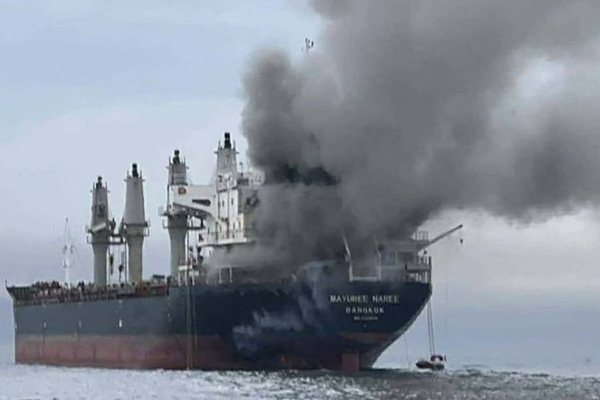
The ongoing conflict in the Middle East has reached a stalemate, leading to a dramatic increase in the risks of passage through the strategic chokepoint of the Hormuz Strait, which is causing a catastrophic disruption in China’s export chain. Exclusive insider information obtained by this publication from the Beijing diplomatic system reveals that the Chinese Communist Party’s attempts to expand its geopolitical influence through the current situation have been thoroughly defeated.
According to a source close to the Chinese Ministry of Foreign Affairs, Wang Ruolin (pseudonym) disclosed to the Epoch Times, “Wang Yi has been repeatedly tasked with communicating with the Iranian Ministry of Foreign Affairs, with the core demand being to ensure the safety of Chinese merchant ships at sea. However, Iran’s response is disheartening. They have indicated that they can only guarantee the safety of ‘some’ cargo destined for Iran and emphasize that it is only ‘some’.”
Wang Ruolin pointed out that this “selective safety” tinged with threats is essentially Tehran’s “soft blackmail” towards Beijing for refusing to provide military assistance. Iran is using this as a bargaining chip, forcing Beijing to make a life-or-death choice between providing substantial military support and securing trade safety. This has resulted in Wang Yi’s secret mediations being futile, further entangling in a tripartite interest trap involving China, Russia, and Iran.
Originally seeking profit through geopolitical maneuvers, Beijing is now facing a severe backlash of diplomatic imbalance and economic stagnation. With the blockade in the Hormuz Strait, the lifeline of China’s southern manufacturing sector has been cut off in reverse, turning this diplomatic gamble into a deep crisis affecting domestic political and economic stability.
A source close to the Chinese diplomatic circle, Sun Min (pseudonym), revealed to the Epoch Times that Beijing had initially planned to leverage its special relationship with Iran to play a key mediating role in the US-Iran conflict, aiming to gain dominance in the “Global South.” However, this vision quickly encountered a reality check.
Reports indicate that Russia has simultaneously stepped up its involvement in Middle Eastern affairs, and the cooperation between China and Russia on the Iran issue is not the single collaboration as commonly perceived by the outside world but rather one with hidden intentions. Both sides are attempting to use Iran as a “bargaining chip” to exchange interests with the United States and alleviate their own diplomatic pressures.
Sun Min also disclosed that both China and Russia have been offering advice to Iran, but Tehran is currently rejecting any diplomatic arrangements. Its core demand is clear: substantial military assistance rather than diplomatic niceties. This leaves Beijing in a dilemma: “Providing military aid to Iran would lead to a full confrontation with the US and its allies, while a refusal means completely forfeiting its influence on the Iranian issue.”
Regarding Beijing’s diplomatic strategy’s debacle, Chinese independent scholar Mr. Qin pointed out that this crisis fundamentally stems from the inevitable backlash of the Chinese Communist Party’s “wolf warrior diplomacy” and “camp confrontation” mindset. Beijing had long been supporting regional troublemakers (such as Iran) behind the scenes to contain the United States, attempting to play the game of encircling one to save the other, but failed to anticipate the situation spiraling out of control.
Mr. Qin stated that the current leaders of the Chinese Communist Party have fallen into a predicament of “creating one’s own traps” in international games: the forces they supported are now cutting off their economic lifelines. The blockade in the Hormuz Strait signifies not just a rupture in global logistics but also a microcosm of the comprehensive collapse of China’s geostrategic position.
Furthermore, the shockwaves from the Middle East have swiftly transmitted to the heart of China’s manufacturing industry. In Yantian Port, Shenzhen, numerous containers labeled for the Middle East are indefinitely backlogged.
As a region with relatively concentrated trade with the Middle East, Guangdong has seen some enterprises experiencing loss of contact with customers and temporary suspension of orders. Companies relying on Middle East routes have begun adjusting their logistics paths. In 2025, the proportion of electro-mechanical products in exports to the Middle East was prominent, covering areas such as electrical equipment and mobile phones.
Affected by the conflict, there have been fluctuations in the supply of naphtha, and the electronics and high-end manufacturing industries face temporary interruption risks in the supply chain. Meanwhile, raw material costs and transportation fees have increased simultaneously, leading to a sustained rise in production costs from energy to light industry, squeezing profit margins.
Ms. Guan, a coordinator in China’s foreign trade system, believes that this war has imposed the heaviest cost on China’s manufacturing industry. She told reporters, “Bullets do not discriminate; shipping and insurance costs are skyrocketing. The only wish of enterprises now is for a ceasefire; otherwise, China’s export system will face structural collapse.”
The head of an electrical appliance private enterprise in Shenzhen, responsible for exporting to the Middle East, anxiously told reporters, “We currently have five containers stuck in the port, unable to be shipped out. These goods are tailored to Middle Eastern specifications, making it difficult to switch orders, and the financial chain has been broken.”
As she knows, there are thousands of containers in Guangdong alone stranded due to channel blockades. Many factories have been forced into a shutdown state due to interrupted order deliveries and blocked capital returns.
Analysts believe that as the conflict continues, Beijing’s operational space in the Middle East has been significantly constrained. With Iran’s insatiable appetite on one side and the teetering domestic manufacturing industry on the other, the Chinese Communist Party’s strategy is showing unprecedented vacillation and chaos. For China, this impact has evolved from a single foreign trade issue into a sustained squeeze on the entire manufacturing system. The geostrategic “grand chessboard” that Beijing had sought to exploit is now turning into a long-term drain on China’s economic structure.
Some scholars argue that the Chinese Communist Party has lost the export advantage it painstakingly built over the past few decades.