
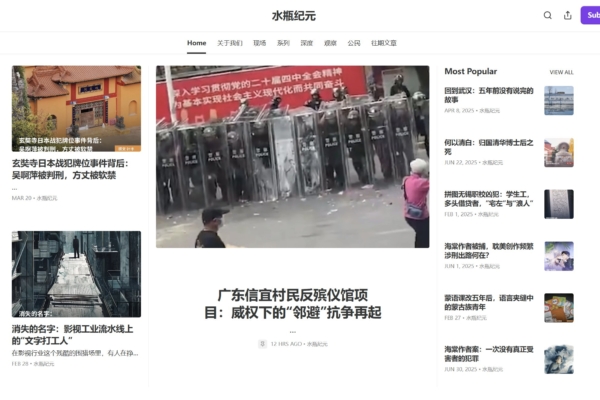
The independent media outlet “Aquarius Epoch,” which has long been dedicated to reporting on the realities of China’s lower classes, labor rights, and marginalized groups, has recently been confirmed to have been permanently banned by the Chinese Communist Party’s internet censorship system. Its main account and related accounts have been successively blocked, and its original content is no longer accessible. This situation has raised concerns among the public about the continued shrinking space for non-fiction writing in China.
The last article published by “Aquarius Epoch” titled “Shenzhen, the ‘World’s Factory’: A Silenced Apple Manufacturing Plant Strike” was released on February 13th. The piece detailed the conflicts that took place during the labor rights struggle at a manufacturing plant in Shenzhen, including wage disputes, labor-management confrontations, and on-site handling of the situation, which garnered widespread attention online.
Shortly after the article was published, the account ceased updating, displaying a message saying “Blocked, content cannot be viewed.” According to sources close to the platform’s operations, the account has been permanently banned under vague categories such as “violations of relevant laws and regulations.”
Jinxi, a network writer from Guangxi (pseudonym), expressed anger at the banning of “Aquarius Epoch.” He told reporters, “I have seen reports by ‘Aquarius Epoch’ concerning the rights of vulnerable groups such as labor disputes, freedom of speech, among other details that significantly differ from official narratives. ‘Aquarius Epoch’ had a high click-through rate, and as its influence grew, the ruling Chinese Communist Party became increasingly worried, hence its decision to ban it.”
Subsequently, the backup account of “Aquarius Epoch,” named “Aquarius Genesis,” was also banned following an update on March 20th, with related accounts facing the same fate. Jinxi remarked, “The authorities spare no effort in controlling speech; even netizens mentioning ‘government officials not needing to pay social security fees’ on platforms like Douyin and Weibo had their accounts deleted. By banning ‘Aquarius Genesis,’ this ‘guilt by association’ type of censorship shows extreme fear towards truth recorders.”
Prior to this, “Aquarius Epoch” had been tracking various social controversies, including events related to contentious historical figures in temples, student deaths abroad, and criminal handling of certain knowledge groups, with their content repeatedly deleted and dissemination limited.
Mr. Liu, an active internet user from Hubei, stated that these accounts focus on chronicling grassroots conflicts and individual situations that are rarely seen in mainstream narratives. He said, “Once their content spreads, it gets quickly suppressed, showcasing the systemic filtering of reality and monopolization of narrative space by the Chinese Communist Party. Online influencer Hu Chenfeng had accounts banned just for sharing controversial opinions, which illustrates not just routine management but a clear political agenda for cleansing and repression.”
Mr. Liu believed that the issues “Aquarius Epoch” long focused on, revolving around social conflicts and individual fates, fall under sensitive content in the current public opinion environment, posing a high risk when consistently publishing such content. He remarked, “The Chinese Communist Party has been fearing people’s uprising for decades; they rose to power through revolutions and understand control in this regard extensively, indicating the approaching end for them.”
Regarding the intensified control of speech by the authorities, scholar Ji Hua from Liaoning (pseudonym) stated that in recent years, the Chinese Communist Party has been escalating its monitoring methods on internet platforms, especially regarding content involving labor disputes, group incidents, and social conflicts, with stricter control measures imposed. He noted, “Once identified as a source of risk, an account may face complete closure rather than limited deletion of individual posts.”
Ji Hua pointed out that such extreme measures make it difficult for accounts engaged in social documentation and investigation to maintain stable publishing spaces, sending a dangerous signal.
On overseas social media platform X (formerly known as Twitter), a netizen commented, “These conscientious public accounts are akin to human rights lawyers in China, continuously oppressed, living aware yet in pain.” This perspective resonated widely, with netizens viewing such media outlets as the “sentries” of Chinese society, and their disappearance signifies a further erosion of the mechanism for public oversight by citizens.
Critics of the severe censorship mechanism employed by the Chinese Communist Party sarcastically likened the bans to “adding a lid to a volcano,” warning that such actions only add more fuel to the powder keg. Some netizens bluntly stated that the authorities’ thorough erasure of truth recorders is a form of “ostrich tactic,” solving issues by silencing those who pose the questions.
Despite facing bans on domestic platforms, “Aquarius Epoch” has not ceased operations entirely. Currently, the team’s account on the overseas platform Substack remains active, continuing to publish relevant content.