
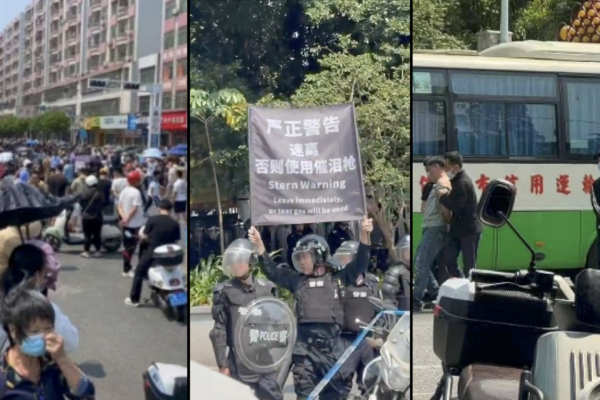
In Guangdong province, the proposed construction of a funeral parlor project in Shuikou Town, Xinyi City, has sparked continuous protests from surrounding villagers and clashes with the police. Local villagers revealed that on March 25, about 3,000 protesters took to the streets, with police arresting people, blocking traffic, and censoring information.
In recent days, the “Yifu Park” funeral parlor project in Xinyi City, Guangdong, has stirred widespread controversy. According to an official announcement released on March 16, the project is located in Malutang on the outskirts of the city, with a total investment of approximately 145 million yuan and a construction period of 10 months.
However, nearby villagers claim that the project is actually only about 700 meters away from Wangyong Village, about 600 meters from the elementary school, and close to a source of drinking water, contradicting the official statements.
Since March 17, hundreds of villagers have been protesting at the village council and city government for several days. On the 19th, the conflict escalated further, with a large number of riot police lining up in front of the city government, confronting the villagers. Video footage from the scene shows intense physical clashes between the two sides, resulting in injuries and arrests.
On March 25, a local villager, Lin Yalong (alias), told Dajiyuan that the protesters originally “didn’t intend to start a conflict,” just to gather at the local park, but they were still apprehended.
He said: “There were about 3,000 people protesting at the scene today (March 25). Everyone was just standing there, not being aggressive, but the police still arrested people.”
He also pointed out that many law enforcement officers were in plain clothes, “whether you were aggressive or not, they still arrested people, targeting those leading to serve as a warning.”
The local villagers planned to continue protesting at the city government, but multiple roads were blocked by the police, requiring ID checks for entry and exit, and some areas experienced prolonged power outages, further escalating tensions.
The core controversy of this incident centers around the site selection of the project and issues related to the disclosure of preliminary information.
Several villagers had previously disclosed to Dajiyuan that during the initial land acquisition, the local government did not mention the funeral parlor project, using the construction of the “Liru Avenue” as the reason. It wasn’t until the public announcement on March 16 that the villagers learned of the actual purpose, with the project’s groundwork already underway.
Lin Yalong stated that the official site selection itself is blatantly problematic: “The location for the funeral parlor construction is very unreasonable, not only close to the village but also near many other villages, and it’s also very close to the city center.”
“We did raise objections, we’ve been voicing concerns early on, but nobody listened,” he added, noting that while the government claimed issues could be raised through “legal channels,” in reality, “we can’t even access these channels, or if we do, there’s no response, it’s just a formality.”
Furthermore, he disclosed that the authorities are pushing for the signing of “consent forms,” requiring signatures from villagers, corporate employees, and even some students. “They go door-to-door, making you sign to agree to build the crematorium, and some companies are also making employees sign.”
In fact, similar mass incidents triggered by the site selection of funeral facilities have occurred in the area before.
In 2019, conflicts erupted in Wenzhou Town, Maoming City, due to issues surrounding the construction of a crematorium. A large number of people gathered to petition, and the police used tear gas and water cannons to disperse them, leading to fierce confrontations, ultimately resulting in the project being halted.
Subsequently, attempts to relocate the project to Boyang Town reignited protests. Eventually, the authorities promised to no longer pursue related construction.
Villagers in Shuikou Town learned that the project had previously been selected in multiple locations, facing strong opposition from local residents each time. Now, the project has landed in their town.
Lin Yalong told reporters that communication between villages is now restricted, with “police stationed at the intersections, not allowing people to leave and also prohibiting entry into the city area,” making it even more difficult to express collective opinions.
Additionally, migrant workers have reported that their families were asked to delete videos of the incident, showing strict control over information dissemination.
Regarding the development of the incident, Canadian democracy activist and Chinese writer Sheng Xue recently stated in an interview with Dajiyuan that constructing a crematorium in close proximity to a village fundamentally tramples on the property value, physical health, and mental well-being of the villagers by state power. When a regime needs to resort to deception to advance municipal projects, it means that it has already deemed the people as enemies.
She pointed out that in the conflict in Xinyi, Guangdong, we can see bolder resistance from the public, possibly because too many people feel at a loss. When someone feels that even basic dignity and peace of home cannot be maintained, and sees no hope for change, this sense of despair overtakes the fear of severe punishment.