
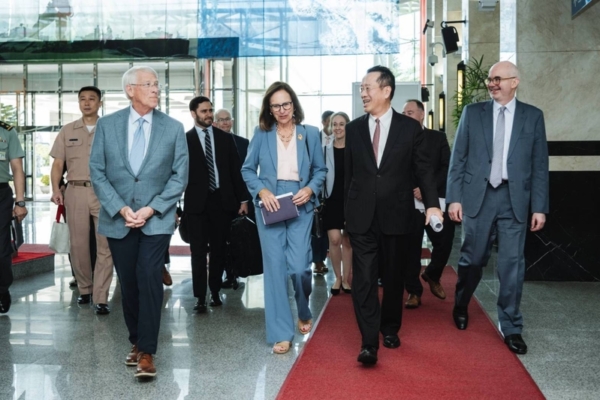
Taiwan’s Minister of National Defense, Chiu Kuo-hsiung, expressed on March 25th that the United States holds a “considerable sense of urgency” in assisting Taiwan to enhance its military capabilities. It is accelerating the advancement of relevant backlog projects and expediting the delivery process of weapons sales to the Taiwanese military.
The Taiwanese legislature reviewed a draft of a NT$1.25 trillion (approximately $39 billion) special defense budget on Wednesday. Minister Chiu Kuo-hsiung stated in an interview with reporters that many ordered weapon systems have begun delivery or have arrived in Taiwan. Chiu mentioned, “For those delayed projects, the United States has set up a special task force aimed at expediting related weapon programs and assisting us in catching up with the established delivery schedule.”
“I have emphasized multiple times that the U.S. actually holds a considerable sense of urgency in assisting us in swiftly strengthening our self-defense capabilities,” Chiu Kuo-hsiung added.
The intrusion of Chinese military aircraft near Taiwan has been longstanding, with annual military exercises across the Taiwan Strait furthering military intimidation towards Taiwan. In response to China’s military threat, Taiwan has made significant weapon purchases from the United States, albeit facing delays in weapon deliveries.
One of the major delayed projects includes the acquisition of 66 Lockheed Martin F-16 BLK70 fighter jets by Taiwan in 2019. The F-16s sold to Taiwan are a new model specifically designed for Taiwan, equipped with advanced aviation electronic equipment, weapon systems, and radar systems aimed at better countering challenges posed by the Chinese People’s Liberation Army Air Force, including the Chinese stealth fighter J-20. To ensure the proper functioning of various systems, circuits, and software, continuous test flights for adjustments are necessary, followed by immediate feedback for production line adjustments. These processes are essential to guarantee the quality and flight safety of the new fighter jets, thus cannot be rushed. Lockheed Martin has disclosed that the company has currently deployed hundreds of personnel working in shifts to full capacity for production.
Moreover, the United States utilizes the Presidential Drawdown Authority (PDA) to directly transfer equipment from active U.S. military inventory to fill the gaps in military capability before the delivery of new procurement. The PDA mechanism authorizes the U.S. President to allocate equipment to grant to recipient countries or provide services without the requirement of congressional approval.
U.S. foreign military assistance predominantly comprises two parts: Foreign Military Sales (FMS) and the Presidential Drawdown Authority (PDA) for directly transferring from existing inventory, where the latter, compared to the former, not only acts more swiftly but is usually provided free of charge.
For a long time, China has expressed strong dissatisfaction with the U.S. arms sales to Taiwan – Beijing has repeatedly demanded the U.S. halt arms sales to Taiwan.
Michael Miller, Director of the Defense Security Cooperation Agency (DSCA), recently revealed that he signed a directive in 2023 that prioritized Taiwan’s orders above other buyers; he emphasized that security cooperation and assistance to Taiwan are among the United States’ top priorities.
On March 25th, Taiwan’s Vice President, Hsiao Mei-chin, stated that Taiwan faces various challenges, highlighting the need to demonstrate a resolute commitment to safeguarding democracy and security. She noted that the relationship between Taiwan and the United States has substantially evolved into a “defense industry partnership,” with resources accurately invested in asymmetric combat capabilities and independent platform construction. She hopes that the government’s proposed defense procurement budget can garner support from the public and the legislature.