
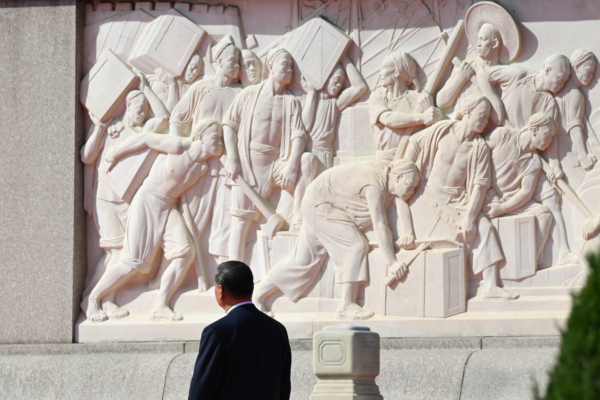
Xi Jinping, the leader of the Chinese Communist Party, who had not left Beijing for over four months, sparked discussions overseas. However, on March 23, he finally departed from the capital.
On March 23, Xi, accompanied by his three closest allies – Li Qiang, Cai Qi, and Ding Xuexiang, once again visited the Xiong’an New Area in Hebei Province, where many negative rumors surround the ambitious project known as the “Millennial Plan.” The Xiong’an project has often been criticized as a massive propaganda effort and a stalled project of the CCP. On that day, Xi defended his decision to develop the Xiong’an New Area, stating that it was a completely correct decision made by the Party Central Committee. However, he did not dare to mention “personally deploying and commanding,” instead shifting the blame onto the entire Party Central Committee.
Xi Jinping, regardless of the hardships faced by the people, has gathered national resources to develop the Xiong’an New Area. As long as money is invested, the construction of the Xiong’an New Area appears to be ongoing on the surface, with some central enterprises being driven to relocate there. However, the ultimate troubles this project will bring to the Chinese people remain to be seen in the future.
Observers had noticed that since Xi Jinping last visited Guangzhou in mid-November 2025, he had not left Beijing for over four months, nor had he traveled abroad. In the past, it had been customary for Xi Jinping to leave Beijing and travel domestically or internationally within a week after the conclusion of the CPPCC in March each year.
For example, following the closure of the National People’s Congress on March 13, 2023, Xi Jinping, after being re-elected as the CCP National President and Chairman of the Central Military Commission, visited Russia for a state visit from March 20 to 22. Similarly, after the conclusion of the CPPCC in March 2024, Xi Jinping departed from Beijing to visit Hunan for four days. In March 2025, following the CPPCC, Xi Jinping visited Guizhou and Yunnan.
After much discussion overseas about Xi Jinping not leaving Beijing for over four months, he promptly departed. However, the Xiong’an New Area is merely an hour’s drive from Beijing, still in the vicinity.
In my opinion, due to the exceptional tension domestically and internationally, Xi Jinping is currently in a period of “limited scope of activity.” Of course, if the situation eases, for political reasons, Xi may still make appearances in various places under heavy protection. However, the opportunity for foreign travel is likely to diminish.
Xi Jinping, despite seeming to hold great power, is currently limited to activities in Beijing and its surroundings. The reasons for this are twofold.
One reason is health issues. For example, during this year’s sessions, Xi Jinping still had two cups placed in front of him, while other participants had only one cup on their tables. One of Xi’s cups, like others, contained tea, but the other cup was personally held by an individual carrying a container resembling a medicine bottle, pouring a liquid into Xi’s cup, possibly traditional Chinese medicine. This may indicate that Xi Jinping has been ill and undergoing treatment.
Secondly, Xi Jinping’s reluctance to leave Beijing for several months could be largely due to fear of assassination. Actions such as the U.S. targeting Iranian military leaders may have frightened Xi Jinping. He is not just afraid of American or Taiwanese agents but also fears his own people, including officials under him.
In recent years, whenever Xi travels, local officials arrange staged “people-friendly” events for Xi Jinping. However, upon closer inspection, it becomes evident that these gatherings are pre-rehearsed.
During his visits to Guizhou and Yunnan in March 2025, security was tight, with Xi Jinping appearing swollen, leading to speculation among netizens that he was wearing several layers of bulletproof vests.
It’s no wonder Xi is concerned. His safety has been at risk for well over a decade, including the reported incidents involving bombs and poisoned needles orchestrated by Zhou Yongkang, a former member of the CCP’s Politburo Standing Committee, before 2012. Xi’s enemies are now more widespread and elusive.
Xi Jinping visited the Dadong Sub-Food Market in Shenyang on January 23, 2025. Three days later, there was an explosion at the market, resulting in multiple injuries and chaos onsite. The incident was widely viewed as a failed attempt to harm Xi Jinping. It was rumored that the explosive device was pre-planted at the scene, but a malfunction delayed the explosion. Subsequent footage circulated online purported to show a person in black clothing lingering beside an electric bicycle shortly before the blast.
In 2017, an attempt to assassinate Xi took place during the National Memorial Ceremony for the Nanjing Massacre victims. The plot, involving former high-ranking officials and businessmen, was thwarted by national security personnel.
Xi Jinping’s first term saw a crackdown on corruption, leading to him making enemies among officials. By October 2017, at the 19th National Congress of the CCP, Xi had consolidated power successfully. However, his move to potentially extend his rule indefinitely by abolishing term limits for the national presidency in March 2018 faced backlash, particularly from the “Second Red Generation.”
The outbreak of the CCP (Chinese Communist Party) virus in early 2020, also known as the COVID-19 virus, led to Xi Jinping’s mishandling of the epidemic, allowing it to spread globally. His reputation suffered further when prominent real estate tycoon Ren Zhiqiang criticized him, leading to Ren’s imprisonment. During the pandemic, Xi pursued a zero-tolerance policy, resulting in numerous humanitarian disasters reminiscent of the “Great Famine” in Mao Zedong’s era.
On October 13, 2022, Chinese citizen Peng Zaizhou hung a banner demanding that the CCP step down and Xi Jinping resign at the Zhongguancun Sìtōng Bridge in Beijing, resulting in his arrest. Subsequently, the nationwide “Blank Paper Movement” erupted in late November 2022, with protesters chanting “Down with the Communist Party! Down with Xi Jinping!” These targeted anti-Xi actions signaled a collapse in Xi Jinping’s public image among the Chinese people.
Xi Jinping entered his third term successfully at the CCP’s 20th National Congress in mid-October 2022, but after his inner circle of allies filled top positions, the administration’s governance became ineffective. Scholar Yuan Hongbing in Australia noted that the CCP’s governing capability had sharply declined in tandem with Xi Jinping’s waning authority. Stagnant economy, difficult livelihoods, widespread resentment among officials, and soaring public discontent have turned Xi into a public enemy.
From 2023 onwards, serious internal divisions erupted within the CCP’s military, leading to the downfall of several generals personally promoted by Xi Jinping, including Deputy Chairman of the Military Committee He Weidong.
In this environment, Xi Jinping’s security measures during his travels became exceptionally stringent.
The security arrangements for Xi Jinping during his trips were always stunning. On July 1, 2022, during his two-day visit to Hong Kong, Xi Jinping chose not to stay overnight in the city, traveling in a bulletproof car brought from the mainland. In November 2018, when Xi visited Papua New Guinea, two domestically-produced bulletproof vehicles were airlifted to the location from China.
During his participation in the BRICS Summit in South Africa in August 2023, all items, including mattresses and utensils, were airlifted by China and rearranged in the presidential suite by the South African police.
During his visit to Malaysia from April 15 to 17, 2025, Xi Jinping exhibited extreme caution, using his own bulletproof vehicle while the Malaysian authorities heavily guarded the roads and ensured tight security around him.
According to local media reports, Xi Jinping’s chartered Air China aircraft landed in Kuala Lumpur International Airport’s Dataran Merdeka around 6:25 p.m. on the 15th. Malaysian Prime Minister Anwar welcomed him, and Xi Jinping traveled to his hotel in a Chinese-made bulletproof vehicle, the “Hongqi N701,” which had been airlifted to Malaysia in advance. On the sides of the vehicle, several security guards from Zhongnanhai accompanied it, similar to the entourage of North Korean leader Kim Jong-un, leaving onlookers amazed.
This scene of security guards running alongside the vehicle was reminiscent of Xi Jinping’s departure after the China-North Korea summit on October 30 the previous year.
While Xi is concerned about security issues overseas, his worries at home may be even more overwhelming.
Before Chinese New Year, Xi Jinping did not visit regions or the military, deviating from the usual practice. On February 10, 2026, Xi interacted with the military through a video message, unusually requiring all military units to “maintain a specified state of alert.” Analysts speculated that following the incidents involving Zhang Yuxia and Liu Zhenli, Xi Jinping feared assassination attempts or coups and dared not leave Beijing.
On February 6, Xi Jinping attended a Lunar New Year performance to entertain veteran military officials stationed in Beijing. During this event, several tall and serious-looking security guards clothed in military attire were present. While they applauded alongside the veterans, their demeanor remained stern. Especially when Xi Jinping shook hands with the elderly officials, the guards appeared tense, a departure from past interactions.
Since assuming power, Xi Jinping has employed male service staff at major CCP meetings. In case of emergency, these individuals can quickly turn into bodyguards. This move reflects Xi’s strategic approach to security precautions.
In recent years, during major banquets hosted by the CCP, Xi Jinping’s “personal bodyguards” have stood out prominently. With serious expressions, they scan the entire venue, creating a stark contrast to Xi’s forced smiles. During Hu Jintao’s era, only common female service staff were typically present beside him during toasting ceremonies.
The presence of male bodyguards in close proximity to top leaders at state banquets only became apparent after Xi Jinping came to power in 2013. These male bodyguards can immediately offer support if Xi were to stumble accidentally, but their primary function is to prevent any harm befalling him in the vicinity.
Members of the Zhongnanhai security detail are part of the Central Guard Bureau, which has become a tool of surveillance during Xi Jinping’s autocratic rule. They monitor all current and former party and state leaders. However, it’s worth noting that those closest to Xi Jinping are often the ones most likely to turn against him.
Current Central Guard Bureau Director Zhou Hongxu has been stationed with the suspected “rebel army” of the 14th Group Army in Yunnan since at least 2005 until the 18th National Congress of the CCP in the autumn of 2012. During the years 1990 to 1994 when Zhang Yuxia was serving as the Commander of the 40th Division of the 14th Group Army, Zhou Hongxu underwent military education before serving as a platoon-level officer within the 14th Group Army. Zhou Hongxu’s rise to become the Director of the Central Guard Bureau was likely recommended by Zhang Yuxia.
While there have been no reports of the Central Guard Bureau being entangled in the military purges, uncertainties remain over the loyalty of those around Xi Jinping, particularly since some were once part of Zhang Yuxia’s inner circle.
On December 4, 2025, Xi Jinping and Peng Liyuan welcomed French President Emmanuel Macron and his wife in Beijing. However, a video circulated on the internet, showing Xi Jinping and his wife waiting for the Macrons at an event. A bodyguard quickly approached Xi Jinping, bending down near his legs, seemingly assisting Xi in adjusting his shoes. From the bald spot at the back of the individual’s head, it was apparent that this security personnel was older, yet acted almost like a servant to Xi Jinping.
The members of the Central Guard Bureau, known as the so-called Zhongnanhai bodyguards, project a tough and strong image. However, with Xi Jinping commanding and treating them like servants, it is unsurprising if some of them develop discontent over time.
(Translation of the original article)