
【Epoch Times March 25, 2026】 On Tuesday, March 24, Israeli Defense Minister Israel Katz stated that Israel will occupy the area in southern Lebanon up to the Litani River and designate it as a “security zone.” Until security is restored in northern Israel, local residents are ordered not to return to their homes.
Lebanese Prime Minister Salim, in an interview with Al Hadath news network on March 22, accused the Iranian Revolutionary Guard of currently commanding Hezbollah in Lebanon to take military actions against Israel, dragging Lebanon into Iran’s conflict unnecessarily. The Israeli military stated earlier that it would expand ground operations against the Iran-backed radical organization Hezbollah in Lebanon.
Katz, in a meeting with the Chief of Staff, stated that the Israel Defense Forces (IDF) are advancing into Lebanon to control the front line for defense, eliminate Hezbollah terrorists, and destroy their infrastructure there.
He mentioned that demolishing buildings near the border is to establish a defensive buffer zone. “Currently, the IDF will control the remaining bridges and extend the security zone to the Litani River.” The Litani River is about 30 kilometers (approximately 19 miles) north of the Israeli border, flowing into the Mediterranean Sea.
Katz previously warned that many terrorists would use residential buildings as cover for their actions or hide behind ordinary residents to resist Israel’s counterattacks.
Homeowner Rawaa Eido tearfully told Reuters that armed militants expected to be targets of Israeli attacks should not appear or reside in residential buildings. “We have no political affiliation with anyone… They are clearly targets, why hide in residential buildings?”
Israeli Chief of Staff Eyal Zamir stated on March 22 that the military would expand ground operations against the Iran-backed radical organization Hezbollah in Lebanon, warning that military actions against Hezbollah have “just begun.”
Since March 13, the IDF has destroyed five bridges on the Litani River and demolished houses in border villages to cut off Hezbollah’s logistics and personnel movements.
Zamir emphasized that the operation would continue until the threat is eliminated from the border and northern Israeli residents can safely return home.
The Lebanese government has not commented on Katz’s statement. However, the Iran-backed Hezbollah in Lebanon has claimed that it will exert efforts to prevent Israeli forces from occupying the south, stating that this action poses a “survival threat” to the Lebanese state.
Senior Hezbollah member Hassan Fadlallah further claimed that any occupation south of the Litani River would be met with resistance.
Katz had previously warned the Lebanese government that failure to disarm Hezbollah could result in territorial loss. This was prompted by Hezbollah’s firing on Israel on March 2, drawing Lebanon into the conflict between the United States and Israel against the Iranian regime of Khamenei.
The Lebanese government decided this month to ban all activities of the Iranian Revolutionary Guard within the country. It also uncommonly announced a ban on any military actions by Hezbollah and demanded the surrender of weapons to be managed by the state.
On October 7, 2023, similarly, Iran-backed Hamas terrorists attacked Israel, killing over a thousand people, and kidnapping over two hundred as hostages, leading directly to the Hamas-Israel war.
When asked about Katz’s comments, UN spokesperson Stephane Dujarric expressed concerns, saying, “This is the situation we least want to see, and the Lebanese people in the south least want to see.”
Israeli emergency services reported that northern Israel was hit by missiles on Tuesday, with one Israeli woman near the border killed and two others injured by shrapnel. The unit did not specify the missile’s launch location, but two Israeli soldiers have died in combat in Lebanon since the start of the war.
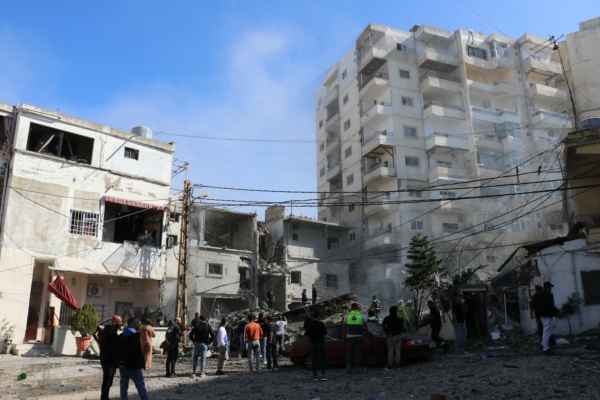
Meanwhile, the Lebanese Health Ministry stated that an apartment building in southeast Beirut was hit by an airstrike overnight, resulting in three deaths, the explosion collapsing neighboring apartment walls and burning furniture inside.
Furthermore, security sources revealed to Reuters that a missile from Iran intercepted in Lebanese airspace late Tuesday was intercepted by a foreign ship off the Lebanese coast. The IDF stated that the missile was launched from Iran, and missile fragments fell in several Lebanese towns.
On the other hand, the Lebanese government declared the Iranian ambassador as a “persona non grata” and ordered him to leave by Sunday, March 29. Earlier this month, Lebanon had ordered dozens of Iranian citizens, including diplomats, to leave.
Israeli Foreign Minister Gideon Saar praised this decision, condemned by Hezbollah, while Lebanese authorities stated that this does not mean cutting ties with Iran.
In fact, Lebanon is not the only country opposing the current Iranian regime. Many Persian Gulf countries have joined the anti-Iran alliance after suffering indiscriminate missile and suicide drone attacks from Iran. They have started providing airports and crucial intelligence to help the US and Israel combat the Iranian regime, even clearing Hezbollah or related terror groups from within their countries.