
Fujian rights activist Wang Xiuying successfully made her first visit to Beijing during the two sessions after 25 years of fighting for rights. She has always believed that it is a fundamental human right for a citizen to exercise their legitimate rights within the boundaries of the law. However, her trip to Beijing this time made her realize deeply that petitioners live in corners beyond the reach of the law.
Wang Xiuying recently documented her experiences in Beijing, and her story has been circulating within the petitioner community. This visit to Beijing marked the first successful trip for Wang Xiuying in her 25 years of advocating for rights. In the past, whenever she bought tickets to Beijing, she would either be blocked at her doorstep before she left home or intercepted halfway on the road.
She used to think that a citizen exercising their legitimate rights within the boundaries of the law is a natural human right. But in China, where the rule of power can override the law and the law cannot restrain the power, she realized that the legal system has its limitations.
She always thought she was advocating for rights in accordance with the law, often boldly purchasing train tickets to Beijing. However, she found out that her right to travel was restricted, and the legal routes did not work, forcing her to take covert paths.
On February 23, the seventh day of the Lunar New Year, she teamed up with experienced petitioners to travel to Beijing. They traveled in a private car, turned off their phones, and shielded their phones to block signals, taking various transportation modes to Beijing along the way.
Around 8 pm on February 24, they arrived in Gu’an, Hebei, and then switched to a taxi, and their journey into Beijing began here. The taxi driver then initiated a “selling petition” action. He claimed to have a long-term cooperation with the personnel at the city’s entrance checkpoint and even gave a red envelope to establish a good relationship in front of them, allowing them to enter the city. He then asked for their ID cards, claiming it was for inspection and would be returned. They naively thought it was a routine check, but the driver took photos of their IDs and contacted the checkpoint personnel. Realizing it was a scheme to sell their information, they quickly asked the driver to stop and got off the taxi after paying the fare.
According to petitioners, in Fujian, selling petitioners’ information to local authorities can fetch up to 10,000 yuan per person.
Subsequently, they found a taxi specifically for transporting petitioners into the city during the two sessions, but each person had to pay the driver 360 yuan as an entrance fee. Wang Xiuying expressed her frustration, stating, “We are victims. We can’t find justice within the provincial government; when we seek help from higher authorities, we have to be secretive, just like a mistress sneaking around. And mistresses don’t have to pay money, yet we have to pay exorbitant fees under the guise of raising the country’s ‘chicken fart’ GDP.”
After being dropped off by the taxi driver around 2 am on February 25 at a metro station on Beijing’s Sixth Ring Road, they spent a cold winter night at a KFC restaurant until the morning.
Thinking that she would be safe in Beijing and the local government would not dare to intercept her in Beijing, Wang Xiuying secretly left her petitioner friends, turned on her phone, took the subway to the State Bureau for Letters and Calls. She shared, “When I came out of the subway station, a person trying to sell petition came after me. I managed to evade them and arrived at the Bureau’s reception center around noon. Being informed that no appointments would be taken that afternoon, I learned that staying in a hotel in Beijing would attract police harassment, who would then notify local authorities to intercept. The petitioners told me the safest place was right outside the Bureau.”
That night, Wang Xiuying paced around the vicinity of the Bureau, witnessing elderly people wrapped in thin clothes huddled under bridges, petitioners shivering at fence edges, curled up in corners, some with dirty and torn blankets lying at the Bureau’s entrance. She spent the whole night shivering in the freezing cold environment, hoping to seek help from the national authorities the next day, watching her fellow citizens speak about their grievances in the icy cold while China aids North Korea with billions and Africa over 600 billion annually.
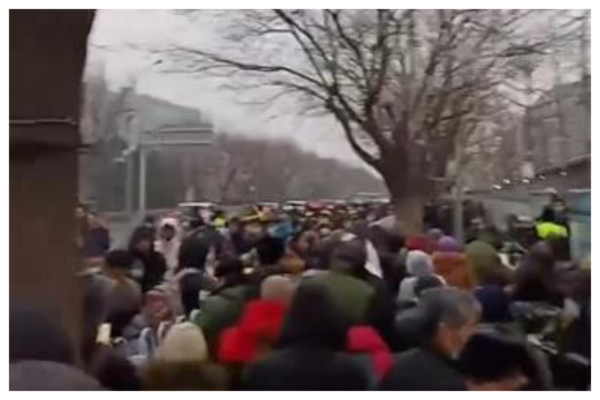
Wang Xiuying, queuing at the Bureau’s entrance for two consecutive days, saw thousands of petitioners mixed with groups of interceptors persuading them to give up, security personnel shouting at the crowded petitioners, witnessing them standing in line the whole day without eating or drinking because leaving the line meant queuing again for another one or two days. The reception area had no seats at all.
Feeling saddened, she expressed, “Petitioners are also humans. Most of the petitioners’ injustices are created by the country’s authorities. Isn’t the Communist Party supposed to practice humane governance? Where are the human rights of petitioners? They are all victims of rights violations, trusting the country’s laws by coming from all over to Beijing, only to end up sleepless, hungry, and freezing. You ask people to love the party and the country, but has this party-state shown any regard for its people? How did the petitioner community come about? The leaders know better than anyone else.”
On the second day, while hungry and queuing in front of the Bureau, local officials called and had her brought back to Fujian by interceptors.