
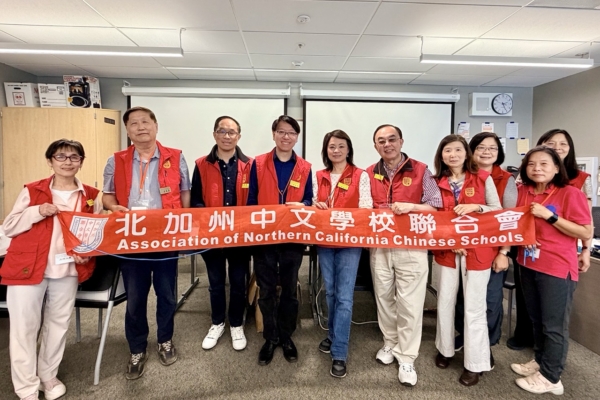
On March 22nd (last Sunday), the Northern California Chinese School Association held its 2026 academic competition at Lynbrook High School in San Jose. A total of 436 students from 28 member schools gathered for the event. Participants went through internal competitions at their respective schools and emerged as top competitors to showcase their skills, attracting nearly a thousand parents, teachers, and students to witness the exciting event.
The competition had been prepared for six months with about 200 volunteers and teachers involved. It featured 16 categories including reading, speech, translation, writing, Chinese typing, calligraphy, and painting, divided into a total of 51 groups. Mandarin reading (59 participants), western painting (48 participants), CFL/CSL reading (47 participants), and pencil calligraphy (47 participants) had the most enthusiastic sign-ups.
Chairman Fu Qijun stated that the competition was divided into Groups A to D, spanning from 5-year-old children to high school students, covering both Mandarin and Cantonese categories. This year, the format remained largely unchanged from previous years, with the only adjustment being the speech time for Group D set at 2 to 2.5 minutes to encourage younger students to participate. Moreover, about 7 to 8 mainstream schools with Chinese immersion programs participated, showcasing the continuous expansion of Chinese language education’s influence.
In terms of student performances, participants demonstrated diverse learning outcomes. Chen Yuting from Independent High School, who competed in Chinese typing Group A, mentioned that the competition helped improve her communication skills and expand her social circle.
The Guo family, including 10-year-old Jiarong, participated in the activities together for the first time. They entered the reading competition with the theme “Redwood Forest and Camel,” having advanced to the competition after three months of daily practice. Jiarong’s mother, Emily, from Singapore, expressed pride in her child’s efforts and progress. She emphasized that Jiarong had overcome stage fright, showed more stable performance, and hoped to gain growth and experience from the competition. She also highlighted the importance of children learning Chinese to understand the culture, communicate with family, and thanked the organizers for providing valuable participation opportunities. She mentioned that Jiarong’s sister also participated in the reading competition, adding more fun to the event.
Jiaxin, who participated in the reading competition last year, switched to Mandarin speech Group A this year with the topic “Artificial Intelligence and Humans, Who is the Better Teacher.” She found the competition challenging with strong competitors and intense competition, which led her to learn speech skills and enhance her Chinese proficiency during the preparation process. Jiaxin’s father, Taiyuan, mentioned that learning Chinese in the Bay Area is not easy, requiring reliance on family environment and school support. Continuous participation in competitions helps build a sense of achievement and maintain learning motivation.
Yingxi participated in Cantonese speech Group A, also on the theme of artificial intelligence. She noted that learning Chinese not only helps communicate with elders but also allows for flexible usage in everyday life. Being able to communicate with her parents in Mandarin and Cantonese at home made her feel very fulfilled.
Yingxi’s father, Qijun, from Hong Kong, jokingly mentioned that his daughter’s fluency in Mandarin far surpasses his own. He mentioned that his daughter started learning Chinese at the age of 5 to communicate with her grandparents, and now she proficiently uses Cantonese, Mandarin, and English, aiming to pass the AP Chinese exam.
Qijun emphasized that children learning Chinese require long-term parental companionship and “persistence.” After overcoming initial resistance, when children realize the practicality and sense of accomplishment in language learning, they will actively continue studying. He personally got involved in educational services by accompanying his daughter’s learning journey, progressing from a volunteer to becoming the association’s chairman, witnessing the rooting and development of Chinese education overseas.