
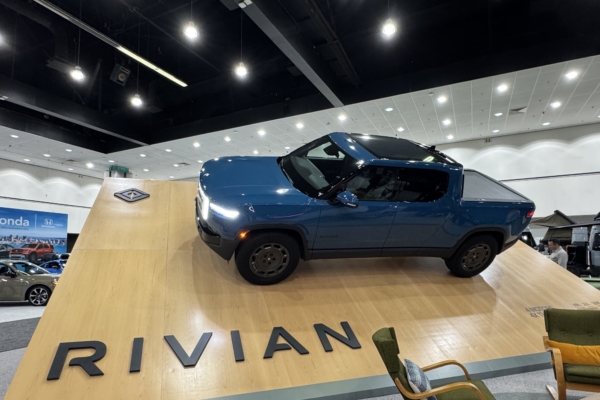
In a recent development, the American ride-hailing platform Uber has announced its plan to invest up to $1.25 billion in the electric vehicle manufacturer Rivian to deploy 10,000 self-driving taxis, known as Robotaxis. The partnership between the two companies was made public on March 19.
According to the agreement, Uber has committed an initial investment of $300 million, with the remaining $950 million contingent on undisclosed “autonomous driving technology milestones.”
RJ Scaringe, the founder and CEO of Rivian, based in Irvine, California, stated that this collaboration will accelerate the company’s progress towards Level 4 autonomous driving (highly automated) and create one of the world’s safest and most convenient autonomous driving platforms. He highlighted that with the continuous expansion of data scale and the combination of the company’s internally developed reasoning platform RAP1 and multimodal sensing systems, self-driving technology will rapidly advance in the coming years.
These self-driving vehicles are expected to be based on the upcoming Rivian R2 electric SUV. While the standard version of the R2 will be sold to consumers, the fully autonomous version will be exclusively available through the Uber platform.
The initial fleet of vehicles is set to hit the roads in San Francisco and Miami by 2028, with plans to expand to 25 cities across the United States, Canada, and Europe by 2031.
Furthermore, starting from 2030, both companies may further negotiate the procurement of up to 40,000 R2 autonomous driving vehicles.
In terms of finances, Rivian achieved its first positive gross profit of $144 million in 2025, although the company still incurred a loss of approximately $3.6 billion that year.
Uber CEO Dara Khosrowshahi expressed confidence in Rivian’s vertical integration capabilities in vehicle design, computing platforms, and software stack, coupled with its expanding user data and fleet operation experience, which has fueled Uber’s confidence in this ambitious project.
Uber has been ramping up its investments and expanding its business endeavors in recent times.
On February 9, Uber announced the acquisition of the delivery business of the Turkish company Getir to expand its Uber Eats service.
On February 23, Uber revealed its acquisition of the parking application SpotHero to integrate parking reservation functionality into the Uber app.
On February 25, Uber, alongside Joby Aviation, announced the launch of an electric “air taxi” project.
The San Francisco-based ride-hailing company achieved profitability in 2023 and surpassed $10 billion in revenue last year.