
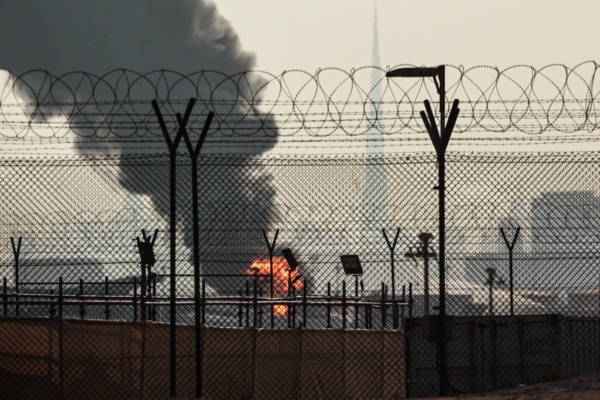
Several sources have revealed to Bloomberg that several of Iran’s largest Gulf Arab neighbors are considering joining the United States in a war against Iran. If Iran attacks the critical infrastructure of these countries, they may be compelled to join the conflict.
The sources state that the Gulf region’s most powerful countries, especially Saudi Arabia and the United Arab Emirates, are finding Iran’s attacks increasingly intolerable, as these assaults have targeted Gulf countries’ ports, energy facilities, and airports. However, they add that they will only join the war when Iran attacks significant power and water infrastructure in the Gulf region.
According to sources, most Gulf countries hold this position, with few exceptions like Oman, which aims to continue playing a role as a mediator.
This war has completely upended the relationship between Iran and its Sunni Arab neighbors. Saudi Arabia and the UAE have worked towards stabilizing their relationship with Iran over the past five years, primarily to prevent the current conflict from erupting. However, following the outbreak of war on February 28, Iran has begun relentless attacks on neighboring countries.
Iran claims that Gulf countries are legitimate targets because the U.S. uses their airspace and territory to launch attacks on Iran – a claim all neighboring countries deny. Previously, countries like Saudi Arabia openly stated they would not allow their facilities or airspace to be used for attacking Iran, yet they have still been targeted by Iranian attacks.
The UAE has been the Gulf country most severely attacked by Iran. The country’s defense ministry announced on Tuesday, March 24, that its air defense system intercepted five ballistic missiles and 17 drones. Since the outbreak of war, the number of missiles and drones attacking the UAE has reached 372 and 1,806 respectively.
Additionally, Bahrain, Kuwait, and Saudi Arabia intercepted Iranian drones and missiles within the past 24 hours. Bahrain submitted a draft resolution to the United Nations Security Council on Monday, March 23, proposing to authorize countries to take “all necessary means” to protect commercial shipping security in the vicinity of the Hormuz Strait.
Using “all necessary means” in diplomatic terms signifies the use of force. This proposal has garnered support from countries including the U.S. and several Gulf nations.
“This is not our war, but Iran has turned it into our war,” quoted Dubai Public Policy Research Center B’huth Director Mohammed Baharoon by Bloomberg.
He suggested that if Iran continues targeting Gulf countries and blocking the Strait of Hormuz, it could compel regional states to form an alliance against Tehran’s “state terrorism.” This could resemble the alliance formed to combat the Islamic State (ISIS) in Iraq and Syria in earlier years.
Last Friday, the UAE stated that it had “destroyed a terror network funded by Hezbollah in Lebanon and Iran, and arrested its members.” In the same week, Kuwait announced the discovery of groups linked to Hezbollah planning destructive activities and plotting to “attack important national facilities.” Hezbollah, denying these accusations, is an Iranian-backed armed organization.
A senior official from a Gulf country informed Bloomberg that all these events have prompted Gulf countries to realize that they must now take more collective action with their U.S. and European allies.
Sources revealed to Bloomberg that the possibility of taking military action against Iran was discussed as one of the options at a foreign ministers’ meeting held in Riyadh, Saudi Arabia last week. The meeting aimed to formulate joint response measures.
Saudi Foreign Minister Faisal Bin Farhan stated in a press conference after the meeting, “I believe that it must be understood by the Iranian side that the Kingdom of Saudi Arabia, as well as the countries that have been attacked and other countries, have very strong capabilities, which they could fully employ if they choose to do so. The current patience is not unlimited.”
Reuters reported last week that Gulf countries, initially cautious about war, have shifted to a more assertive stance after witnessing Iran’s attacks on Dubai Airport, the Al-Rasheed Hotel where diplomats reside, and various oil facilities in different countries.
Multiple Gulf countries have communicated to the U.S., urging the American military not to prematurely cease operations against Iran and emphasizing the need to completely dismantle Iran’s capability to threaten oil routes and the region’s economy.
Numerous informants shared with Reuters their concerns that if Iran’s military capabilities are not significantly weakened, the region will continue to be subject to Iran’s extortion in the long term.