
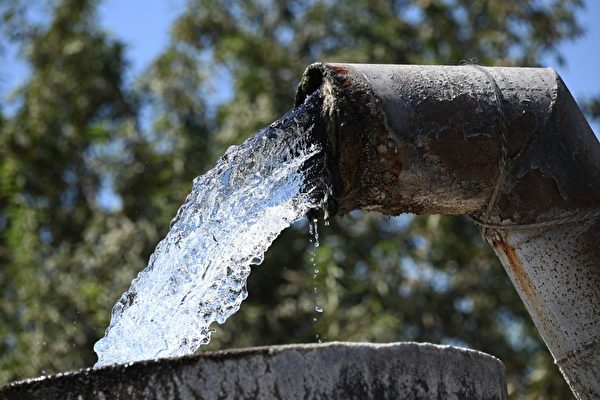
In 2020, Daba Village in Yongle Town, Fengjie County, Chongqing, became a so-called “billion yuan village” by cultivating navel oranges. However, according to villagers, the village has long been plagued by water shortages, making it difficult for irrigation of fruit trees and daily drinking water, relying solely on rainwater collected from roofs, foul-smelling creek water, and even “pig urine water” for daily life. The government-invested water supply project in the area seems to be merely a facade.
Situated on the south bank of the Yangtze River, Daba Village comprises seven villager groups with over 1,300 households and 4,000 residents. In 2019, Daba Village was selected as a national “One Village, One Product” demonstration village for its navel orange cultivation, and in 2020 and 2021, it was recognized as a national “billion yuan village” for its rural characteristic industries.
Regarding the villagers’ difficulties in accessing drinking water, the village secretary of Daba Village, Zuo Mingchun, claimed that “villagers do not face difficulties in drinking water” and “no one drinks rainwater.” A director named Li from the Water Resources Bureau of Fengjie County also stated that “the centralized water supply coverage in Daba Village has basically reached 100%, currently relying on centralized water supply as the main source, with villagers supplementing with self-built decentralized emergency water sources.” Public records show that from 2017 to 2025, Daba Village completed 13 water projects with a total investment of over 8.5 million yuan.
However, during a private investigation by the media, it was found that not only some villagers were drinking rainwater, but there were also claims of people drinking “pig urine water.”
A villager from Daba Village, going by the pseudonym Lao Zhao, mentioned that their drinking water comes from a spring-fed ditch near Longwang Tang. When the journalist scooped up a ladle of water from their reservoir, it faintly exuded a fishy smell.
Accompanying Lao Zhao to the water source, the water pit was filled with green floating plants, and as the ditch continued upstream, plastic bags, pig dung, and other rubbish appeared along the waterway. The water’s surface even had black foam floating, emitting a stench of animal excrement. Another villager named Lao Qian, who draws water from the same source at Longwang Tang, revealed that “the water used to be fine, but after someone started raising pigs upstream, the water quality deteriorated significantly.”
A villager from Group Two in Daba Village, Lao Sun, mentioned that over 40 households in their vicinity consume boiled rainwater collected from their rooftops, and “every spring before the rain, we clean the water tanks, and there is nearly two fingers thick layer of sediment at the bottom of the tanks.”
Residents of Group Five, near the Yangtze River, directly draw water from the river for consumption. When asked if the river water is filtered or disinfected, they mentioned that they cannot afford the cost, stating, “Who can afford it? There’s nothing we can do.”
As for the water scarcity issue, several villagers explained that the newly constructed or expanded drinking water and irrigation projects in the area have not been functioning properly in recent years. For instance, a diesel water pump produced in 2019 at Zhoujiawan Beach was left rusting on the beach; and a high-power water pump installed at Baifanping had severed connecting pipes on the beach.
Lao Jiang, a villager, said that irrigation facilities were constructed by the local government during the period of poverty alleviation, with the original plan to pump water from the Yangtze River to Longdong Bay water reservoir, covering the orchards of Groups Three, Five, and Six in Daba Village. “Since its completion until now, not only have the villagers not used it, but some water pipes have even been stolen,” he added.
The Swan Lake drinking water project, completed in 2019, was reported to resolve the drinking water issues of over 620 households in the village. However, many villagers reported that the project was not functioning properly, and numerous water pipelines had been sawn off. Water meters in the villagers’ homes indicated that most had been installed for multiple years without exceeding a water usage of 5 cubic meters.
Lao Li, a villager, shared that when the Swan Lake drinking water project was completed, they were told it would provide stable water supply, “We were very happy. But it turns out that the workers just turn on the water while inspecting and taking photos, and once they leave, we are left without water.”
Lao Wang also expressed, “When officials come to inspect, they fill the water tanks from Tiejia Village the day before, and as soon as the inspection team leaves, the water supply is cut off.”
In response to the report, officials from the Yongle Town government stated that the Swan Lake drinking water project and irrigation project were subsidized with funding for high-efficiency and energy-saving irrigation projects in 2018 during the poverty alleviation period, without feasibility reports.
After the report was exposed, many netizens commented, expressing their disbelief and questioning the situation in Daba Village. It was remarked, “A billion yuan village yet facing water shortages. The two scenarios seem contradictory but coexist. Who deceived whom?”; “Deception for development!”; “These kinds of things are common at the grassroots level”; “Most of Hubei is like this”; “My grandmother’s village probably has only two to three hundred people now, always spending money on renovations. Why isn’t there any infrastructure development in villages with thousands of residents?”; “Check what water the village cadres are using”; “This is definitely a trick. You should investigate thoroughly”; and “Water is the source of life and must be strictly regulated!”